Why Fusion, Why Now
Fusion has been 'thirty years away' for decades. Several things genuinely changed at once.
- Enablers
- HTS magnets · computation · open validation
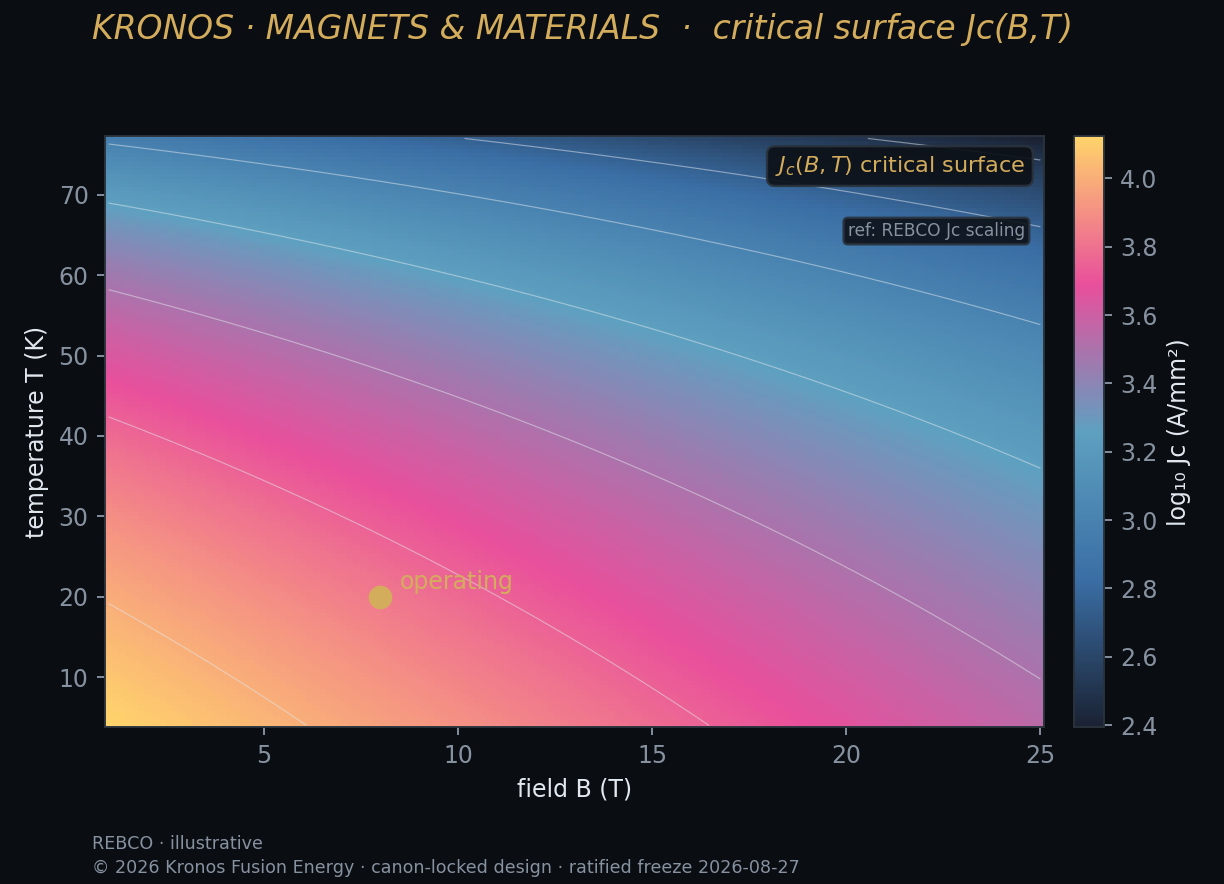
Three shifts make the compact approach credible now: high-temperature superconductors that reach fields impossible a decade ago; cheap, powerful computation for design-space exploration and uncertainty quantification; and an open-science culture that lets a design be validated by anyone. Kronos is built on all three.
Common questions
High-temperature superconductors make compact high-field machines possible, the physics database is mature, and business models that earn before net-electric power lower the barrier to a first product.
Because it does not wait for net-electric gain — the breeder's neutrons and isotopes give it a route to revenue now, with breeder construction slated for Q2 2027.