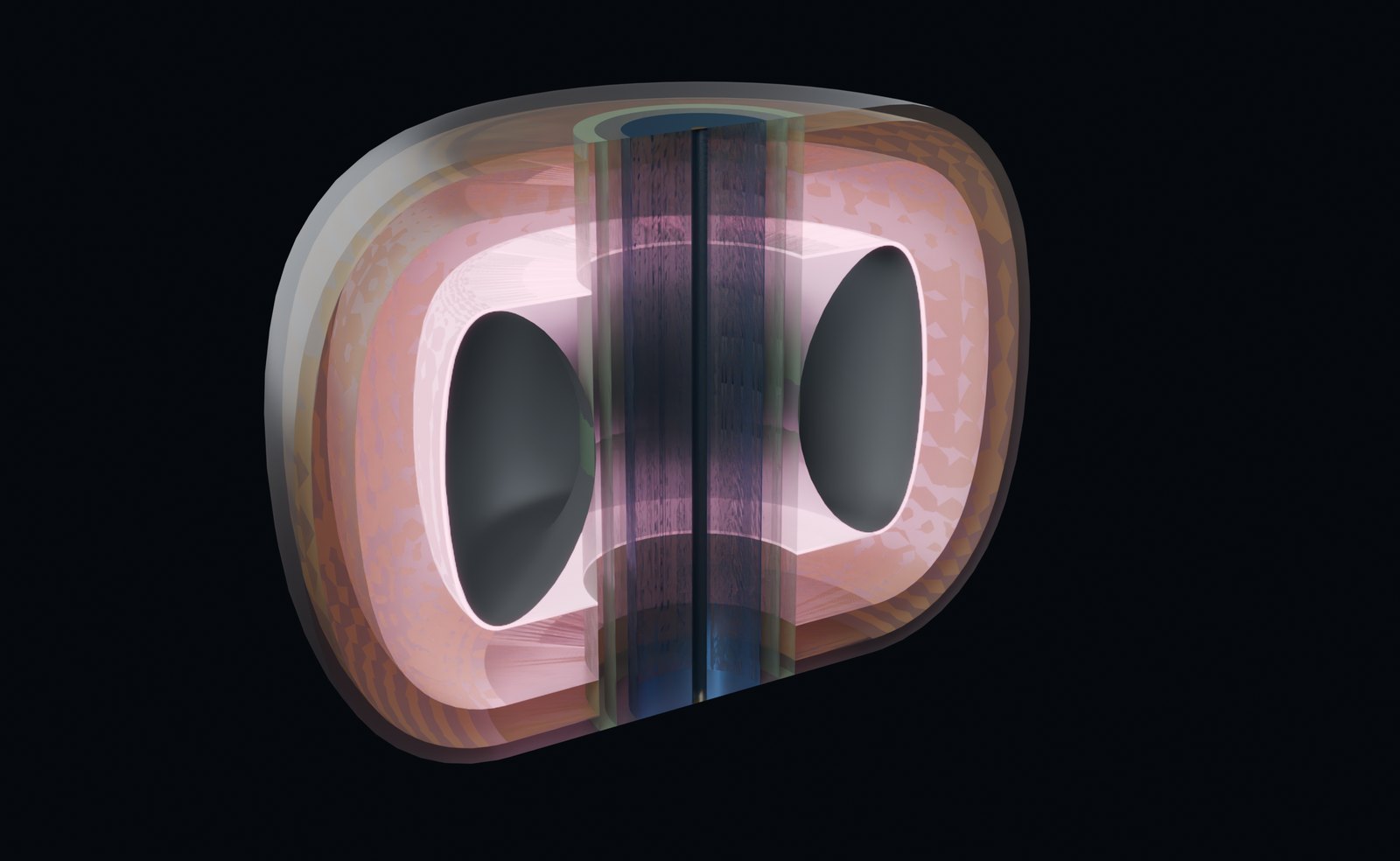
Triangularity (δ)
How D-shaped or reverse-D the plasma is; negative triangularity can suppress edge instabilities.
Triangularity δ measures how the plasma's corners are pulled in or out relative to a pure ellipse. Positive δ gives the familiar D-shape; negative δ points the corners the other way.
HYPERION adopts negative triangularity, δ = -0.30, a configuration that can suppress edge-localised modes while maintaining good confinement — a deliberate stability choice.
For decades positive triangularity was standard because it supports the H-mode pedestal. Negative triangularity, which HYPERION adopts at δ = -0.30, has emerged from experiments (notably on DIII-D and TCV) as a way to access good confinement while avoiding the large edge-localised modes that damage divertors — solving an operational problem through configuration rather than added machinery.