The Neutron Economy
How the breeder's neutrons create value — tritium, isotopes, and more.
- Neutron power (breeder)
- 70.7 MW
- Uses
- Tritium, isotopes, He-3
The breeder's 70.7 MW of neutron power is not waste — it is the product. Neutrons breed tritium, can produce medical and industrial isotopes, and drive the helium-3 supply the burner needs. This 'neutron economy' is what makes the breeder a business before the burner reaches net electricity.
Kronos treats neutron management as value capture, not just a shielding problem.
Turning a shielding problem into a product
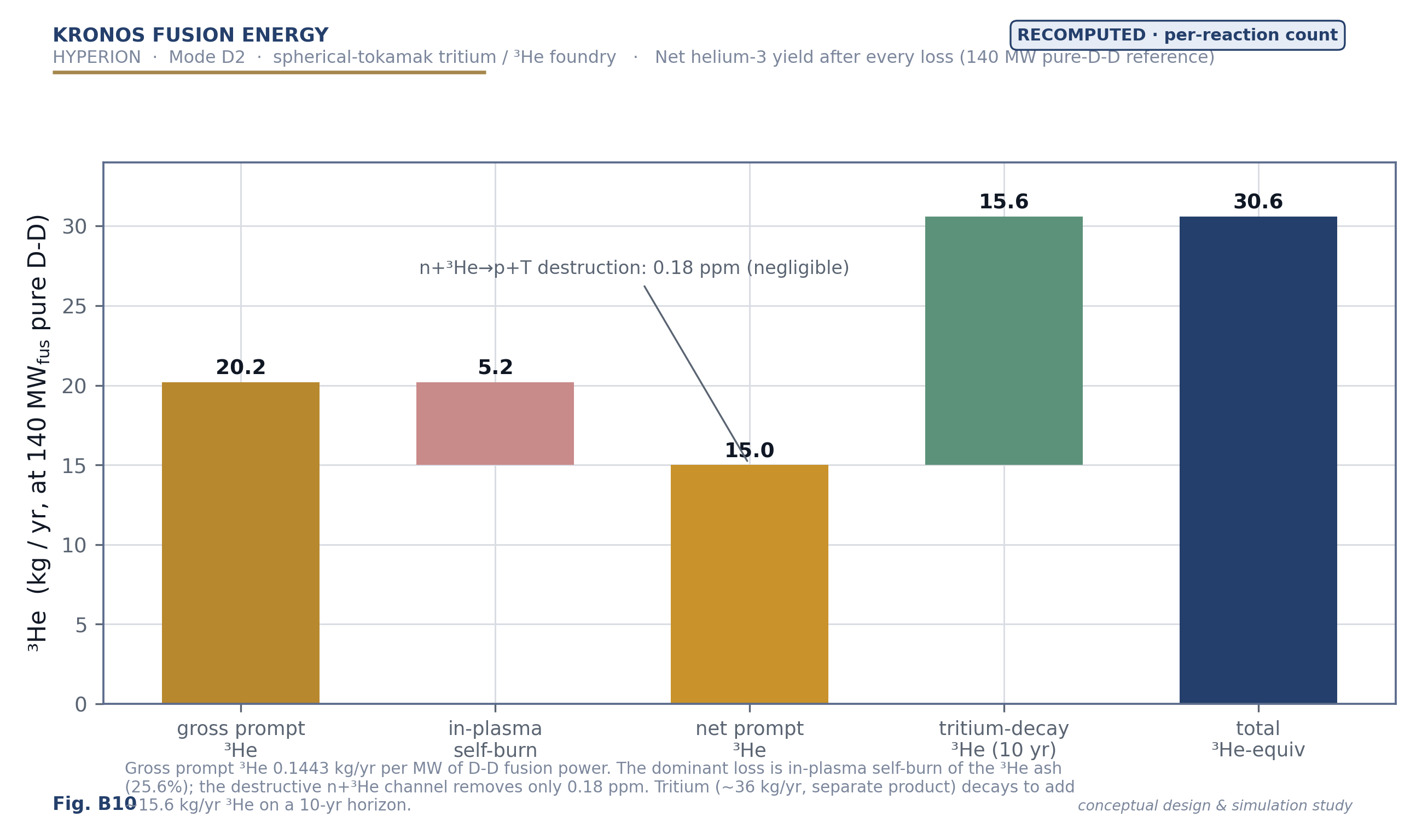
In a conventional D–T reactor, 70.7 MW of neutron power is mostly a materials and shielding burden. Kronos inverts that: the neutrons breed tritium (4.0 kg/yr/yr), co-produce helium-3 (1.97 kg/yr/yr), and can make medical and industrial isotopes. The neutron flux that others engineer against is, for the breeder, the product line.
The neutron economy reframes the breeder's 70.7 MW of neutron power from a shielding burden into a product line. Those neutrons breed tritium, co-produce helium-3, and can make medical and industrial isotopes — value that exists whether or not grid-scale net-electric fusion is ever solved, and the foundation of the breeder-first strategy.
Reframing the breeder's 70.7 MW of neutron power from a shielding burden into a product line is the commercial heart of Kronos. Those neutrons breed tritium, co-produce helium-3, and can make medical and industrial isotopes — value that exists independent of grid-scale net-electric fusion, which is exactly why the breeder is built first.
Common questions
Neutron-derived products: tritium (4.0 kg/yr/yr), helium-3, and potentially medical/industrial isotopes — all from its 70.7 MW of neutron power.
Its value is framed as strategic (quantum, medical, burner fuel), distinct from near-term revenue. The bankable near-term product is tritium.