Technical

The Magnet Materials Suite
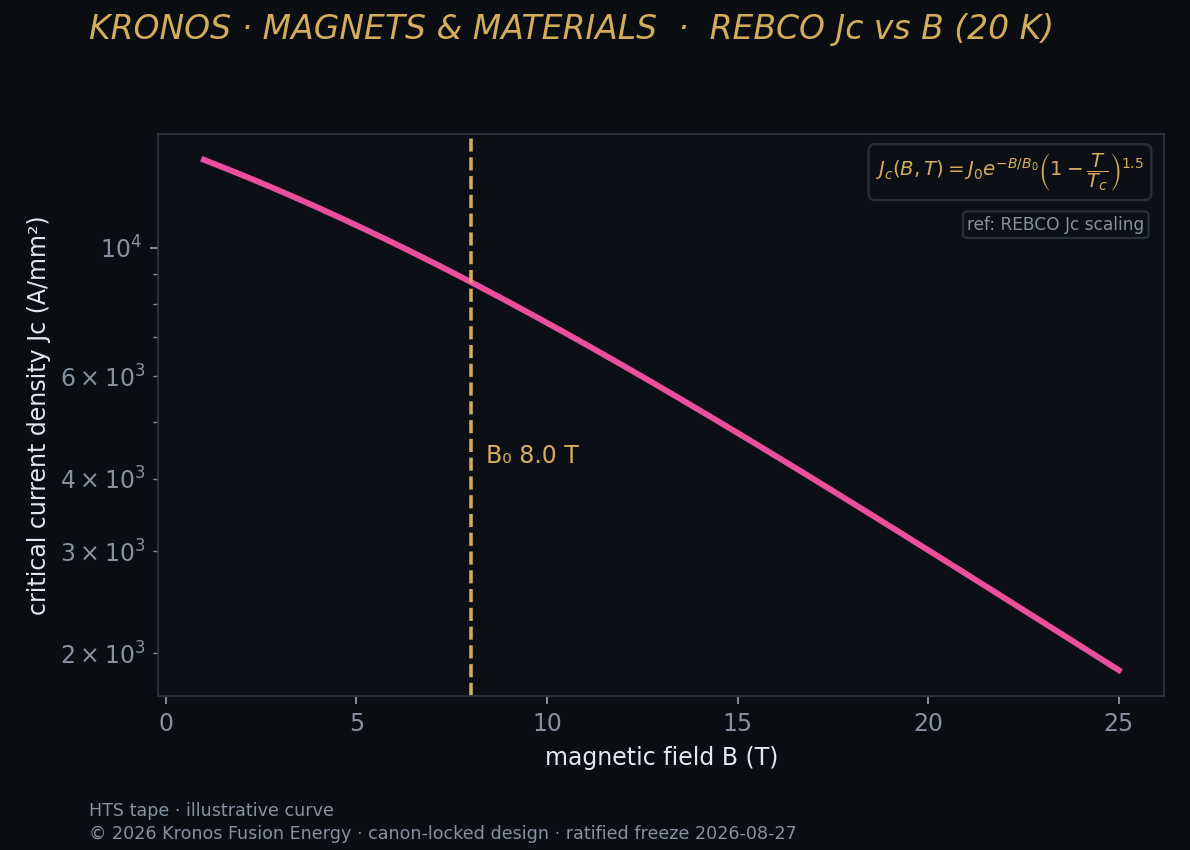
Every material that goes into a Kronos magnet, and why.
- Core
- REBCO + structure + insulation
A Kronos magnet combines REBCO superconductor, copper stabiliser, a Hastelloy-class substrate, high-strength structural alloys, and radiation-tolerant insulation — each chosen for its role in reaching 16.84 T safely. The suite is documented in the open REBCO study.
Cyclic fatigue of the structure is the binding gate.
Common questions
What is in the magnet materials suite?
REBCO superconducting tape, copper stabiliser, cryogenic structural steels and insulation — the material set that makes a high-field, mechanically-loaded coil work at cryogenic temperature.
Which material choice is most critical?
The structural alloy carrying cyclic Lorentz loads, since magnet fatigue is the binding gate — the superconductor enables the field, but the steel survives the forces.