Technical
The Loss Cone
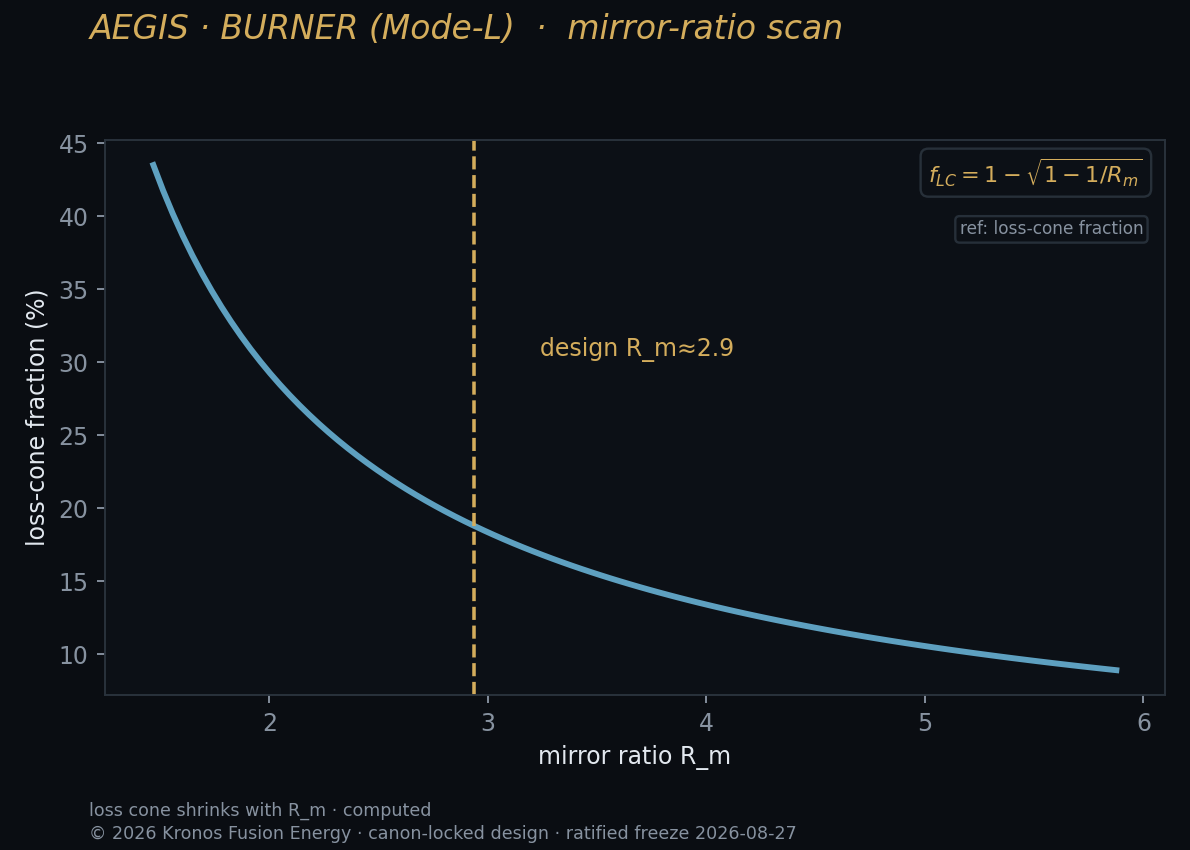
The range of velocities through which a mirror leaks — and why plugs are needed.
- Meaning
- Escaping velocity range
In a magnetic mirror, particles whose velocity is too aligned with the field are not reflected and escape through the 'loss cone'. Refilling and plugging the loss cone is the central mirror challenge, which the tandem-mirror ambipolar plug addresses.
It is the physics behind the burner's plug-density requirement.
Common questions
What is the loss cone?
The range of particle velocities that can escape out the ends of a magnetic mirror. Particles whose motion falls in it are not reflected and are lost — the mirror's fundamental leak.
How does the burner deal with it?
With high-field plugs and an ambipolar potential that reflect escaping ions — effective only if the plug reaches the ~16 density ratio, the burner's binding condition.