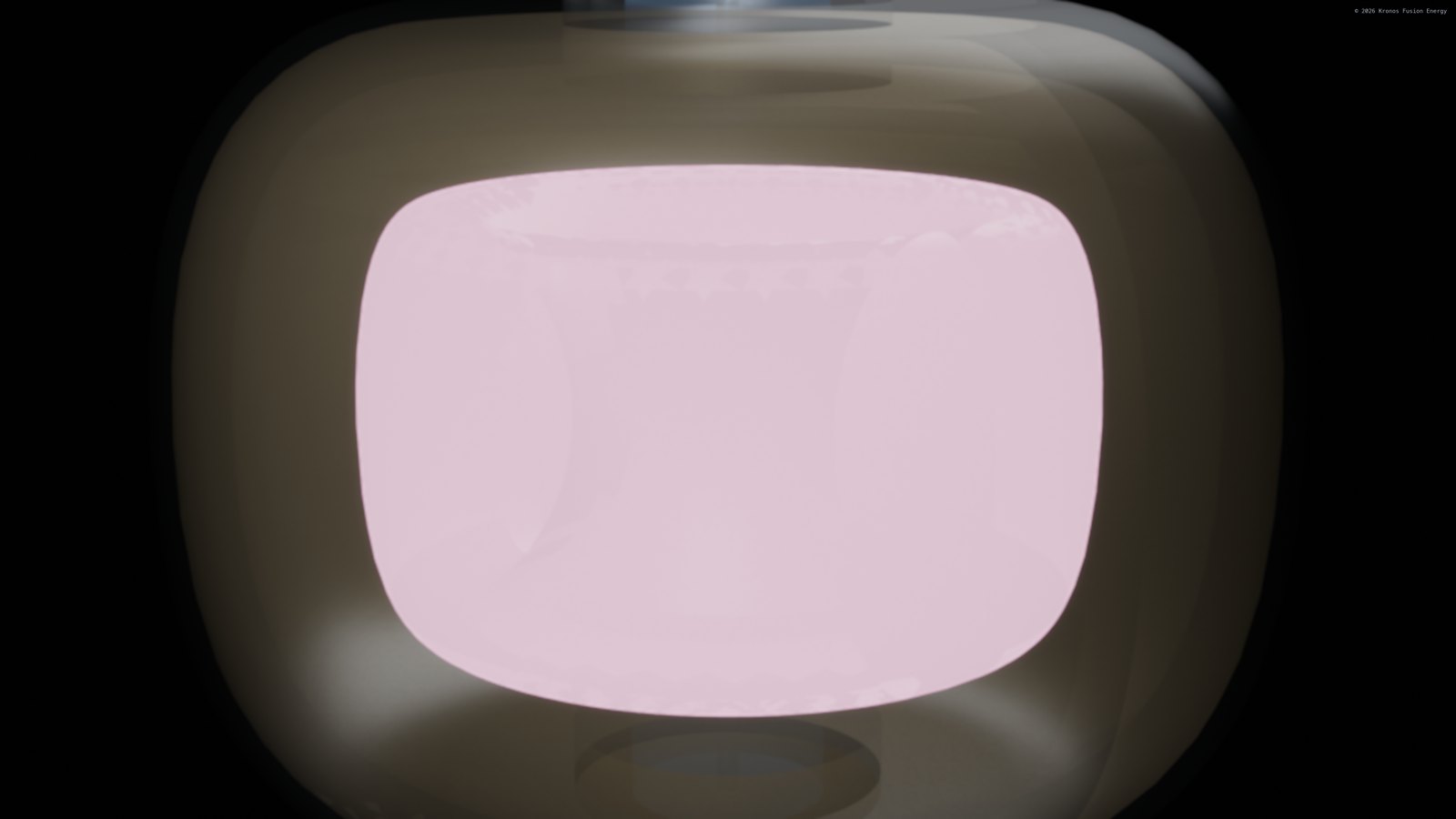
The D–³He Reaction in Detail
How deuterium and helium-3 fuse to helium-4 and a proton — all charged, ideal for direct conversion.
- Products
- &sup4;He + p (both charged)
- Total
- 18.3 MeV
- Neutron fraction
- 5.44%
Deuterium and helium-3 fuse to a helium-4 nucleus and a proton, releasing 18.3 MeV entirely as charged particles. Because no primary neutron is produced, the energy can be recovered by direct conversion rather than a thermal cycle — the physical basis for the burner's QE = 1.31.
Side D–D reactions still emit some neutrons, giving the burner its 5.44% neutron fraction — low, but the reason Kronos says low-neutron, not aneutronic.
Because D–³He releases its 18.3 MeV almost entirely as charged particles, its energy can be recovered by direct conversion instead of a steam cycle — the physical basis for the burner's QE = 1.31. Side D–D reactions still emit some neutrons, giving the 5.44% fraction that keeps Kronos honest about calling it low-neutron rather than aneutronic.
Common questions
Its 18.3 MeV is released almost entirely as charged particles, which can be decelerated and collected as electricity instead of boiling water. That is the basis of the burner's QE = 1.31.
No — side D–D reactions still emit some neutrons, giving a neutron fraction of 5.44%. Kronos calls the burner low-neutron, never aneutronic, which is a deliberate honesty choice.