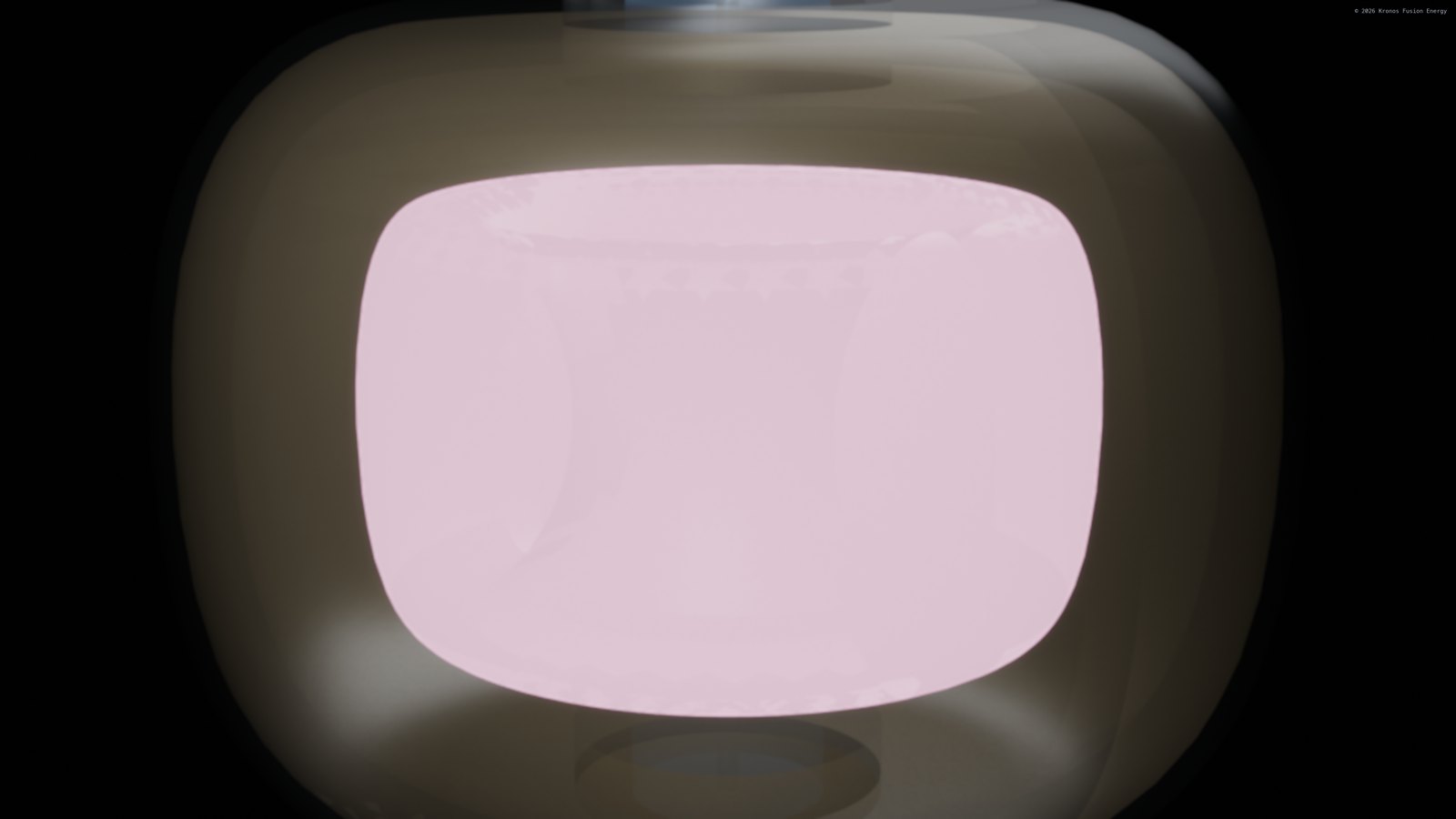
The D–³He Tandem Mirror (Burner)
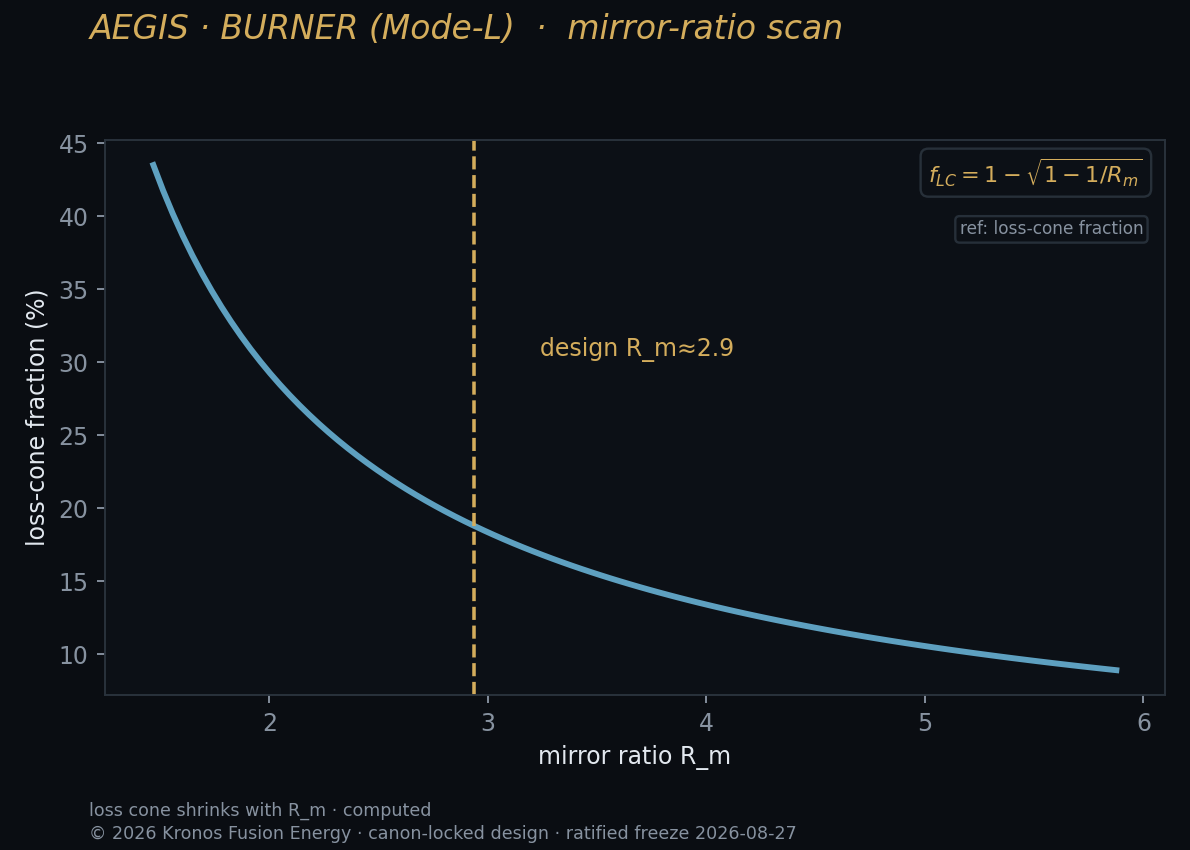
The burner is a straight machine, not a doughnut — and that linearity is a feature: no disruptions, direct conversion, and a length you can scale to the job.
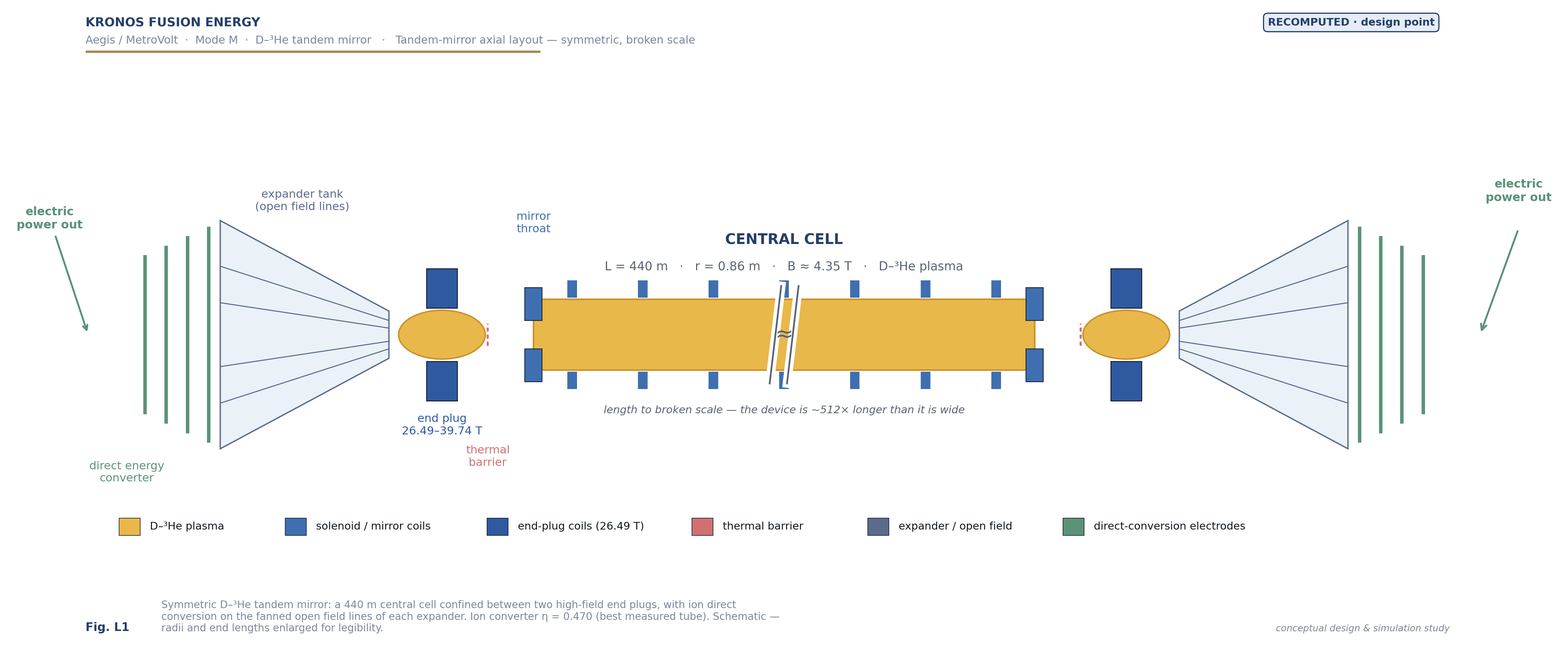
A tandem mirror confines plasma in a straight central cell capped by high-field magnetic plugs at each end. Dense plugs build an ambipolar potential that electrostatically confines the central-cell ions. The Kronos burner runs D–³He at about 90 keV, with plug fields reaching 26.49 T.
Because most of the energy emerges as charged particles, the burner uses direct energy conversion at about 0.70 efficiency, quoting an engineering gain of QE = 1.31 at a neutron fraction of just 5.44%. The same physics scales across three housings — 55 m, 440 m and 1400 m.
| Fuel | D–³He |
|---|---|
| Temperature | 90 keV |
| Neutron fraction | 5.44% |
| Plug field | 26.49 T |
| DEC efficiency | 0.70 |
| Engineering gain | 1.31 |
A tandem mirror confines plasma in a straight central cell capped by high-field plugs whose electrostatic potential holds the ions in. The Kronos burner runs D–³He this way, gaining a disruption-free machine that converts energy directly and scales by length (55 m/440 m/1400 m) — with the plug-density requirement (~16) as its honest open item.
Common questions
A tandem mirror cannot disrupt, its exhaust flows straight into a direct converter, and it scales by length. The price is end-plugging — the plug-density requirement (~16).