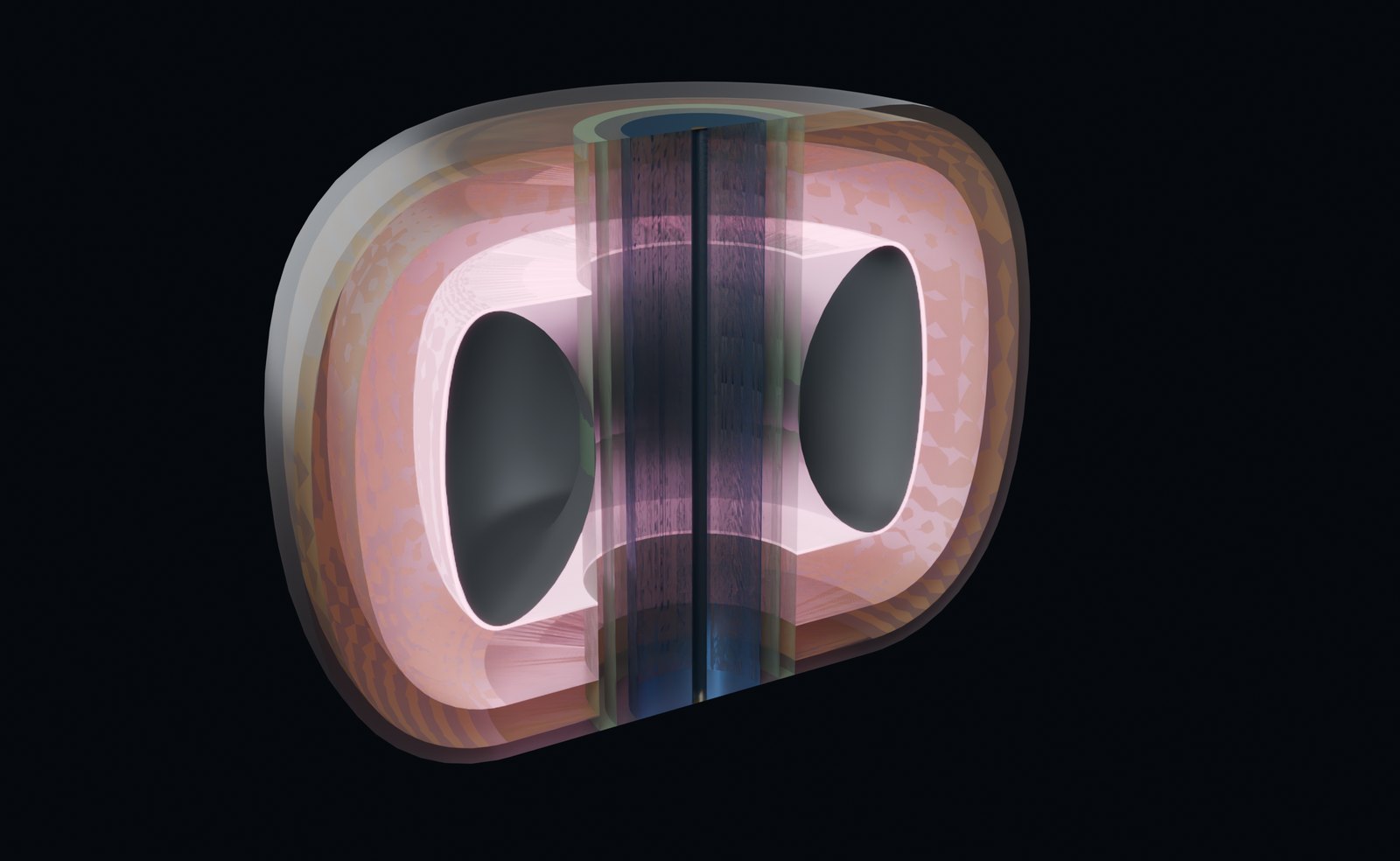
The Spherical Tokamak (HYPERION)
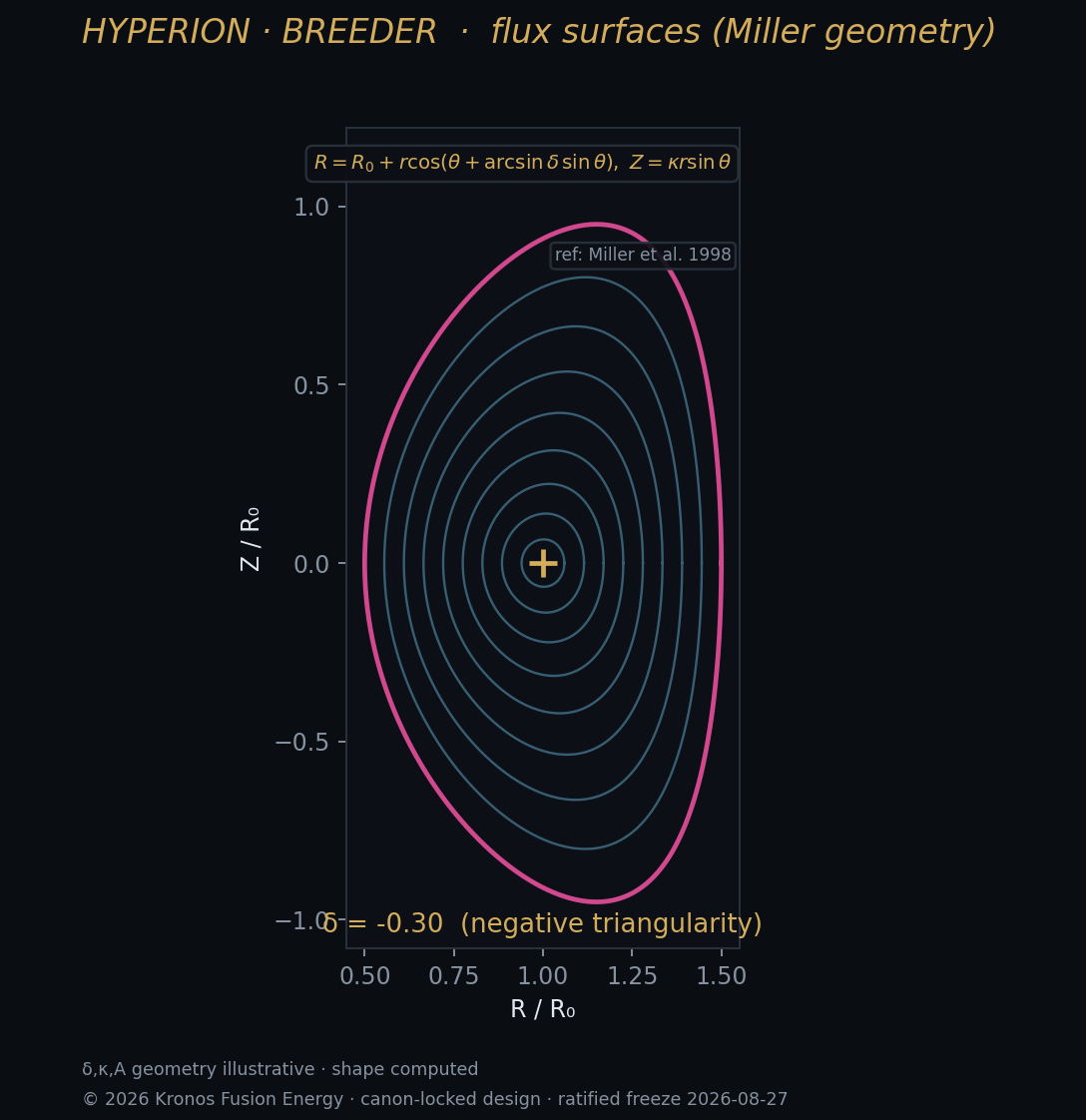
The breeder is a spherical tokamak because that geometry buys the most plasma pressure per tesla — the key to a compact, economical neutron source.
A spherical tokamak squeezes the hole in the doughnut almost shut, running at low aspect ratio (A = 2.5). That geometry naturally supports strong elongation (κ = 2.0) and high beta, so it holds more plasma pressure for a given magnetic field than a conventional tokamak.
HYPERION runs 9.66 MA of plasma current in an 1.2 m major radius machine, with a peak field of 16.84 T and negative triangularity (δ = -0.30) to tame the plasma edge. Its product is not electricity but neutrons and tritium — the fuel and the driver for the burner economy.
| Aspect ratio | 2.5 |
|---|---|
| Major radius | 1.2 m |
| Elongation | 2.0 |
| Peak field | 16.84 T |
| Plasma current | 9.66 MA |
| Design gain | 3.076 |
A spherical tokamak squeezes the doughnut's hole almost shut, running at low aspect ratio (A = 2.5), which naturally supports strong elongation and high beta. HYPERION uses that geometry to be a compact, high-performance neutron and tritium source at Q = 3.076, accepting the tight, highly-loaded central column as the defining engineering trade.
Common questions
Low aspect ratio (A = 2.5) lets it hold high plasma pressure (βN = 1.532) for a given field, making a compact, economical neutron source. The trade is a tight central column.