Radiation Protection
Keeping doses to workers and public well within limits by design.
- Approach
- Shield, contain, remote-handle
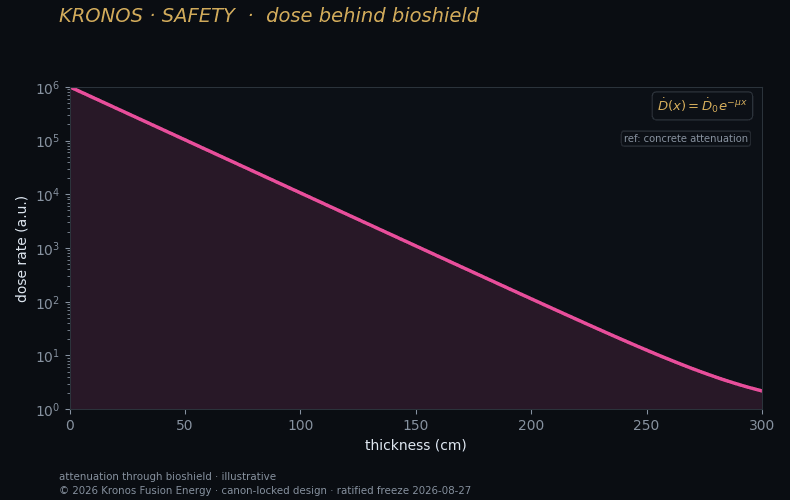
Radiation protection uses shielding, containment and remote handling to keep worker and public doses well within regulatory limits. Fusion's lack of long-lived waste and chain reactions makes this more tractable than in fission, though tritium and activation still require rigour.
Kronos designs to established radiological standards.
Common questions
Mainly neutrons during operation and activated structure afterwards, concentrated in the breeder. There is no chain reaction and no spent fuel; the hazards are handled by conventional shielding and access control.
Yes — being low-neutron (5.44%), it produces far less activation than the breeder, which is one reason it could in principle be sited closer to where its power is used.