The Plug-Density Requirement
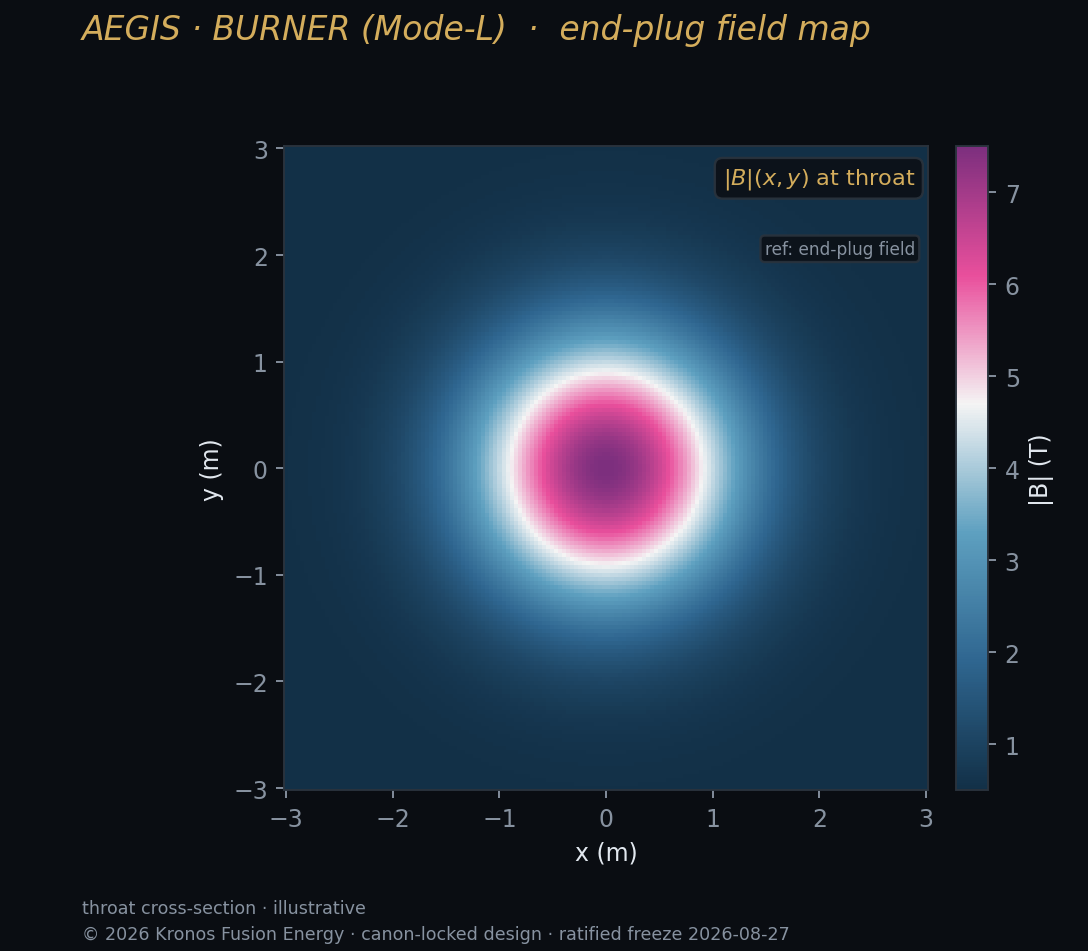
One number gates the burner. Kronos puts it front and centre rather than in a footnote.
- Requirement
- n_p/n_c ≈ 16
- Class
- Requirement, not result
- Gating experiment
- Plug demonstration
In a tandem mirror, the end plugs must reach a density well above the central cell to build an ambipolar potential deep enough to confine the central ions. The Kronos burner's net-positive operation is contingent on a plug-to-central density ratio of about np/nc = 16.
At a substantially lower ratio, the machine does not close and its engineering gain is not defined. This is why Kronos labels the burner's net power requirement-class: it is a target set by physics, to be demonstrated, not a measured outcome.
Why the ratio has to be so high
The ambipolar potential that plugs a tandem mirror scales with the logarithm of the plug-to-central density ratio and with the plug electron temperature. To confine central-cell ions deeply enough for net power, the Kronos burner needs a ratio near np/nc = 16. At a substantially lower ratio the potential is too shallow, ions leak, and the machine does not close — its engineering gain becomes undefined.
How it gets retired
The gate is closed by a dedicated plug demonstration: a mirror experiment that establishes the required density ratio with sloshing-ion and thermal-barrier techniques. Until that demonstration succeeds, Kronos presents the burner's net power as a target defined by the validation suite, not a measured result — and the breeder's value stands independently of it.
The plug-density requirement is the burner's single most important honest caveat: net power depends on the end plugs reaching a density about 16 times the central cell to build a deep enough confining potential. Kronos labels the result requirement-class and closes it with a dedicated plug demonstration, while the breeder's value stands independently of it.
Common questions
Because it depends on reaching a plug-to-central density ratio of about 16. That is a physics requirement to be demonstrated, so Kronos labels the result a target rather than an achievement.
The burner does not close as a net-electric machine at the design point. The breeder's products — tritium, neutrons, isotopes — do not depend on it, which is why Kronos builds the breeder first.