Plasma-Facing Materials
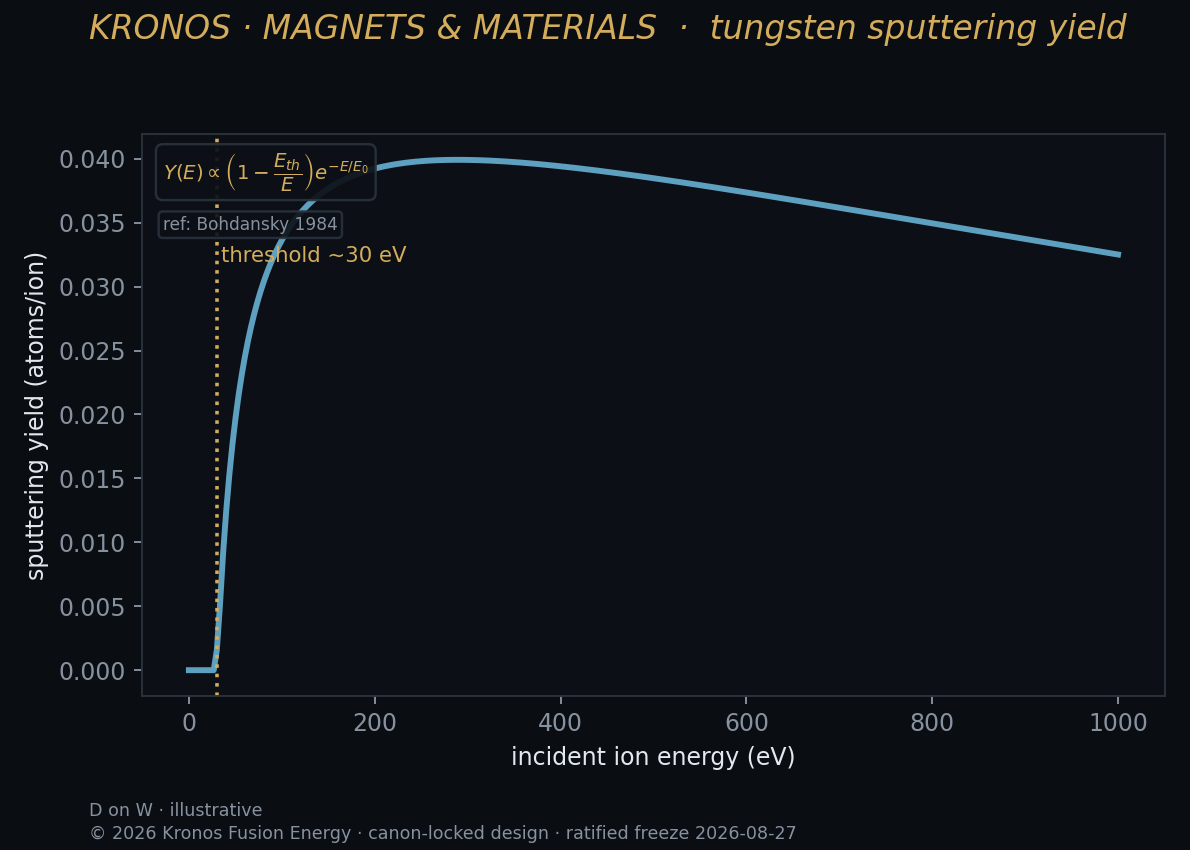
The refractory materials that survive direct exposure to the plasma edge.
- First-wall load (breeder)
- 1.97 MW/m2
- High-flux material
- Refractory metals
Plasma-facing components — the first wall and divertor targets — must tolerate intense heat and particle flux. Refractory metals such as tungsten are standard for the highest-flux surfaces. HYPERION's first wall is designed for 1.97 MW/m2; the burner's loading is far gentler.
Material choice trades heat tolerance, erosion, and activation. Kronos reports the loadings and the qualification path rather than assuming survival.
Plasma-facing materials live in the harshest environment in the machine, so they are chosen for heat tolerance, low erosion and low tritium retention rather than strength. Tungsten armour on copper-alloy heat sinks is the reference pairing, rated for HYPERION's 1.97 MW/m2 first-wall load, and every plasma-facing component is designed to be inspected and replaced.
Common questions
Heat tolerance, low erosion and low tritium retention rather than strength. Tungsten armour on copper-alloy heat sinks is the reference pairing, rated for HYPERION's 1.97 MW/m2 first-wall load.
No — plasma-facing components are consumables designed to be inspected and replaced remotely, because they live in the harshest environment in the machine.