The Lawson Criterion and the Triple Product
One inequality governs whether a fusion plasma can pay for itself. Kronos designs to it explicitly, and reports where each machine sits against it.
- Break-even
- Q = 1
- Confinement time (breeder)
- 0.374 s
- Confinement quality
- H98 = 1.0
- Ion temperature (breeder)
- 15 keV
John Lawson's 1955 criterion states that for a plasma to release more fusion energy than it takes to heat it, the product of density n and energy confinement time τE must exceed a threshold that depends on temperature. The modern form multiplies in temperature T to give the triple product n·T·τE, measured in keV·s·m-3.
Why it is the right yardstick
The triple product captures the essential tension: fusion power scales with density squared and with reactivity (a strong function of temperature), while losses scale with how quickly the plasma cools. A machine can reach the same triple product with a hot, diffuse plasma or a cooler, denser one — which is exactly the design freedom Kronos exploits across its two machines.
Where Kronos sits
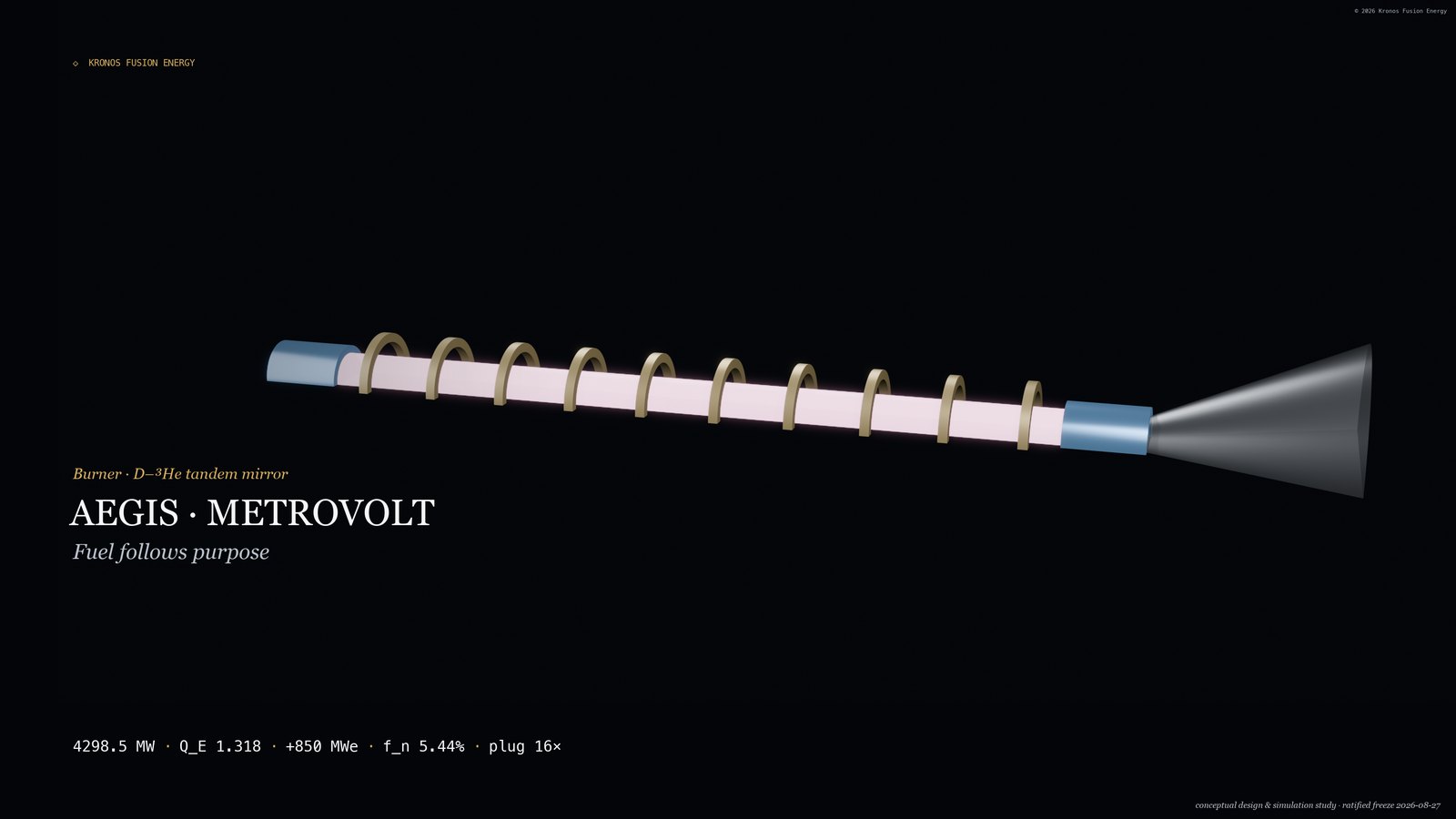
The HYPERION breeder is designed for an energy confinement time of 0.374 s at a confinement quality of H98 = 1.0, an ion temperature near 15 keV, giving a fusion gain of Q = 3.076. The D–³He burner operates far hotter — around 90 keV — because its fuel requires it.
Lawson's inequality is the one number that decides whether a fusion plasma can pay for itself, combining density, temperature and confinement time into the triple product. Kronos designs to it explicitly and reports where each machine sits — the breeder at 15 keV and 0.374 s, the burner far hotter at 90 keV because its fuel demands it.
Common questions
Density × temperature × energy confinement time — the single figure of merit for fusion performance. Exceed a threshold and the plasma produces net power.