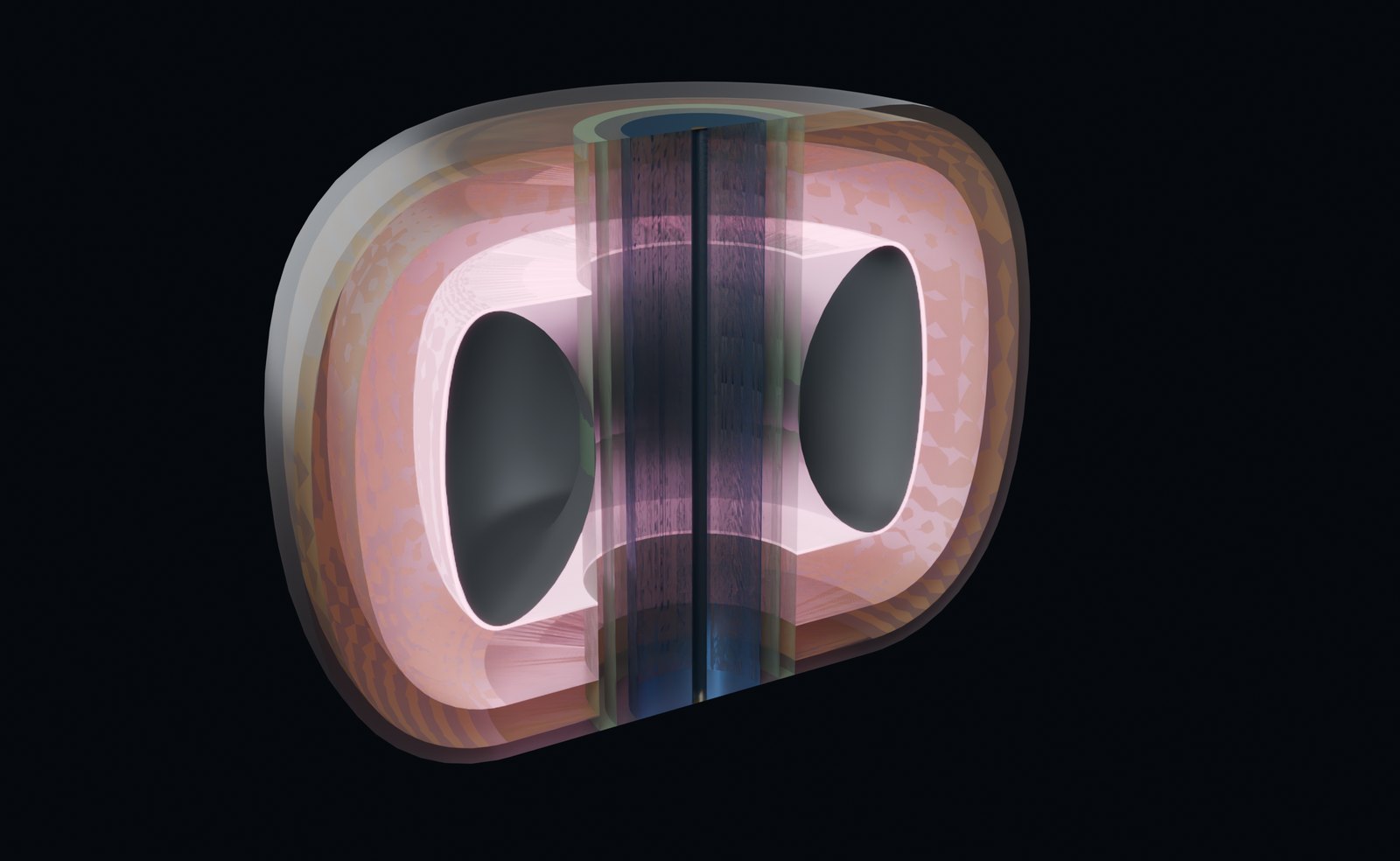
The Inertial-Confinement Approach
Compressing fuel with lasers or beams — a pulsed alternative to magnetic confinement.
- Type
- Pulsed
- Milestone
- NIF target gain, 2022
Inertial confinement (e.g. the public NIF facility, which achieved target energy gain in 2022) compresses fuel pellets to fuse under their own inertia. It is a fundamentally pulsed approach with different engineering challenges — driver efficiency and repetition rate — from magnetic confinement.
Kronos uses magnetic confinement, a continuous rather than pulsed route to a power plant.
Common questions
Instead of holding a diffuse plasma steadily, it compresses a tiny fuel pellet so fast that it fuses before flying apart — the approach NIF used for its 2022 target gain.
Because driver efficiency and repetition rate make inertial fusion a very different power-plant problem. Kronos's continuous magnetic machines produce steady output, which suits firm power and isotope production.