What Fusion Is, and Why It Is Hard
Fusion powers the stars. On Earth the challenge is not whether it works — it does — but whether a machine can hold a plasma hot enough, dense enough, and long enough to produce more energy than it consumes, and do it economically.
- Breeder gain Q
- 3.076
- Breeder fusion power
- 85.0 MW
- Burner neutron fraction
- 5.44% (low-neutron)
- Status
- Design & validation
Nuclear fusion merges light atomic nuclei into heavier ones, converting a sliver of their mass into energy according to E = mc². A deuterium–tritium reaction releases 17.6 MeV — millions of times more energy per reaction than burning a chemical bond. The catch is that nuclei are positively charged and repel one another; only at temperatures of tens to hundreds of millions of degrees do they move fast enough to fuse.
The three levers
Every fusion concept trades off the same three quantities, combined in the Lawson triple product: plasma temperature, density, and energy confinement time. Raise all three high enough and the plasma produces net power.
- Temperature — the fuel must be hot enough for nuclei to tunnel through their mutual repulsion; D–T peaks near 10–20 keV (100–230 million K).
- Density — more nuclei per cubic metre means more reactions per second.
- Confinement time — the plasma's heat must be held long enough to sustain the reactions rather than leaking away.
How Kronos approaches it
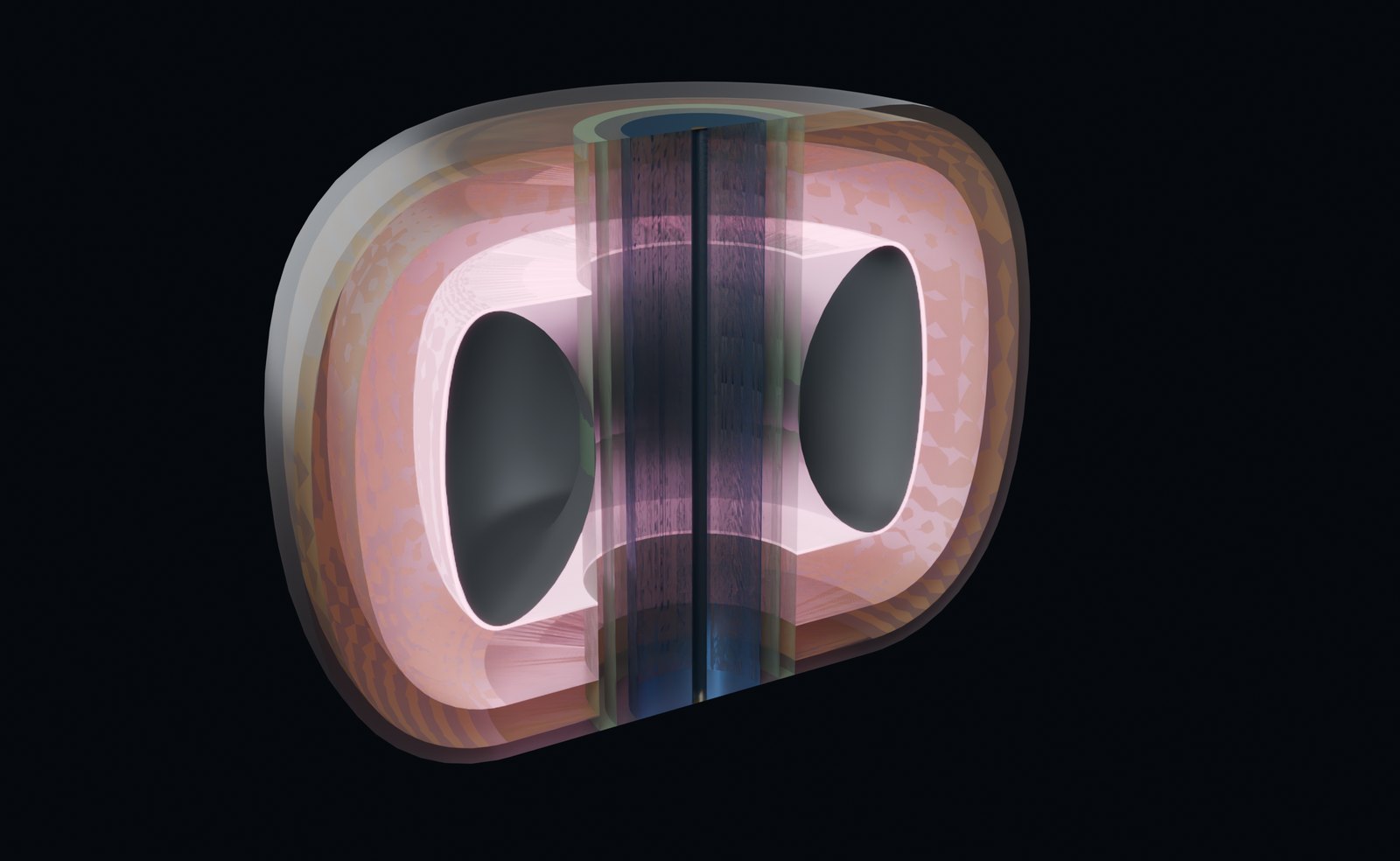
Kronos runs a two-machine strategy. The HYPERION breeder is a compact spherical tokamak that produces neutrons and breeds tritium; the D–³He tandem-mirror burner converts a fuel that is far cleaner in neutrons directly into electricity. Neither machine claims ignition — both are honestly described as driven systems.
Common questions
Two positively charged nuclei repel, so they must be heated to tens or hundreds of millions of degrees and held together long enough to fuse. Doing that while getting more energy out than you put in is the whole challenge.
By selling the breeder's neutrons, tritium and helium-3 rather than waiting on net-electric power. HYPERION runs at plasma gain Q = 3.076 — net-positive plasma, driven and steady — with a business that does not depend on grid electricity.