Disruption Physics
What actually happens in a disruption, and why avoiding it matters.
- Phases
- Thermal + current quench
A disruption chains together a thermal quench (heat dumped in under a millisecond) and a current quench (current collapsing in milliseconds), generating heat loads, electromagnetic forces and runaway electrons. Understanding the chain is what enables avoidance and mitigation — and why the disruption-free burner is architecturally attractive.
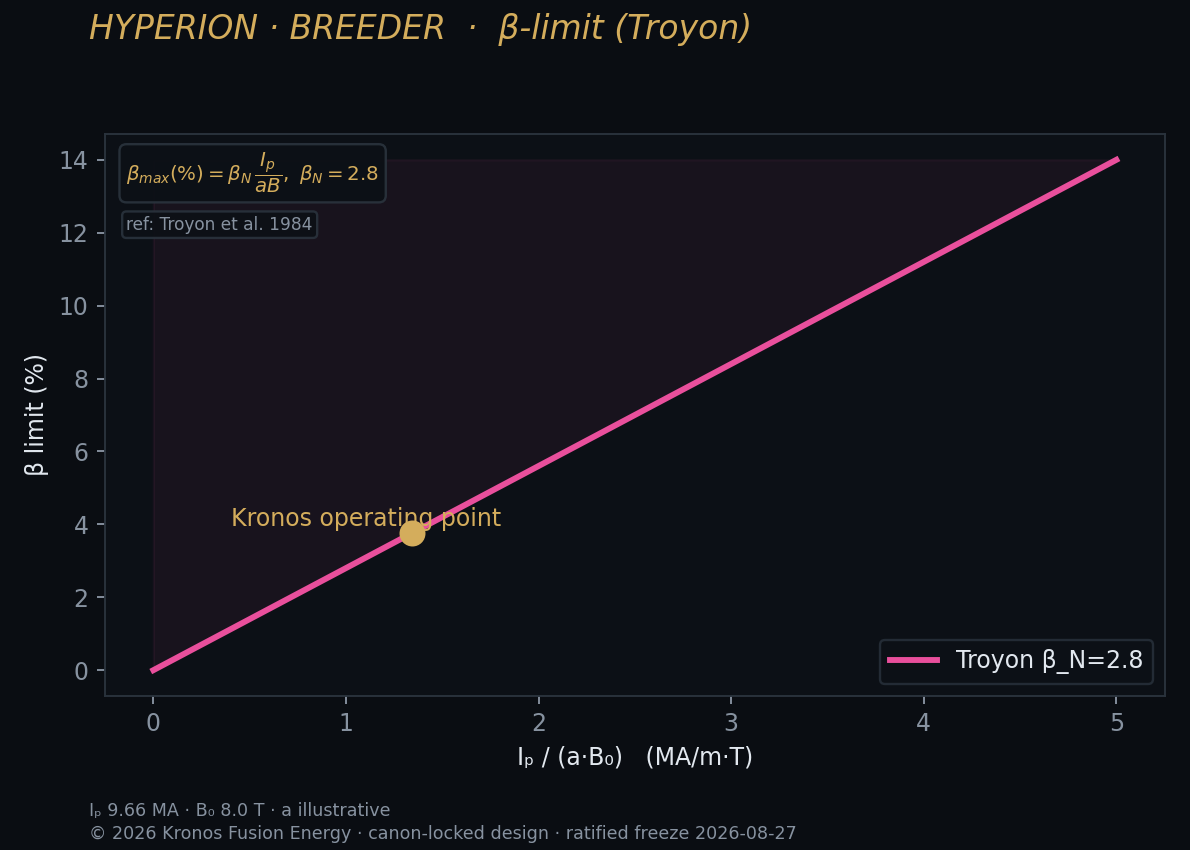
Kronos designs the breeder conservatively to minimise disruption risk.
Common questions
A sudden loss of confinement in a tokamak that dumps the plasma's energy and current, producing intense heat loads, mechanical forces and possible runaway electrons. It is a defining tokamak failure mode.
No — the linear tandem-mirror burner has no plasma current to disrupt, so it avoids this failure mode entirely. That is one of its architectural safety advantages over the breeder.