Decommissioning a Fusion Plant
Taking a plant apart at end of life — easier than fission, with mostly short-lived waste.
- Waste
- Mostly short-lived
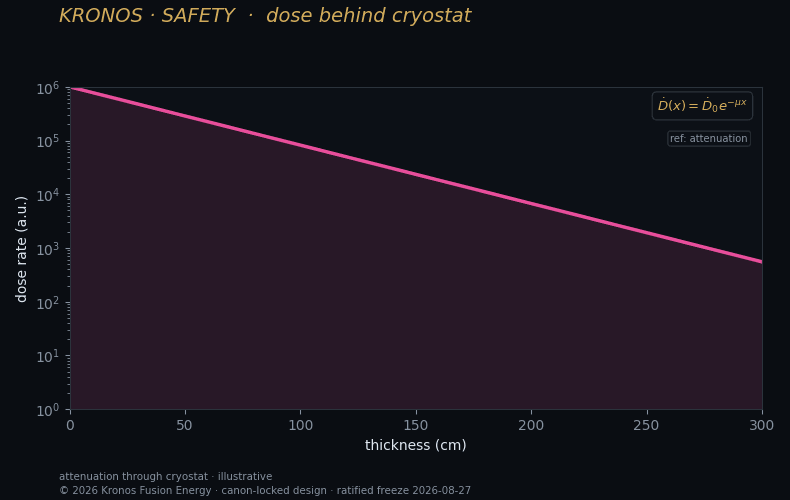
At end of life, a fusion plant's activated structure decays far faster than fission waste; with low-activation materials, most of it reaches clearance levels within decades. Decommissioning is a manageable, planned process rather than a millennia-long liability.
It is part of the honest lifecycle picture.
Common questions
Structural metal made mildly radioactive by neutrons — no spent fuel and no long-lived high-level waste. Low-activation materials are chosen so that much of it decays to hands-on levels within decades.
There is no fissile inventory and no long-lived high-level waste stream, so the decommissioning problem is bounded and shorter-lived — though Kronos still screens waste class and volume per component rather than assuming it away.