DEC Collector Ring
A biased electrode ring that recovers ion energy as electricity.
- Role
- Direct conversion
- Efficiency
- 0.70
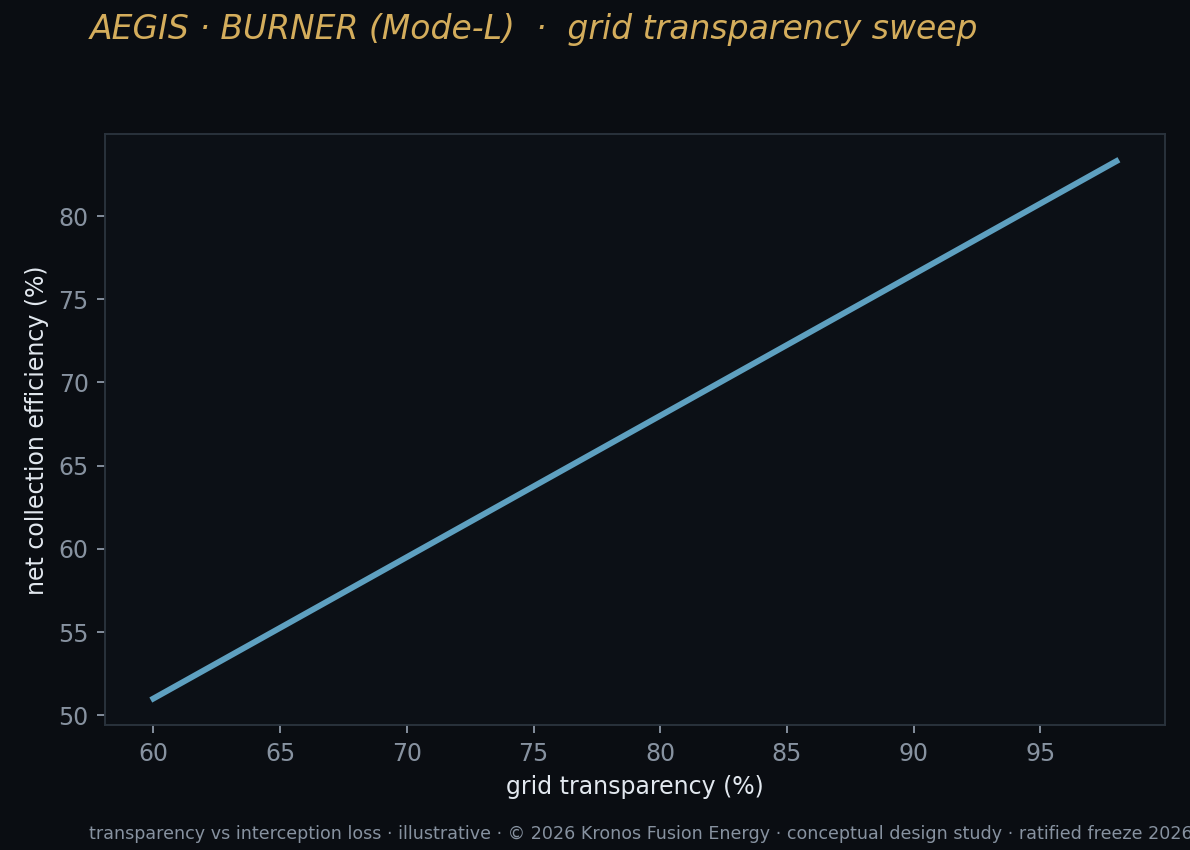
The direct-energy converter's collector rings — an angled, biased 'venetian-blind' array — decelerate the burner's escaping ions and collect their energy as electricity at about 0.70, the heart of the burner's direct conversion.
The direct-energy converter's angled, biased 'venetian-blind' collector rings decelerate the burner's escaping ions and collect their energy as electricity at about 0.70. They are the heart of direct conversion — the component that lets the burner skip the steam cycle and lift its plant-level efficiency.
Common questions
Its angled, biased 'venetian-blind' rings decelerate the burner's escaping ions and collect their energy as electricity at about 0.70. It is the heart of direct energy conversion.
Because D–³He releases its energy as charged particles, they can be turned into electricity directly instead of via heat. That is the single biggest reason the burner's plant-level efficiency (QE = 1.31) can exceed a thermal plant's.