
What this document is, and how to read its numbers
This is a combined editorial. It gathers, in one volume, the two design studies Kronos Fusion Energy released in 2026 — a compact spherical-tokamak tritium/helium-3 breeder and a deuterium–helium-3 tandem-mirror generator — together with the intellectual-property estate, the people, and, in the internal edition, the full commercial case. The scientific text is the same text that appears in the arXiv preprints and the journal submissions; the editorial adds the apparatus a reader needs to hold the whole program at once, and nothing in the physics is altered to fit it.
The honesty stance is the asset
Every headline quantity carries an evidence class — Derived Recomputed Measured Requirement — and, where a number is a modelled extrapolation rather than a demonstrated value, it is labelled as such and its downside is shown next to it. Several quantities in the underlying corpus moved after first publication; where a value has been withdrawn or restated, the record says so plainly. This is deliberate: a diligence team will find the load-bearing assumptions, so the document surfaces them first.
- Title
- The Kronos Fleet — Hyperion · Aegis · MetroVolt: A Combined Design & Commercialization Study
- Author
- Priyanca Ford, Founder & CEO, on behalf of Kronos Fusion Energy
- Edition
- 2026 Combined Editorial · first issue
- Companion works
- The five-paper arXiv drop — (1) Breeder, (2) Burner, (3) REBCO magnet & tape, (4) Direct Energy Conversion, (5) AI/ML/Quantum control — with matching numbered Zenodo deposits, plus the IOP journal and IAEA-FEC submissions. Patents were filed before the drop.
- Naming
- Hyperion = the breeder; Aegis (defense) and MetroVolt (data-center) = one generator in two housings. Internal mode letters (D1, L) do not appear on public surfaces.
- Status
- Conceptual design & simulation study. Nothing herein is a construction commitment.
The fleet at a glance, and the way its numbers are marked
This volume opens with Orientation, presents the five research papers as a bound sequence, and closes with the Apparatus. Foundations sets out the three general results both machines rest on. Paper One is the Hyperion breeder; Paper Two the Aegis / MetroVolt generator; Papers Three, Four and Five are the enabling science — high-field REBCO magnets and tape, direct energy conversion, and the AI / ML / quantum control stack. A Digital Twin & 3-D Model part follows, then the Environmental profile. The Economics and levelized cost and the Business Case and diligence record appear in the internal edition only; the Simulations proof record and the Apparatus — patent portfolio, team, limitations, and sources — close both editions.
The fleet at a glance
| Hyperion | Aegis | MetroVolt | |
|---|---|---|---|
| Role | Strategic-isotope foundry | Defense installation power | Campus power |
| Machine | Spherical tokamak | Tandem mirror | Tandem mirror |
| Fuel | Deuterium–tritium | Deuterium–helium-3 | Deuterium–helium-3 |
| Delivers | Tritium · ³He · 14 MeV n | Resilient installation power | Firm campus power |
| Physics bar | Fusion gain only | Closure (gates named) | Closure + lunar ³He |
| In the fleet | Breeds the fuel | Proves the generator | Commercial destination |
How the numbers are marked
Every headline quantity carries an evidence class — Derived from first principles, Recomputed from raw data, Measured in hardware, or a Requirement yet to be met. Financial figures carry a case label and are confined to the internal (confidential) edition. Values that moved after first publication are shown as withdrawn or restated rather than quietly changed. A capability you can evaluate is one whose limits are on the page.
One platform, in nine papers
This volume collects the 2026 Kronos editorials as one bound web edition. The five foundational papers describe the platform’s machines and enabling science; the four companion studies develop the tritium fuel cycle, the integrated platform, the advanced-fuel choice, and the safety case. Every number is drawn from a single frozen physics record, and closure is stated in two tiers throughout — closed-on-model versus closed-demonstrated — never “closed” unqualified. Economics are excluded; honest gates are carried.
Table of Contents
Symbols, units, and the names of things
Why a breeder, and why it can be small
United States tritium supply is structurally fragile: weapons-stockpile tritium is produced through a single commercial reactor, and the federal replacement requirement — tritium decays at 5.5% per year — has been met by increasing irradiation loading rather than by adding a second source. Helium-3 is rationed. A domestic, non-reactor capability to produce both isotopes is of strategic interest independently of whether it is inexpensive.
The obstacle to a fusion isotope source has never been the nuclear physics, which is textbook, but the perceived need for a power-plant-scale machine. Hyperion removes that obstacle with one observation: a breeder needs fusion gain — reactions — not net electricity. Demanding net electricity is what forced every prior breeder concept into a large plasma, a large blanket, and a dangerous standing tritium inventory. Freed from that requirement, the machine is sized to a national supply requirement of order kilograms per year — and the size that results is small.
Size the breeder to a named national requirement, not to a power rating, and the two obstacles that defeated every prior fusion-breeder proposal — machine scale and tritium inventory — both fall below their binding thresholds. The physics never forbade a small breeder; it forbade a large one.
The fusion helium-3/tritium breeder has been proposed before and rejected in print — Wittenberg on a licensing/inventory basis, Greenspan & Miley on the merchant-breeder economics — but every prior study sizes the breeder to a fusion fleet’s support ratio, where the inventory objection bites. Hyperion sizes to a named non-fusion requirement, at which the objection inverts.
The design point and the power balance
The zero-dimensional power balance fixes the gain. At the frozen operating point (config 22021, gate BR-L1-A1) the compact spherical tokamak reaches a plasma gain of Q = 3.0763 at a fusion power of Pfus = 85.04 MW and a plasma current of Ip = 9.66 MA, at negative triangularity δ = -0.3. This is a driven, sub-ignition target — it does not need to close the electrical loop, only to run reactions at a useful rate. Computed · frozen

Negative triangularity — the confinement lever
Negative triangularity is the design’s confinement lever, established at both turbulence scales with nonlinear gyrokinetics. At the operating gradient it cuts the combined ITG+TEM ion transport by 40–45% relative to a positive-triangularity twin (gate BR-L2-A1c), and suppresses electron-scale ETG transport by 79–80% — leaving the operating point quiet and subcritical. The direction is corroborated against the TCV and DIII-D negative-triangularity campaigns; the magnitude is a design-target caveat carried openly.

The tritium breeding ladder
The breeder’s product is tritium, and its credibility rests on an honest mass balance. Each deuterium–tritium fusion consumes one triton, so the per-unit burn rate follows from the fusion power: ΛT = 4.76 kg-T fpy−1. The net surplus is a confirmed ladder: three-dimensional neutronics on ENDF/B-VIII.0 raise it from 0.29 kg-T yr−1 (literal recipe) through 0.9 (solid-beryllium blanket) to ~2.0 kg-T yr−1 per unit at the advanced blanket — net TBR 1.42, the confirmed per-unit ceiling across twelve configurations.
A single advanced unit is a tritium exporter at the ~2.0 kg-T yr−1 scale. A national-scale 4 kg-T yr−1 supply is a fleet property — two advanced units, or four-to-five solid-beryllium units, with helium-3 aggregating to 3.6-4.5 kg yr−1 — never a single-unit claim, because the spherical-tokamak centrepost caps the per-unit ceiling.

The centrepost, as a quantified consumable
The inboard centrepost is the defining vulnerability of a normal-conductor spherical tokamak, and the design does not argue it away: it is a consumable, scheduled-replacement cartridge with a best-case life of 0.58 full-power-years, tunable against a tungsten-carbide shield that trades directly with breeding coverage. The materials-lifetime problem is converted into a maintenance-interval problem, which is the tractable one.

Disruptions, answered directly
The disruption response is answered rather than assumed negligible, and it is demanding. On a NIMROD-verified equilibrium the current-quench time is 7-19, the runaway-electron avalanche is severe (E/Ec ≈ SEVERE), and the halo current reaches 35 of the plasma current. The honest conclusion is a hard design requirement: shattered-pellet-class disruption mitigation, triggered inside the current-quench window. The risk is stated as a requirement, not waved away. Design requirement
Net electricity is a category error for this machine and is excluded. Hyperion succeeds by gain, breeding ratio, helium-3, and neutrons — the materials a fusion economy needs — and the burner, its companion, carries the power story.
One machine, two housings
Aegis and MetroVolt are two application housings of one deuterium–helium-3 tandem mirror — fixed defence installations and data-centre generation — sharing the mirror physics and the direct-energy-conversion train. The machine burns an advanced fuel that is low-neutron, never aneutronic: at the design point it reaches an engineering gain of QE = 1.318 at a neutron fraction of only 5.44%, an order of magnitude below deuterium–tritium.
Closure is requirement-class, not demonstrated. The machine closes on the frozen physics, but it needs an end-plug density ratio of 16 — far above the GDT-measured value — which is the design’s largest open item, retired by a named plug-scale potential experiment, not by a hoped-for breakthrough.
The size-scaling result
The paper’s principal new result concerns synchrotron reabsorption: it is not a fixed fraction of fusion power but scales with machine size, an analytic consequence of a harmonic cutoff that grows with minor radius. That single observation reframes the mirror’s power balance and sets where on the device-length ladder the engineering gain crosses unity.

The plug, and the uncertainty
The end plug is where the machine lives or dies. It confines the central-cell ions electrostatically, and the potential it must hold sets the density ratio that is the design’s binding gate. We do not present a single flattering number: the engineering gain is reported as a band under uncertainty quantification, with its probability of exceeding unity stated honestly rather than a point estimate asserted.


Why deuterium–helium-3
The fuel is chosen on the physics, not the aneutronic ideal. Where the product is power and neutrons are a liability to shield and a source of activation, deuterium–helium-3 is correct because 5.44% is the lowest neutron burden among fuels with accessible reactivity. Its one honest cost — helium-3 availability — is met by the breeder’s co-product helium-3 and, at fleet scale, lunar supply. The magnet that makes the plug is buildable within demonstrated practice; the magnet is not the gate. The generator improves with direct energy conversion, but its closure is governed by the plug potential, stated plainly.
One mechanics, applied twice
The magnet paper does one thing carefully and applies it to both machines: bore-resolved hoop stress, which scales with the winding bore — exactly what worst-case derating hides. Resolving the stress by bore rather than assuming a single conservative bound changes which coil is the binding constraint, and it does so in the design’s favour.
The breeder’s centre-post is stress-comfortable at its operating field. The burner’s small-bore plug coil — once feared infeasible as a bare winding — is resolved by a stress-managed structural shield that closes the full plug field at a healthy strain margin. The magnet is not the gate.

The stress profile, resolved by bore
Hoop stress in a high-field winding grows with the bore radius, so a small-bore, very-high-field coil and a large-bore, moderate-field coil are not interchangeable at the same nominal field. Resolving the profile turns a single worst-case “infeasible” verdict into a map: where the bare winding is stress-limited, and where a structural shield carries the load. The burner plug sits in the second regime, and the shield closes it.

Two claims, kept apart
Honesty here is a matter of not conflating two different statements. A field-capability claim about the conductor — what the REBCO tape can carry — is not a coil record, and we never present it as one. The feasibility map states, per coil, whether it is stress-comfortable as a bare winding, or feasible only with a structural shield, or pending a finite-element confirmation. The plug coil is the last-resolved case, and its resolution retires what had been the design’s magnet gate.

The consequence for the platform is direct: with the plug coil resolved, the burner’s one remaining gate is the plug potential — a plasma-physics experiment — not the plug magnet. The magnet science moved the gate off the coil.
The loss channel is not the birth channel
The case for direct energy conversion in a deuterium–helium-3 mirror is usually made about the 14.66 MeV proton, which carries about 80% of the charged birth energy and invites a high-efficiency ion converter. That framing describes the birth spectrum, not the axial loss channel. At a reactor ion temperature the proton is born far above its Stix critical energy and thermalizes predominantly on the electrons before it can escape.
Booked against a finite axial-confinement time, the axial exit carries a thermalized split in which the electron/thermal stream (≈55.5%) is larger than the residual directed-ion stream (≈44.5%) — an inversion of the received picture that holds across 20–200 keV. The dominant recovery target is a directed electron stream, and no published converter recovers directed electrons.


The quasineutral expander
We propose the inverse of the usual magnetic-nozzle usage: a quasineutral, two-species expander that recovers the electron channel against the ambipolar potential of the expansion, so the space-charge wall never forms. One worked embodiment (expansion ratio 20, 5 T → 0.25 T) recovers a bounded ≈28% of the electron channel after realistic losses, lifting the axial electric recovery by ≈13% (≈97 MWe), at a converter module efficiency of 0.7.

A bounded lever, not the closure mechanism
We place direct energy conversion correctly in the plant balance: the generator’s energy multiplication is gated by the recirculating plug and thermal-barrier power, not by conversion efficiency. The expander is a bounded upside — it improves the generator without being what makes it close. Kronos has built no converter; every number is a design target, a model output, or an open-risk inference. Even a bounded-negative experimental result on the expander closes a named open problem in advanced-fuel energy conversion. Bounded lever
Three tiers, held apart
A nuclear-regulated fusion generator must be controlled across ten orders of magnitude in time — microsecond magnet protection through month-scale fuel logistics — and every automated actuation must be bounded, auditable, and reproducible. Machine learning and quantum technologies are often invoked for this without saying what is deployable now versus what is a decade away. We hold three technology-readiness tiers strictly apart, and report each with its evidence and its misses.

Tier 1 — physics-informed AI, deployable now if clamped
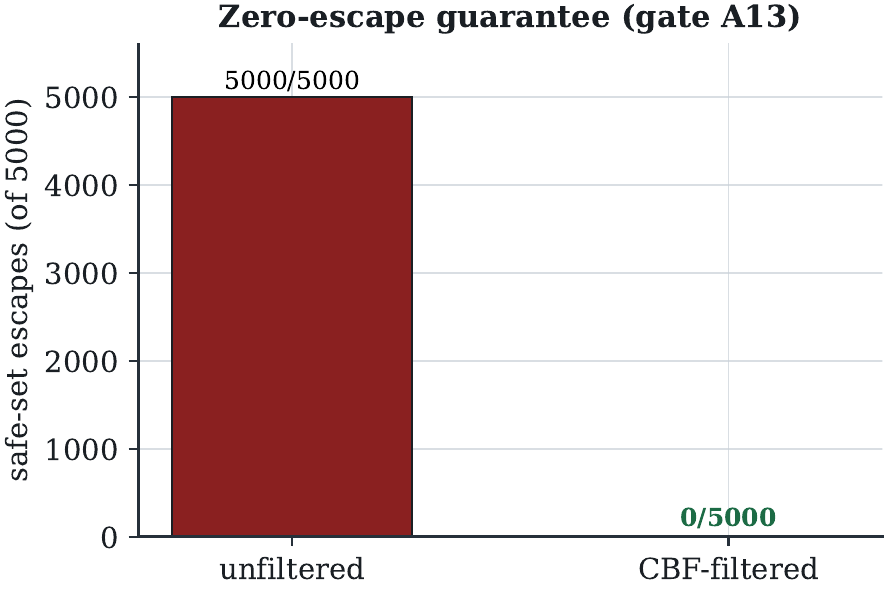
The load-bearing requirement is that a learned controller cannot drive the machine out of its safe operating envelope. A robust control-barrier-function filter provides this with an analytic forward-invariance guarantee: over 5000 Monte-Carlo trajectories, 0 escape the safe set with the filter against 5000 of 5000 without it. Around it, a Bayesian-optimization surrogate reaches leave-one-out R² = 0.987. Physics-informed AI is deployable in the loop because its error is bounded and deterministically clamped.
A learned controller can pursue performance while a proven clamp guarantees the machine stays in the safe envelope — zero safety-set escapes with the filter, backed by proof, not by a training score.

Tier 3 — quantum computation, an offline calibration tier
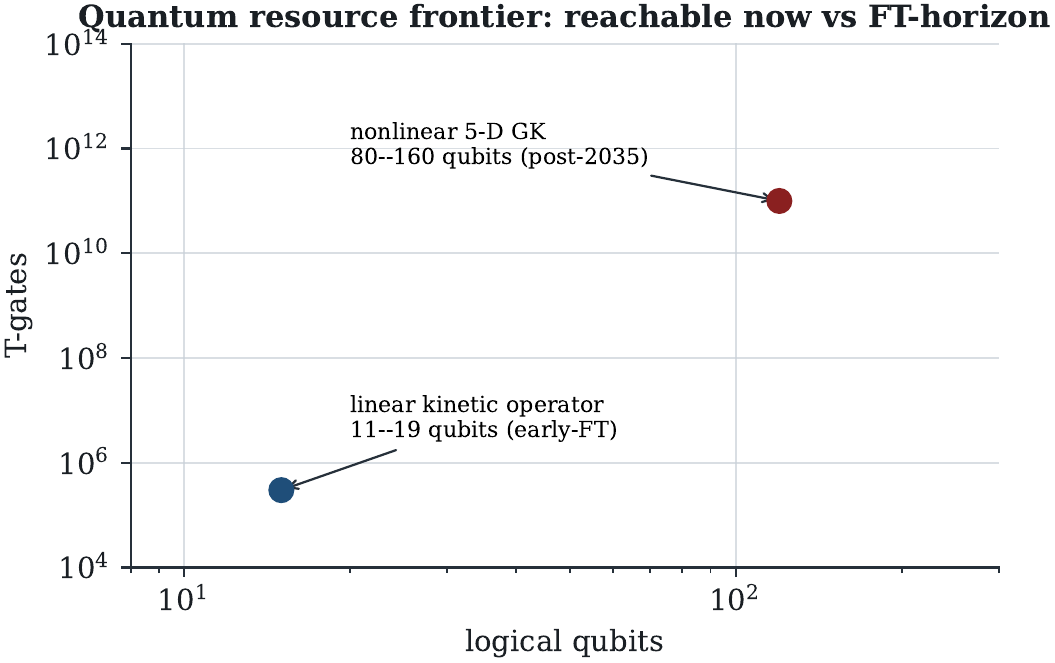
For fusion, quantum computation is an offline calibration tier with no resource crossover this decade. Landau damping reproduces on a 5-qubit circuit to a few percent, and variational quantum chemistry reaches chemical accuracy on the fusion-alloy fragments — but the honest resource split is load-bearing: the linear kinetic operator needs 11–19 logical qubits, and the nonlinear gyrokinetic problem that would most help the machine is fault-tolerant-horizon. Noisy hardware today shows no advantage; the classical baseline is cheaper at every demonstrated scale.

Reporting the misses
We report every missed pre-registered target rather than reframing it. The physics-informed equilibrium network was intended to become a fast native solver and did not: it reached 1.4% relative-L² error against a 1% goal. Keeping this negative in the record is part of the method. The contribution is a certifiable, resource-honest system and method for compact-fusion control — not new plasma physics. Reported, not reframed
The vulnerability, met head-on
A spherical tokamak buys its high beta and compactness with a slender inboard centrepost that no thick shield can protect without defeating the geometry. The honest response is not to claim a long-lived centrepost, but to make it a consumable and prove the maintenance architecture around it.
The centrepost’s finite life is converted from a materials-lifetime barrier into a scheduled-replacement line item, closed by four coupled analyses on the frozen design point.

Four analyses, one architecture
The structural check confirms the coil stress against the analytic Lamé solution; the fused strain-rate-plus-magnetization detector catches a quench well ahead of the terminal voltage; and the reliability/maintainability model sets the cadence at which a cartridge swap keeps availability whole.


Breeding is a lever, not a constant
A breeder’s blanket must return more than one triton per fusion neutron, net of parasitic absorption and leakage. In a compact spherical tokamak the inboard coverage is capped by the centrepost, so the lever must be characterized honestly and its ceiling identified rather than assumed.
Net TBR rises from ~0.86 (bare lithium) through the low-1.1s (solid-beryllium multiplier) to 1.42 (advanced blanket) — the confirmed per-unit ceiling across twelve configurations, reproducing across ENDF/B-VIII.0 and FENDL-3.2 to under 0.3%.

The shield trade, quantified
The centrepost sits closest to the 14 MeV source and cannot be thickly shielded without growing the machine. Rather than argue this away, the design books the fluence and damage against the shield, and reads the cartridge interval off the result.
The damage rate is 18.85 dpa/fpy at the design shield; a thin shield shortens the cartridge life and a thick shield lengthens it but displaces breeding blanket. The design point balances life against coverage rather than maximizing either.

Numbers you can check, not trust
A design series is only as credible as its weakest unverifiable number. The discipline here is that every headline quantity is a frozen anchor with an evidence class, regenerable from named, deposited code — so a reader can reproduce it rather than take it on faith.
The breeding ratio — the number the whole breeder case rests on — reproduces across two independent nuclear-data evaluations to under 0.3%. The result is a property of the geometry and cross-sections, not of one code path.

A loss turned into a gain
The advanced-fuel mirror’s charged products are a resource, not just a loss. If their energy can be redirected into the fuel ions rather than lost as heat through the loss cone, the recirculating power the mirror must supply falls, and the net electric gain rises.
A mode-converted channeling wave raises the recoverable charged fraction from ~8% (collisional baseline) to ~80% in the worked embodiment — a bounded upside that eases the power balance without being what makes the machine close.

Marginal, and honest about it
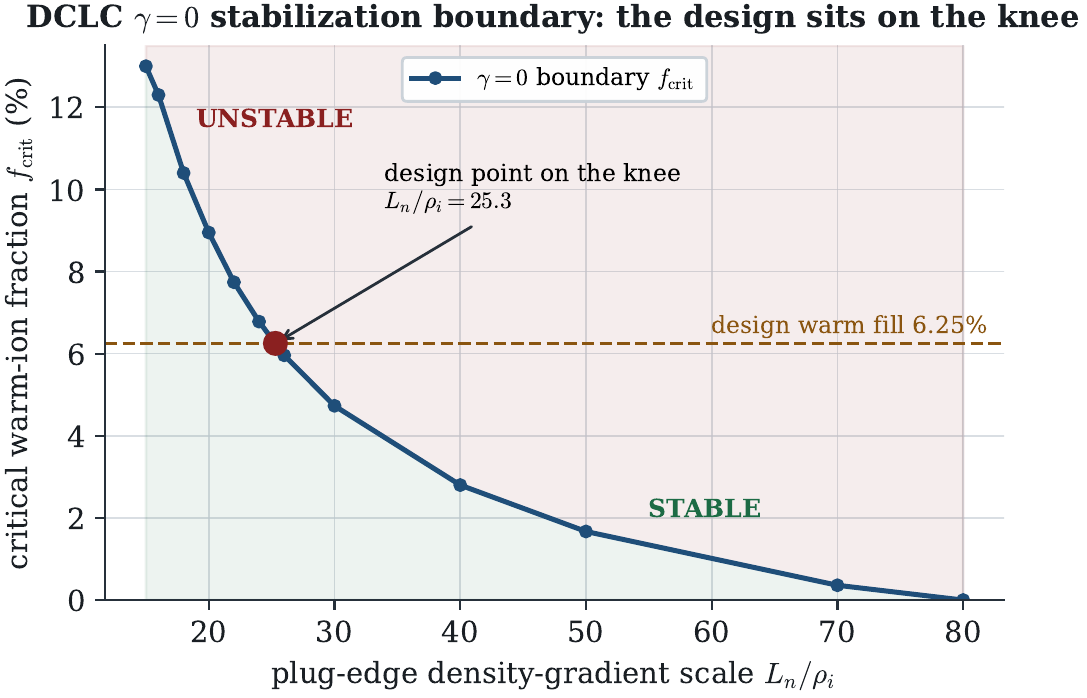
The end plug lives or dies on its microstability. Rather than assert a comfortable margin, the paper maps the exact marginal-stability boundary and places the design point on it — on the knee, cleared only for sufficiently broad edge gradients.
On the stabilization knee: DCLC is cleared for broad plug-edge gradients, with a weak residual cyclotron mode carried openly. Marginal but bounded and quantified, not claimed comfortable.

Performance inside a proof
A learned or optimization-based controller cannot be allowed to drive a nuclear-regulated machine out of its safe envelope. The clamp guarantees it cannot: a control-barrier filter with a closed-form solution wraps any controller and enforces forward invariance of the safe set.
0 of 5000 trajectories escape the safe set with the clamp, against 5000 of 5000 without it — backed by an analytic forward-invariance proof, not a training score. Scope is stated openly: the reduced-order model and a declared disturbance bound.

What quantum can do — and can’t, yet
Quantum computing is often invoked for fusion without a resource budget. Here it comes with one. Landau damping reproduces on a small circuit and variational chemistry reaches chemical accuracy on the alloy fragments — genuine, but far from the problem that would move the machine.
The linear kinetic operator is an early-fault-tolerant target (11-19 logical qubits); the nonlinear gyrokinetic problem that would most help is fault-tolerant-horizon. Noisy hardware shows no advantage today — the classical baseline is cheaper at every demonstrated scale.

Attack your own gates first
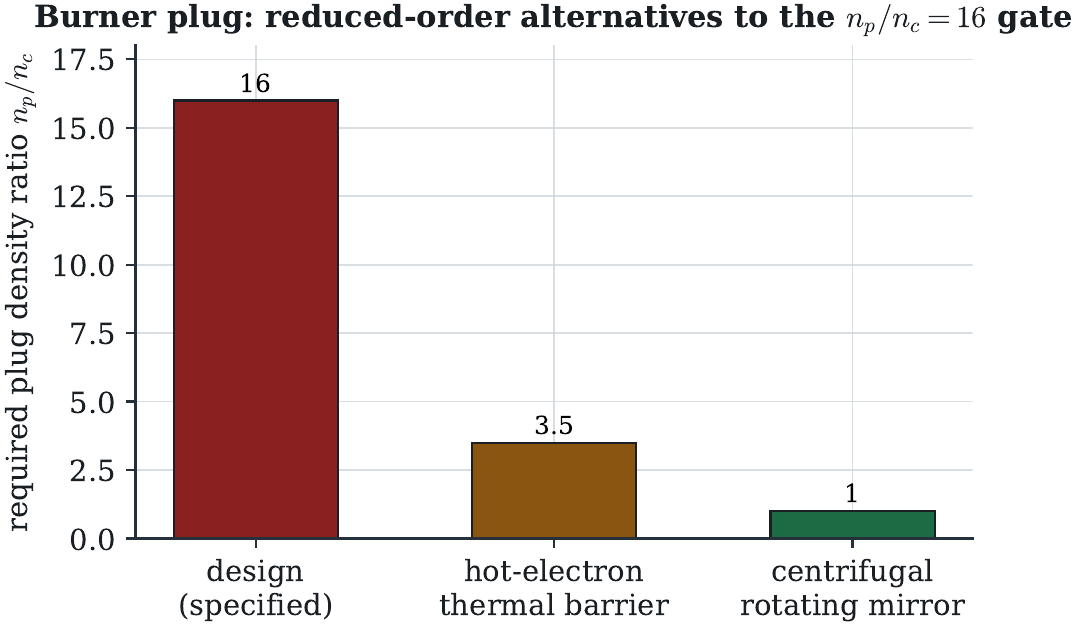
The most valuable thing a design team can do is red-team its own binding constraints before a reviewer does. For each honest negative in the platform, this paper brainstorms alternatives, bounds them, ranks them, and promotes only the promising ones — screening bounds, explicitly not banked results.
The current-drive burden falls 58% below fusion power inside unused pressure headroom; tritium closure is restored independent of the multiplier; and the burner plug-density gate is attacked by a thermal barrier and a centrifugal architecture. Directions, ranked — not claimed closed.

The confinement lever, at both scales
Negative triangularity is the breeder’s confinement lever, and the claim is established where it counts: nonlinear gyrokinetics at both the ion and electron scale, not a reduced-order scaling.
Negative triangularity cuts ion-scale transport by 40–45% and electron-scale ETG by 79–80% versus a positive-triangularity twin, leaving the operating point quiet and subcritical — corroborated against TCV and DIII-D.

Naming the worst case
A credible design names its worst case rather than assuming it away. On a verified equilibrium, the disruption picture is demanding: a fast current quench, a severe runaway-electron avalanche, and a substantial halo current.
The runaway avalanche is severe and the halo current reaches 35% of plasma current, so the conclusion is a hard requirement — shattered-pellet-class mitigation triggered inside the current-quench window — not a hope that the risk is small.

The charged products, tracked
In a mirror the fusion products are trapped and their fate is set by loss-cone dynamics. Tracking them is what tells the conversion train how much ash accumulates and how much axial power it must recover.
The confinement of the fast products sets both the ash the machine must exhaust and the directed axial power the direct-energy-conversion and alpha-channeling systems recover — the input to the whole power balance.

Strategic value is not fuel supply
Helium-3 links the two machines but does not close between them, and the paper is careful to say so. The breeder’s helium-3 is a co-product of the tritium inventory’s decay — strategically valuable, but not a bulk fuel source for a burner fleet.
The tritium half-life makes decay-sourced helium-3 far too slow to fuel a fleet (~192/105/45 breeders per burner), so burner-scale supply is lunar-gated around 2038–40. The breeder’s helium-3 is strategic co-product value, distinct from fuel and from revenue.

Stable, with the margins shown
A design point is only usable if it is stable, and the honest way to report stability is with the margin, not a binary pass. At the frozen point the equilibrium is ideal-MHD-stable, and the margins against the binding limits are quantified.
The equilibrium clears the kink and ballooning limits with quantified margin — reported as numbers to check, not a claim to trust.

The hardest power-handling problem, scoped
A compact machine concentrates its exhaust power on a small divertor area, which is where power-handling is sharpest. The portfolio ranks the options — conventional, advanced-magnetic, and liquid-metal — against that load rather than picking one by preference.
Each option is ranked on detachment and power handling against the compact machine’s concentrated load; the flowing-lithium vapor-box option, developed in a companion, couples heat exhaust to the fuel cycle.

Choosing the structure for its afterlife
What a fusion structure becomes after irradiation — its activation, decay heat, and waste class — is a design choice made at material selection. Reduced-activation steels are chosen to keep the retired structure in a low-level-waste class.
Reduced-activation steels target a low-level-waste classification and short-cooldown or hands-on maintenance where practical — material-selection targets carried openly, pending qualification.

A breeder is only as credible as its mass balance
A fusion breeder’s product is tritium, and the temptation, historically, has been to quote a single flattering breeding ratio and move on. We do the opposite. We develop the tritium fuel cycle as a confirmed ladder of design points, derive the burn rate from first principles, and separate what a single unit delivers from what a fleet delivers — because conflating the two is how prior breeder concepts overstated themselves.
A single advanced unit is a tritium exporter at the ~2.0 kg-T yr−1 scale. A national-scale 4 kg-T yr−1 supply is a fleet property — never a single-unit claim, because the spherical-tokamak centrepost caps the per-unit ceiling at net TBR 1.42.
The burn rate, and the surplus
Each 17.59 MeV deuterium–tritium fusion consumes one triton, so the per-unit burn rate follows directly from the fusion power: ΛT = 4.76 kg-T per full-power-year at 85.04 MW. The net surplus available for export is then S = (TBR − 1) ΛT. The breeding ratio, not the burn rate, is therefore the design lever — and it is a lever, not a constant. Derived from Pfus
The breeding ladder
Three-dimensional OpenMC neutronics on ENDF/B-VIII.0 place the ladder. The literal frozen recipe gives net TBR ~1.06 and a surplus of 0.29 kg-T yr−1; a dedicated 5 cm solid-beryllium multiplier raises it to ~1.19 and 0.9; and the advanced blanket — a void-reduced breeder with a solid-beryllium multiplier and a steel reflector — reaches net TBR 1.42 and about 2.0 kg-T yr−1 per unit.
This TBR 1.42 is the confirmed per-unit ceiling across twelve blanket configurations; a lithium–lead alternative was explored and does not beat it, and the result reproduces across an independent nuclear-data evaluation to under 0.3%. Cross-library reproduced

Per unit versus fleet
The distinction is load-bearing. A single advanced unit exports tritium at the ~2.0 kg-T yr−1 scale. A national-scale 4 kg-T yr−1 supply is reached by two advanced units, or four-to-five solid-beryllium units — and the co-produced helium-3 aggregates the same way, to 3.6-4.5 kg yr−1 across the fleet. We never claim 4 kg-T yr−1 from one unit.

The closed loop
The fuel cycle closes through direct internal recycling of unburned tritium from the exhaust, blanket tritium extraction, detritiation of process streams, and permeation control at the blanket–coolant boundary. Direct internal recycling minimizes the standing inventory — and the standing inventory, not the breeding ratio, is what the safety case turns on — by returning unburned fuel promptly rather than through a large buffered store.
Helium-3, bred by the decay of surplus tritium at equilibrium, is a co-product of that inventory rather than an independent channel. The standing-inventory value that sets the accident source term is computed in the fuel-cycle model and carried to the safety companion — flagged as the governing safety quantity, not asserted here. Computed downstream
One surface, two problems solved
A flowing liquid-metal surface solves the erosion and thermal-fatigue problems of a solid divertor by renewal, and a vapor box dissipates the incident power by radiation. The remaining question — which metal — is answered by tritium retention, because the divertor is also part of the fuel cycle.
Coupled permeation-retention modelling ranks lithium optimal by three to six orders of magnitude over lithium-tin, lead-lithium, and tin — so the surface that best dissipates the exhaust power also best minimizes the tritium it holds and leaks.

Detect the quench, not the voltage
REBCO magnets store enormous energy and quench slowly — exactly the wrong combination for voltage-based protection, which acts only after a small resistive voltage has built along a slowly spreading zone. The answer is to detect something that changes early.
A fused strain-rate-plus-magnetization detector fires at 0.089 s, 2.935 s ahead of the voltage threshold (SNR 322.5), cutting the current-time integral the winding must absorb. An in-winding nitrogen-vacancy magnetometer supplies the magnetization channel and tolerates the neutron environment at margin 39.

A credible safety case names the hazards
Fusion’s safety advantages are real, but they are too often asserted rather than bounded. A credible case names the hazards and bounds each one. Fusion’s inherent advantages — no fission-product inventory, no criticality, a small driven plasma — are genuine; but the tritium inventory and the activated structure are real hazards that must be quantified, not waved away.
A minimized mobilizable-tritium source term, no criticality or meltdown mechanism by construction, and a low-activation-waste target — with the governing quantity, the standing tritium inventory, computed, not asserted.
The dominant hazard: mobilizable tritium
The accident source term is set by the mobilizable tritium inventory. The design minimizes it through direct internal recycling of unburned fuel, which avoids a large buffered store, and through permeation control at the blanket–coolant boundary and detritiation of process streams. The standing-inventory value is computed in the fuel-cycle model and is the governing safety quantity; we carry it rather than assert a figure, and we flag it as the load-bearing input to the source term. Computed (fuel-cycle)
No meltdown, by construction
There is no fission-product decay-heat inventory and no chain reaction. The fusion plasma requires several simultaneous conditions — confinement, heating, fuelling, field — and the loss of any one quenches it on a short timescale. An unmitigated loss of control therefore terminates the reaction rather than escalating it; there is no physical mechanism for a runaway or a core melt. The decay heat that remains is from activated structure, not fuel, and is bounded by the material selection.
Waste, activation, and the safety basis
Structural activation is minimized by low-activation steel selection, targeting a low-level-waste classification of the retired structure and, where practical, short-cooldown or hands-on maintenance. The consumable centrepost cartridge is designed for scheduled handling within this waste class, and the burner’s 5.44% neutron fraction — an order of magnitude under deuterium–tritium — further reduces activation at the power plant.
This is a design-basis safety argument, not a licensed safety analysis report: the source term depends on the computed standing inventory carried from the fuel-cycle companion, and the waste classification is a material-selection target pending qualification. Regulatory treatment is developed in the licensing companion. What the case establishes is that every hazard is bounded, and the one that governs is computed. Design-basis
The path fits the hazard
A program that ignores its regulatory path can build a working machine it cannot deploy. The United States settled fusion’s path in a direction that suits a compact, low-source-term platform: byproduct material, not the reactor framework.
The byproduct-material framework is materials-oriented, Agreement-State-administrable, and graded — the correct lens for a machine whose only significant source term is a bounded tritium inventory, with no criticality mechanism. The strategy is early pre-application engagement.
No transformer, no hidden power
Steady-state operation means no ohmic transformer to renew the plasma current, so the current must be sustained by bootstrap and external drive. The external share costs recirculating power, and an honest design states it rather than assuming a high bootstrap fraction.
Of the 9.66 MA total, the bootstrap current self-generates ~15.5% and external drive supplies 8.16 MA, whose wall-plug power is a named line in the recirculating budget — booked openly, not hidden. The bootstrap fraction is a lever, stated modestly.

A defining constraint, not a detail
The central solenoid a conventional tokamak uses to induce its current does not fit in a spherical tokamak’s slender centrepost. Startup is therefore a defining problem: the current must be born and grown without a transformer.
Outboard induction, electron-cyclotron heating, and a helicity or beam seed grow the current to the flat-top, where the non-inductive and bootstrap currents sustain it. The ramp auxiliary power and the profile-control hand-off are flagged as carried engineering risks, not a solved sequence.
The neutron a breeder already makes
The 14 MeV neutron a breeder makes to breed tritium is a resource with more than one use. The same source can qualify materials in a true fusion spectrum and breed medical isotopes in target stations — co-products of the neutron economy.
A fusion-spectrum materials-qualification volume about 59× the reference dedicated facility — a capability the field has lacked — and a fission-free route to shortage-prone isotopes like molybdenum-99. Booked as strategic-material capability, not revenue.

A platform, not a machine
Kronos is usually described one machine at a time — the breeder, or the burner — and that framing undersells what has actually been built. Kronos is a platform: a compact negative-triangularity spherical-tokamak breeder that makes strategic materials, and a deuterium–helium-3 burner that makes power, sharing a magnet basis, a control architecture, and a single frozen physics record. The two machines are not a portfolio bet placed twice; they are one architecture that produces the materials a fusion economy needs and the power it will run on.
All three products — breeder, and burner in two housings — close on the frozen physics; every component is buildable within demonstrated practice; and the distance to demonstrated closure is three named experiments, not open physics.

The breeder — a strategic-materials platform
The compact spherical tokamak reaches Q = 3.0763 at 85.04 MW of fusion power and supplies four products: tritium along a confirmed breeding ladder to about 2.0 kg-T yr−1 per unit (net TBR ceiling 1.42); helium-3 at about 0.9 kg yr−1 per unit; 14 MeV neutrons for materials qualification; and co-produced medical and industrial isotopes.
Negative triangularity (δ = -0.3) suppresses turbulence into a quiet subcritical core; the equilibrium is ideal-MHD-stable; and the inboard centrepost is a consumable, scheduled-replacement cartridge rather than a lifetime component. Net electricity is a category error for the breeder and is excluded — the breeder’s success is measured in gain, breeding ratio, and the materials it makes, not in megawatts to the grid. Frozen anchor
The burner — power in two housings
The deuterium–helium-3 tandem-mirror burner reaches QE = 1.318 at a neutron fraction of only 5.44% — an order of magnitude below deuterium–tritium, low-neutron but never aneutronic. It is deployed in two housings, Aegis (fixed defence installations) and MetroVolt (data-centre generation), that share the mirror physics and the direct-energy-conversion train.
Its one residual physics gate is the plug potential — an end-plug density ratio of 16 — and the high-field plug coil qualifies structurally, so the magnet is not the gate. The honest open item is a plug-scale potential experiment, named and scoped, not a hoped-for breakthrough. Requirement-class
The strategic helium-3 loop
Helium-3 links the two machines but does not close between them. The 12.3-year tritium half-life makes the breeder’s decay-sourced helium-3 far too slow to fuel a burner fleet — of order ~192/105/45 breeders per burner — so burner-scale helium-3 is honestly lunar-gated, around 2038–40. The breeder’s helium-3 is a strategic co-product with national-security, cryogenic, and quantum value: distinct from bulk fuel supply, and distinct from revenue.
The programme timeline
The build canon is founder-locked. Construction begins Q2 2027; first-of-a-kind tritium follows in 2030–31; the ~100 MW test burner in 2032; and lunar helium-3 gates the burner fleet around 2038–40.

Closure, in two tiers
We state closure in two tiers throughout and never say “closed” unqualified: closed-on-model (what the frozen physics delivers) versus closed-demonstrated (the named experiment that retires each residual gate).
The defensible headline is not that Kronos has finished, but that it knows exactly what remains: each product closes on the frozen physics, every component is buildable within demonstrated practice, and what stands between on-model and demonstrated is three named experiments. That is the honest statement of where the platform stands.
Fuel choice is the decision
Every fusion company implicitly picks a fuel, and the pick determines everything downstream: the neutron load, the tritium logistics, the required temperature, the conversion strategy. The choice is too often made emotionally — toward the aneutronic ideal — rather than on the physics. We grade all four candidate fuels on the same ruler and let the Kronos architecture fall out of the grades.
No fuel wins on every axis. Kronos runs deuterium–tritium where the product is the neutron and the bred material (the breeder) and deuterium–helium-3 where the product is power and neutrons are the liability (the burner, only 5.44% neutronic) — with helium-3 honestly lunar-gated. Proton–boron is not chosen.
The scorecard
The single most decisive axis is the neutron fraction of the fusion power — it sets the shielding, the activation, and whether the machine can sit near people and hardware. Deuterium–tritium is ~80% neutronic; deuterium–deuterium ~66%; deuterium–helium-3 only 5.44%, and even those neutrons come from an unavoidable D–D side reaction; proton–boron is effectively aneutronic at under 1%.

The Kronos reading of the scorecard
The architecture follows the grades rather than the ideal. Where the product is the neutron and the bred material — tritium, helium-3, isotopes, materials qualification — deuterium–tritium is correct, because its high neutron output is the whole point; this is the breeder. Where the product is power and neutrons are a liability to shield and a source of activation, deuterium–helium-3 is correct, because 5.44% is the lowest neutron burden among fuels with accessible reactivity; this is the burner.
Proton–boron is not chosen: its temperature, its radiation, and the absence of any demonstrated gain outweigh its aneutronic appeal today. And the one honest cost of the deuterium–helium-3 choice — fuel availability — is met by the breeder’s co-product helium-3 and, at fleet scale, lunar supply gated around 2038–40. The scorecard, not the aneutronic ideal, drew the architecture. Design rationale
The curse of dimensionality, sidestepped
A kinetic distribution on six-dimensional phase space is hopeless on a dense grid. Learned surrogates trade fidelity for speed and quantum solvers are a fault-tolerant-horizon prospect. We take a third route: exploit the low-rank structure the distribution actually has.
On the BGK test the relative-L² error falls exponentially with rank — to 2×10−⁴ at rank 8 — while storage grows only linearly to ~0.19× the dense grid. A handful of singular modes capture the distribution to engineering accuracy.

A solver, not a storage trick
Because the streaming and collision operators act directly on the compressed representation, the low rank reduces the cost of advancing the solution, not merely of holding it — the difference between a solver and post-hoc compression. It runs on classical hardware available now; the compressibility of the full nonlinear gyrokinetic distribution is the honest open question. Classical, today
Getting the dominant loss right
The case against advanced fuels has always centred on radiation. Whether the burner closes depends on computing the synchrotron loss correctly — not on an order-of-magnitude estimate that can be off by 37×.
Against a 2546 MW radiated scale, synchrotron loss ranges from 919 MW (Trubnikov) to 1803 MW (reabsorbed transport) to 66,677 MW optically-thin. The last is unphysical — the plasma is optically thick at the harmonics that carry the power. A design adopting any single estimate without the transport calculation is off by up to 37× in its dominant channel.

Optical depth, and why size helps
The plasma is optically thick to harmonic n*≈10.4; above it the emission escapes. Because that cutoff grows as the one-third power of minor radius, the synchrotron loss fraction falls as the machine grows — the analytic origin of the burner's size-scaling. Synchrotron loss rises steeply with electron temperature while fusion power saturates, so there is a maximum-QE temperature, and the transport calculation locates it. First-principles
The survival question, answered directly
The first wall sees the full 14 MeV flux and the plasma edge, and it is a consumable. The question is how long it lasts before displacement damage, gas swelling, erosion, or hydrogen uptake forces replacement. We compute all four and identify the binding one.
Displacement damage accumulates at ~9.78 dpa/fpy behind the armor, reaching replacement-class damage within a few full-power-years — the governing limit. Gas swelling, erosion, and permeation are quantified and subdominant.

The other three channels, bounded
Helium/hydrogen bubbles (kinetic Monte Carlo on DFT binding energies) accumulate but do not reach life-limiting swelling; sputtering/erosion (binary-collision transport) is manageable within the displacement-limited interval; and hydrogenic permeation (finite-element transport) sets the tritium-inventory boundary condition the fuel-cycle and safety papers carry. The wall is a scheduled-replacement component on a defined damage budget. Independent codes
A point needs a tolerance
The breeding ratio is the number the whole breeder case rests on, and its credibility depends on the light-element cross-sections behind it. A responsible design states not just the TBR but its nuclear-data tolerance, and identifies which channels drive it.
The breeding-carrying light channels diverge 55–66% between evaluated and model data at 14 MeV — an order of magnitude more than the ~15% spread of the heavy structural channels. Because the TBR is near-linear in the light rates, those channels are the error bar; the voluminous structural data contributes little.

The requirement
The consequence is a data requirement, not a caveat: the light breeding channels must be taken from evaluated covariances and, where the field's evaluations disagree, targeted by measurement. Reporting a TBR without propagating these covariances understates the tolerance on the most load-bearing number in the design. Data requirement
The tape you want changes
A fusion magnet's conductor is chosen for field and stress, but it must survive years of fast-neutron fluence at cryogenic temperature — and the irradiation environment selects a different tape than a room-temperature optimization would.
Artificial-pinning-centre tapes raise the in-field critical current but reach their irradiation-damage knee sooner. For fusion fluence the plain un-doped tape retains a longer service life, because neutron irradiation supplies its own pinning — an inversion of the usual selection, with a Jc-onset-knee surrogate to screen candidates.

Stabilizer and self-protection
A graphene-reinforced ultra-pure aluminum stabilizer retains ~2×10⁴ S/cm at cryogenic temperature in 30–35 T, a lighter, lower-loss bypass than copper; and a vanadium-sesquioxide (V₂O₃) interlayer gives passive quench protection — insulating in normal operation, conducting to shunt current turn-to-turn once a turn heats. A conductor architecture for a neutron environment, distinct from the magnet's field/stress design. Materials architecture
Breaking the coupling
A tandem mirror plugs its central cell with a potential, and the hotter the central-cell electrons, the more potential (and power) the plug must supply. The thermal barrier breaks this coupling — letting the plug hold a large ion-confining potential while keeping the central-cell electrons cool.
Booking the barrier, the confining-potential requirement falls from 248.75 to 167.9 keV — a 33% cut in the binding gate. Heating the barrier hot electrons rather than the whole central cell removes ~1093 MW of ECH, and in the aggressive limit lifts QE from ~1.3 toward 3–5.

One named experiment
The barrier is the burner's cornerstone claim, and its distance to demonstrated closure is a single WHAM-scale thermal-barrier experiment that establishes the sustained depression and the decoupling at accessible field and density — a plasma-physics experiment, not a materials or magnet gate. Cornerstone claim
Not an AC machine in disguise
Most fusion power-plant studies assume an AC turbine hall. A direct-energy-conversion machine does not have one: its converters produce DC at high voltage. When the load is a data center — itself a DC bus — the interface is shorter and different.
About 54% of gross output is delivered as DC at 50–250 kV, with no synchronous generator and no grid-frequency stage. Reaching an 800 V rack bus takes 2–3 stages, against 4–5 for a conventional AC plant that must synchronize then rectify.

Follow the load with electronics, not plasma
A direct converter modulates at ms scale. Following the load by throttling the plasma is far more costly: the gross-to-net amplifier is 4.14, so a 10% plasma dip cuts net export ~41%. Load-following is done on the electronic path with dump and storage, holding the plasma at its efficient point. Economics, siting, and service-level content are internal and excluded. Power electronics
Buildability is de-risking too
A breeder fleet needs enriched lithium, nuclear-grade beryllium, and long REBCO tape in quantities and on timelines that must be checked. We rank the bottlenecks and report the relaxations that move them, keeping cost out of scope.
The longest-lead item is 90%-enriched lithium-6 — but the neutronics meet the breeding target at 30–60 at%, because the compact geometry and multiplier recover the breeding the lower enrichment would cost. Relaxing the spec moves the single hardest item off the critical path, with no physics penalty.

A cartridge line, not a bespoke build
Because the centrepost is a consumable, it is manufactured as a cartridge on a ~10–15 unit/yr line rather than fabricated as a bespoke lifetime component — converting a single-point manufacturing risk into a production-rate specification ordinary industry can meet. All cost content stays internal. Buildability
A live estimate, not a fixed interval
A consumable component is only manageable if you can predict its end of life before it arrives. A dual-channel estimator fuses a physics-based fluence trajectory with a damage-correlated in-situ observable, giving a live remaining-useful-life with a confidence interval that drives the maintenance cadence — rather than a static worst-case number.
A data-driven estimator is trustworthy only inside its trained regime; extrapolated past its support it can be confidently wrong. The framework monitors whether signals stay in-distribution and, when they do not, defaults to the conservative physics bound — the difference between a decision aid and a hazard.
Authority as a function of evidence
Automated control on a regulated machine raises a governance question usually answered by fiat: how much authority should the automation have? We answer it by tying authority to evidence. A subsystem whose models are validated has earned more autonomy than one whose models are still reduced-order.
The maximum authority — magnitude, rate, irreversibility — a controller may exercise on a subsystem is a monotone function of that subsystem's maturity score. High-maturity subsystems admit wide, fast authority; low-maturity ones are clamped to a narrow, reversible band, the balance deferred to a human or a physics-bounded safe controller.
An auditable rule for licensing
The principle gives a regulator an auditable governance rule rather than a promise: authority is derived from documented model maturity and expands only as that maturity is demonstrated — a property a licensing review can inspect. Governance
An intractable search, funneled
A refractory high-entropy alloy space has more candidates than any team can evaluate by density-functional theory directly, and for fusion each must pass a stability and a neutron-activation test. Searching it requires a method fast enough to screen thousands and strict enough to enforce activation.
A universal ML potential ranks thousands of compositions by formation energy at a fraction of DFT cost; DFT confirms the survivors at full accuracy; and an activation-transport down-select rejects any whose waste class or decay heat is unacceptable, regardless of mechanical merit — a qualified handful from an intractable start.
Why activation goes early
The novelty is not the ML potential alone — it is placing neutron activation as a co-equal filter with stability, early. A refractory alloy that is excellent but activates into a high-level-waste class is useless to a plant, and screening it out only at the end wastes the search. The alloy results are the materials companion; this is the method. Materials informatics
No free lunch in the operating plane
Where a breeder operates is decided by the constraints that box it in, not a single figure of merit. Across the whole operating plane, source strength and wall loading trade one-for-one against centrepost life — a fixed ratio, no corner where more neutron output comes free of centrepost cost.
The admissible current is a coupled floor/ceiling problem: the floor is the q95/MHD edge, the ceiling the centrepost fluence, and the tritium-startup requirement — often assumed binding — sits inside with ~1.7× margin. So the true floor is the MHD edge, not fuel startup; the design current 9.66 MA sits inside.

The actionable output
The synthesis identifies which constraints bind: the centrepost-fluence ceiling and the MHD-edge floor do; the tritium-startup floor does not. A designer moving the operating point trades centrepost life against edge stability, with fuel startup a non-issue in this window — a clearer picture than treating all constraints as co-equal. Systems synthesis
The patent portfolio
The estate spans a granted high-field magnet patent, pending utility and 2026 provisional filings that map to the two products, a digital-twin control provisional, a registered trademark application, and the original 2022 provisional family. Every patentable disclosure in the five-paper arXiv drop was protected before publication: the breeder and burner provisionals were filed 1–2 August, and a publication-gap omnibus filing the evening before the drop swept up the DEC, plasma-control, and REBCO-winding matter of the three otherwise-unprotected papers. Patent numbers and application serials are matters of public record; claim scope is summarised, not reproduced.
Granted & pending utility
2026 provisional filings — mapped to the products
Trademark & origin
The narrow, defensible magnet novelty — the specific conductor and the digital-twin winding optimisation, not high-field REBCO as a category — is the commercial core that can earn ahead of any Q > 1 milestone, with markets in fusion magnet supply, MRI/NMR, accelerators, and proton therapy. The claim is scoped honestly: the high field is a system field result, not a stand-alone-coil record; the small-bore plug coil is structurally infeasible as a bare winding but resolved by a stress-managed structural shield (feasible-pending-FEA); and the winding-tape experiment returned a null result. The value is the method, not a field record.
Founding partners, board, advisors & auditors
Kronos is built by a bench of advanced-fuel-fusion, high-field-magnet, direct-conversion, and materials specialists, with a board and operations team drawn from defense, national laboratories, and industry. Dates are shown as ranges; where a tenure has ended or is term-ending, the range says so.
Founding Partners — Science
Board
Scientific Advisors
Scientific Auditors
Operations
Legal counsel is retained; those roles are held on the internal roster and are not listed here.
List of Figures
Sources
[1] H.-S. Bosch and G. M. Hale, “Improved formulas for fusion cross-sections and thermal reactivities,” Nuclear Fusion 32, 611 (1992).
[2] A. S. Richardson, NRL Plasma Formulary, Naval Research Laboratory (2019).
[3] I. E. Ochs, E. J. Kolmes, and N. J. Fisch, “Bremsstrahlung and the electron–electron contribution in fusion plasmas,” Physics of Plasmas (2024).
[4] T. H. Rider, “Fundamental limitations on plasma fusion systems not in thermodynamic equilibrium,” Physics of Plasmas 4, 1039 (1997).
[5] ITER Physics Expert Groups, “ITER Physics Basis,” Nuclear Fusion 39, 2137 (1999).
[6] N. A. Uckan and J. Sheffield, “Tokamak scaling and confinement,” in Tokamak Concept Improvement, IAEA (1989).
[7] O. Sauter, C. Angioni, and Y. R. Lin-Liu, “Neoclassical conductivity and bootstrap current,” Physics of Plasmas 6, 2834 (1999).
[8] F. Troyon et al., “MHD limits to plasma confinement,” Plasma Physics and Controlled Fusion 26, 209 (1984).
[9] J. P. Freidberg, Plasma Physics and Fusion Energy, Cambridge University Press (2007).
[10] R. F. Post, “The magnetic mirror approach to fusion,” Nuclear Fusion 27, 1579 (1987).
[11] D. E. Baldwin, “End-loss processes from mirror machines,” Reviews of Modern Physics 49, 317 (1977).
[12] T. K. Fowler, R. W. Moir, and T. C. Simonen, “A new simpler tandem mirror,” Nuclear Fusion 57, 056014 (2017).
[13] G. L. Kulcinski and J. F. Santarius, “Advanced fuels and the D–3He cycle,” University of Wisconsin Fusion Technology Institute.
[14] W. L. Barr and R. W. Moir, “Test results on direct energy converters for mirror reactors,” Nuclear Technology/Fusion 3, 98 (1983).
[15] D. B. Go et al., “Thermionic energy conversion in the twenty-first century,” Frontiers in Mechanical Engineering 3, 13 (2017).
[16] M. Wang et al., “The AME 2020 atomic mass evaluation,” Chinese Physics C 45, 030003 (2021).
[17] J. E. Menard et al., “Fusion nuclear science facilities and pilot plants based on the spherical tokamak,” Nuclear Fusion 56, 106023 (2016).
[18] A. J. Creely et al., “Overview of the SPARC tokamak,” Journal of Plasma Physics 86, 865860502 (2020).
[19] T. P. Wright, “Factors affecting the cost of airplanes,” Journal of the Aeronautical Sciences 3, 122 (1936).
[20] U.S. Department of Energy / NNSA, Stockpile Stewardship and Management Plan, FY2024.
[21] J. F. Santarius, G. L. Kulcinski, and L. A. El-Guebaly, “A strategy for D–3He fusion energy development,” Journal of Fusion Energy 17, 33 (1998).
[22] M. A. Abdou et al., APEX advanced blanket concepts, Fusion Engineering and Design (1999–2003).
[23] Federal Register, notice on supply of tritium to non-federal entities (1999).
[24] Kronos Fusion Energy, “Simulation register and reproducibility deposit,” Zenodo (2026).
[25] A. O. Thome et al., “ELM-free negative-triangularity edge on DIII-D,” Plasma Physics and Controlled Fusion (2024), doi:10.1088/1361-6587/ad6f40.
[26] T. Eich et al., “Scaling of the tokamak near scrape-off layer power width,” Nuclear Fusion 53, 093031 (2013).
[27] J. Lim et al., “Scrape-off-layer width in negative-triangularity plasmas,” Nuclear Fusion / Plasma Physics and Controlled Fusion (2023).
[28] A. O. Nelson et al., “Prohibition of second-stability access at negative triangularity,” Plasma Physics and Controlled Fusion 64, 124002 (2022).
How this document was made
The Kronos Fleet — Combined Editorial, 2026 is set in Fraunces (display), Gelasio (text), and IBM Plex Mono (data & equations), carried forward from the Kronos editorial design system.
The figures are rendered at 300 dpi from the deposited generator scripts; the document is composed as a single self-contained file with embedded fonts and imagery, paginated to US Letter, and rendered to PDF through a headless Chromium engine in matched light and dark editions.
Every headline quantity carries an evidence class; withdrawn and restated values are marked as such. Nothing herein is frozen beyond the founder-approved Tier-A set.
Explore it live — turn the interactive 3-D model, run the deposited solvers in the physics validator, and watch the companion film series.
Notice, status, and distribution
Conceptual design & simulation study. This document reports a conceptual design and simulation study. It is not a construction commitment, a safety-analysis report, a regulatory filing, or an offer of securities. Forward-looking statements — schedules, costs, market sizes, and performance — are estimates subject to the limitations set out in the Simulations part and may change.
Numbers and their classes. Quantities are reported with evidence classes and case labels; modelled, assumed, and requirement-class values are identified as such and are not to be quoted without their labels.
Public edition. This edition carries the physics and design only; all financial, funding, and defense-commercial content has been removed for public distribution. The scientific text corresponds to the arXiv and journal submissions.
© 2026 Kronos Fusion Energy. All rights reserved. Hyperion, Aegis, and MetroVolt are product designations of Kronos Fusion Energy.