Learn › Comparisons & deep-dives
Deep dive · Honesty
The open questions.
A design is only as credible as the problems it admits. Here are the ones Kronos has not solved — stated as requirements and gates, with the evidence class for each.
- Breeder
- Confinement H₉₈ ≈ 2.28 · exhaust gate · triangularity sign
- Burner
- Plug-density requirement · direct-conversion efficiency
- Fuel
- Commercial helium-3 supply (lunar, ~2036)
- Economics
- Absolute margins; the capital anchor value
Breeder — HYPERION.
- Confinement. The design needs a confinement multiplier of about H₉₈ = 2.28 on a profile basis — demanding, and not yet confirmed by nonlinear gyrokinetics. This is the breeder's load-bearing open item.
- Exhaust. The divertor exhaust gate is a requirement (≈90% radiated fraction), quoted from an extrapolation outside the fitted range — a requirement, not a verdict.
- Triangularity sign. The deposit carries δ = −0.30, but the sign decision is formally open; the −21% current benefit sometimes claimed for negative triangularity is prohibited as out-of-domain.
- Availability. Steady-state but damage-life-limited (capacity factor ~0.58–0.83).
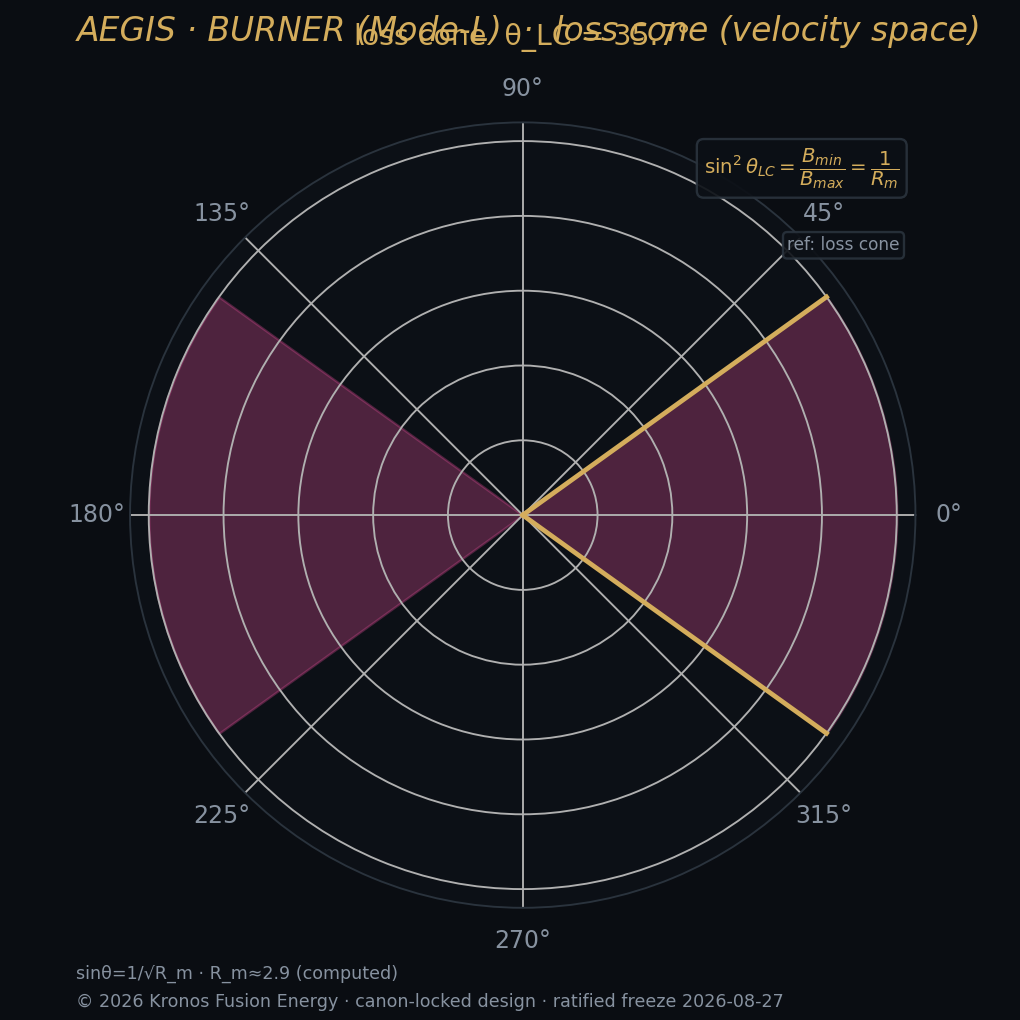
Burner — Aegis / MetroVolt.
- Plug density. The largest open item: the closing point needs an end-plug density ~16× the central cell (~347× GDT).
- Direct conversion. Real DEC efficiency depends on collector design and the electron power channel — named limits, not solved constants.
- Helium-3 supply. A commercial fleet is gated on an external (lunar) helium-3 supply that does not yet exist.
None of these require new physics. All are quantified, and all are falsifiable — which is the point of publishing them.
Why lead with the gapsNaming an open problem turns it into a research target; hiding it turns it into a future scandal. Kronos chooses the first.