Deep Dive: Neutronics & Activation
How a low-neutron design transforms the shielding, material lifetime, and waste picture — with a high-fidelity OpenMC calculation planned to fix the numbers.
- Neutron fraction
- 5.44% (frozen design point; ~7.70% operating baseline)
- Wall damage
- ≤ ~22 dpa over 30 FPY, bounding (≤ ~36 dpa qualification)
- Shield
- Compact center-stack shield; explicit fluence budget
- High-fidelity
- OpenMC (S63, planned)
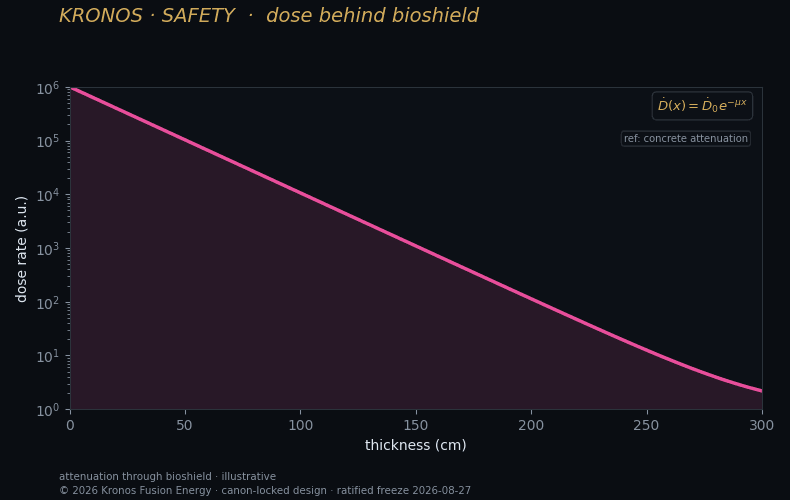
Neutronics — how a reactor's neutrons deposit energy, damage materials, and activate structures — sets the shield thickness, the component lifetimes, and the waste profile. For Kronos it is unusually gentle, because being low-neutron changes every one of those quantities.
The neutron fraction is 5.44% at the frozen burner design point (~7.70% at the operating baseline) — more than an order of magnitude below D–T's 79.7%. At that fraction the first-wall neutron loading stays low (bounded at ≤ ~0.089 MW/m² by the historical fuel-schedule envelope), the first wall accumulates a bounding ~22 dpa over 30 full-power-years — within its ~36-dpa qualification, so it lasts the plant life — and activation and waste are far lower than a D–T machine. It also lets the compact center-stack shield fit in the tight inboard space.
The design carries an explicit neutron-fluence budget for the shielded center stack, and a high-fidelity OpenMC neutronics calculation (S63) is planned to fix the true shield performance and lifetimes — currently based on the reduced-order fluence ledger.