Deep Dive: Lawson & the Triple Product
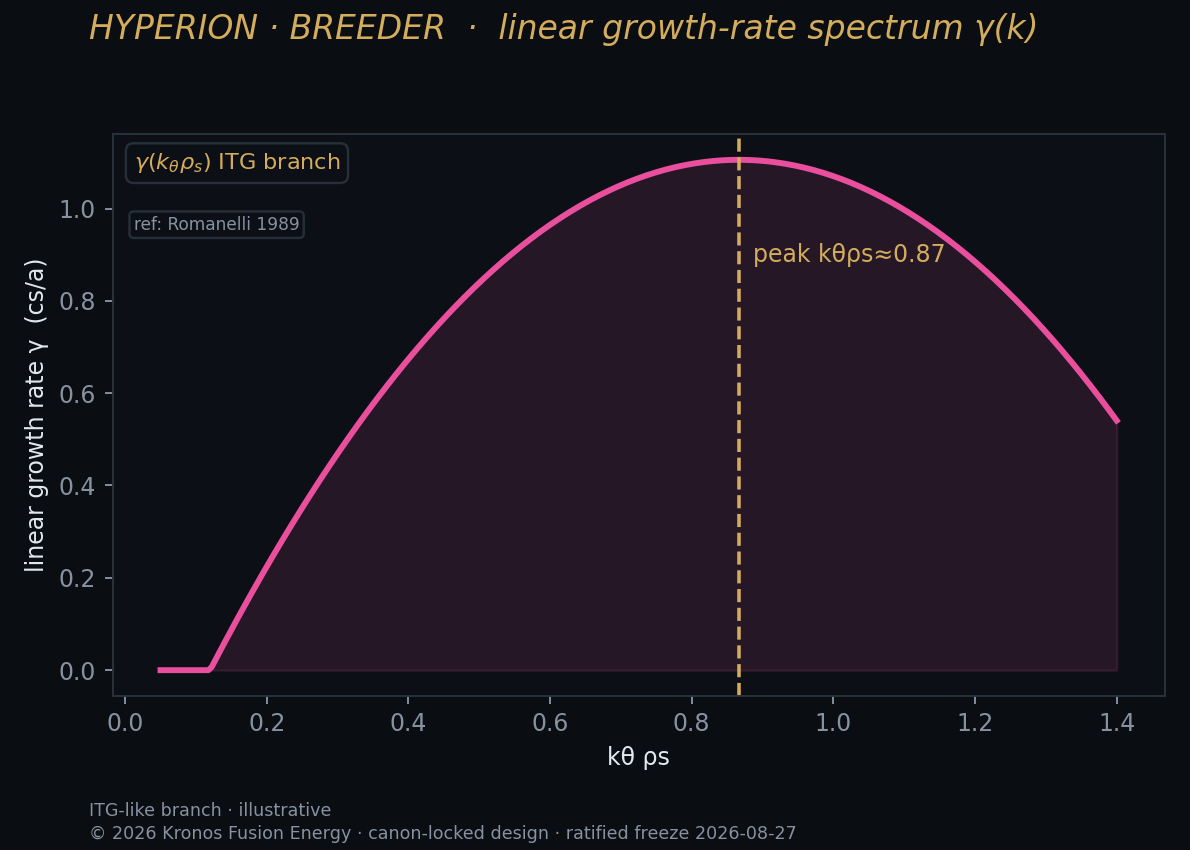
The condition for net fusion — density × temperature × confinement time — done honestly with radiation losses, yielding the H98 = 2.28 requirement and a driven, not igniting, operating point.
- Triple product
- n · T · τ_E
- With losses
- Bremsstrahlung 718 MW, synchrotron 158 MW
- Requirement
- H98 = 2.28 (profile basis, Mode D)
- Operating point
- Driven, not ignited
The Lawson criterion — expressed as the triple product of density, temperature, and confinement time — is the bar a plasma must clear for net fusion. Kronos evaluates it with radiation losses included, because a high-field, high-density plasma radiates strongly.
Folding in bremsstrahlung (718 MW, corrected relativistic basis) and synchrotron (158 MW at R_wall = 0.90), the confinement multiplier the chain requires is H98 = 2.28 at the Mode-D baseline — the largest bet in the design. The plant reaches its target triple product through high density (n̄_e = 2.2 × 10²⁰ m⁻³), high near-thermal temperature (Ti = Te = 48 keV), and the confinement negative triangularity is meant to deliver.
Crucially, Kronos is honest that the resulting operating point is driven, not igniting — strongly net-positive (Q_eng = 3.9 on the exhaust-honest Mode-D ledger), but sustained by continuous heating. Doing the Lawson analysis with losses, and stating the driven result plainly, is part of the design's honesty. See the confinement case.