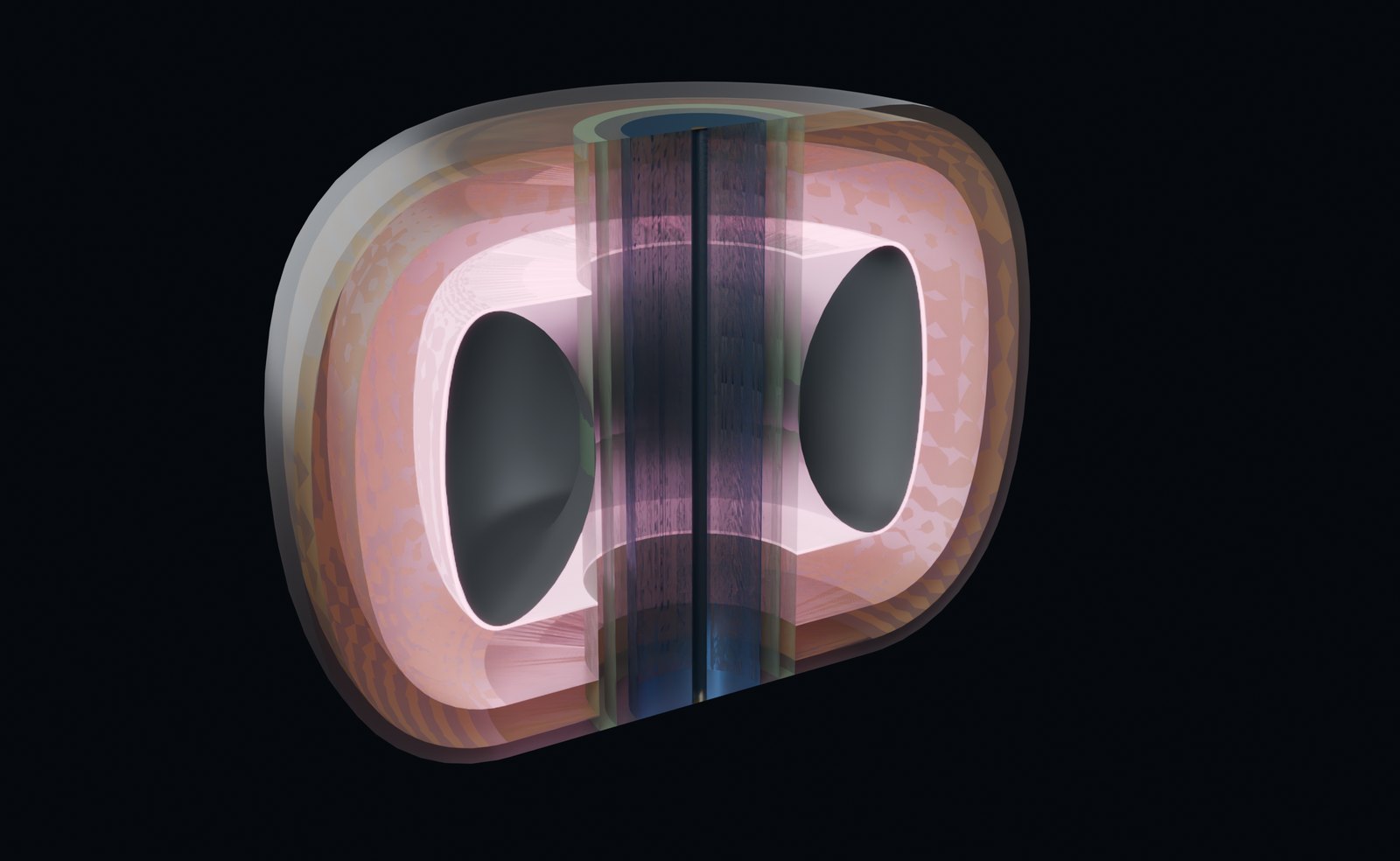
Plasma-Exhaust MHD Generator
An MHD generator extracts electricity from flowing conducting plasma exhaust with no moving parts — one mode of the Kronos multi-modal converter.
- What
- Generates power from moving conducting fluid
- Principle
- A conductor moving through a field induces voltage
- Moving parts
- None
- Analysis
- S17 (plasma-exhaust MHD)
A magnetohydrodynamic (MHD) generator produces electricity directly from a conducting fluid in motion: as ionized plasma exhaust flows through a magnetic field, the field deflects positive and negative charges to opposite electrodes, driving a current — the same principle as a dynamo, but with a plasma jet instead of a spinning coil, and no moving parts.
Kronos MetroVolt uses a plasma-exhaust MHD generator (deposited analysis S17) as one stage of its multi-modal conversion train, capturing energy from the flowing exhaust before other stages recover what remains. Having several complementary conversion modes — MHD, CPDC, thermionic, and photonic — is what lets the design quote a blended, gate-adjudicated efficiency rather than betting everything on one method.