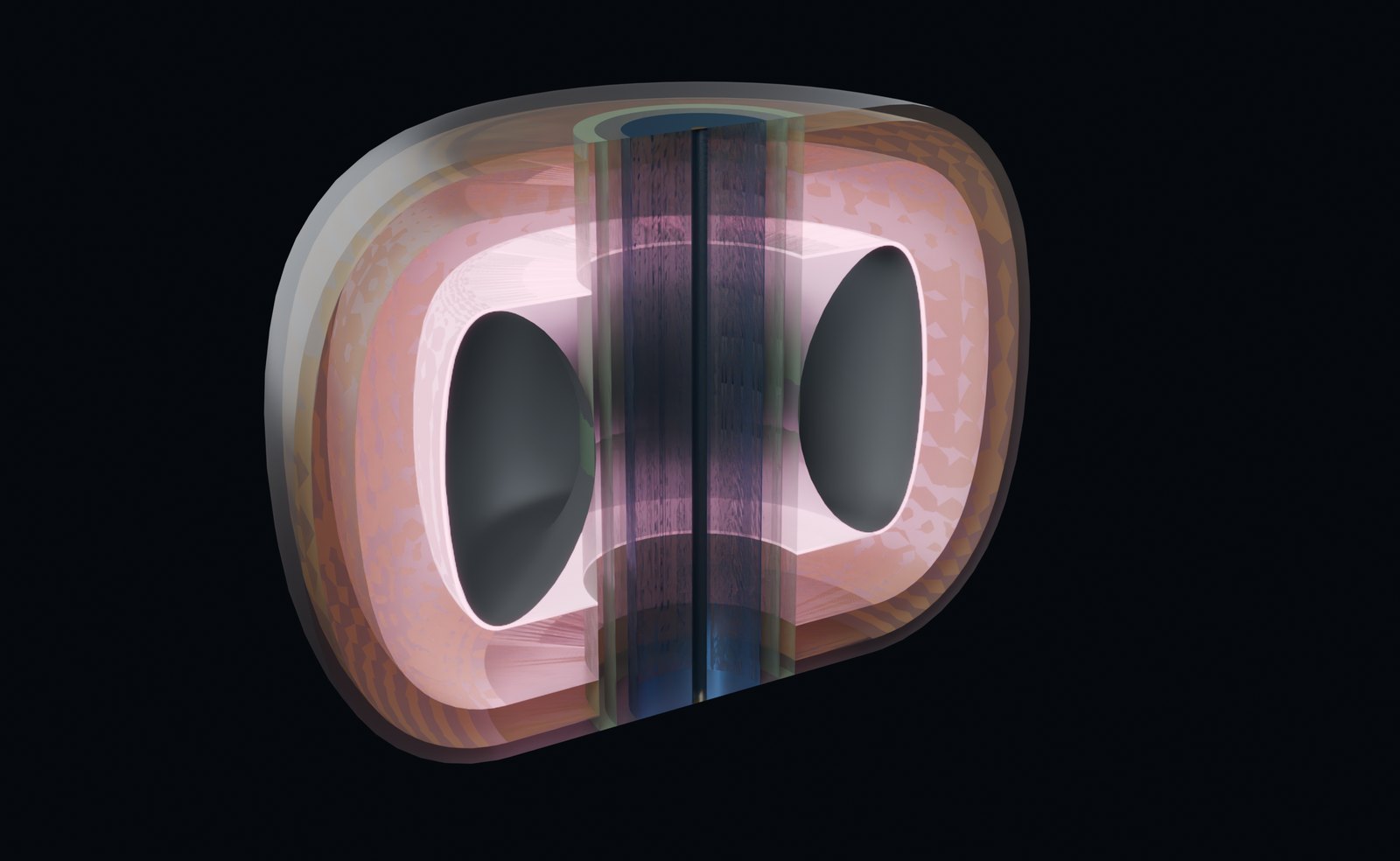
Fusion cannot melt down or run away, and a low-neutron design minimizes activation and long-lived waste. Here is the honest safety picture for the Kronos design.
Fusion's safety case is structurally different from fission's. There is no chain reaction and no
critical mass — the plasma contains only seconds of fuel at any instant, and any interruption to confinement,
heating, or fuel supply extinguishes it. A fusion plant cannot melt down or run away.
The remaining question is materials. Fusion neutrons activate structural components, creating some
short-to-medium-lived radioactive material — but nothing like the long-lived spent fuel of fission. Because the
Kronos design is low-neutron (a neutron fraction of 7.70% at the Mode-D operating point (≈5.44% at the frozen design point), roughly an order of magnitude below deuterium–tritium), the
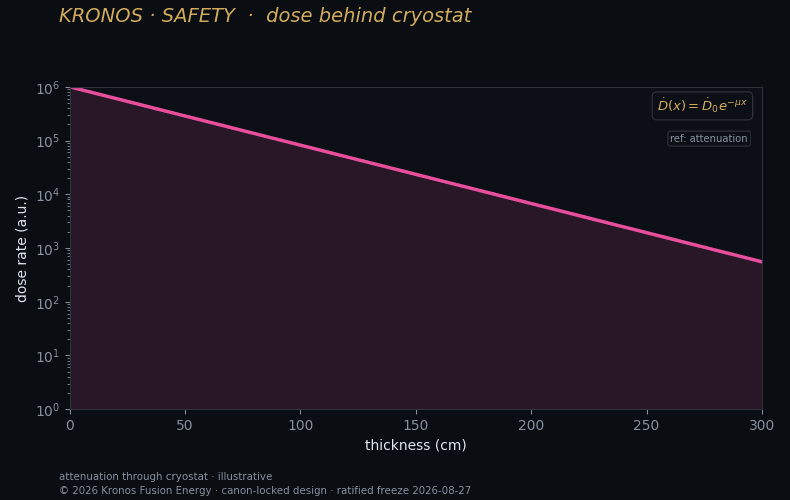
activation and shielding burden is dramatically reduced. The design still carries an explicit neutron-fluence
budget for the shielded center stack, and manages tritium within the staged fuel cycle — the company states these
as engineering hazards to control, not as accident risks to fear.
Questions & answers
Can a fusion plant melt down like a fission reactor?
No. Fusion has no chain reaction to run away. The plasma holds only seconds of fuel at any moment; lose confinement, heating, or fuel supply and the reaction simply stops. There is no decay-heat meltdown pathway of the kind that drives fission-reactor safety design.
Does fusion make radioactive waste?
Far less than fission, and nothing comparable to long-lived spent fuel. The main issue is neutron activation of structural materials. Because Kronos is low-neutron (neutron fraction 7.70% at the operating baseline (≈5.44% at the frozen design point), roughly an order of magnitude below D–T), activation and shielding burdens are much smaller than in a D–T plant.
What are the real hazards to manage?
Honest answer: tritium handling within the staged fuel cycle, magnet stored energy, and residual neutron activation of the center-stack structure. These are engineering-controlled hazards, not accident-scale ones, and the design carries an explicit neutron fluence budget for the shielded center stack.