Learn › Questions people ask
FAQ · MetroVolt
How does MetroVolt connect to the grid?
Like any large baseload plant — through high-voltage transmission — but with two differences: its output comes partly from direct energy conversion, and it is firm, running continuously rather than intermittently.
- Output
- ≈ +2832 MWe firm baseload
- Conversion
- Direct energy conversion + thermal cycle
- Role
- Firm, dispatchable power
- Siting
- Near large continuous loads
MetroVolt is a large baseload generator, so at the plant boundary it connects to the grid the way any multi-gigawatt plant does — through step-up transformers and high-voltage transmission. Two things make it different from a conventional thermal plant.
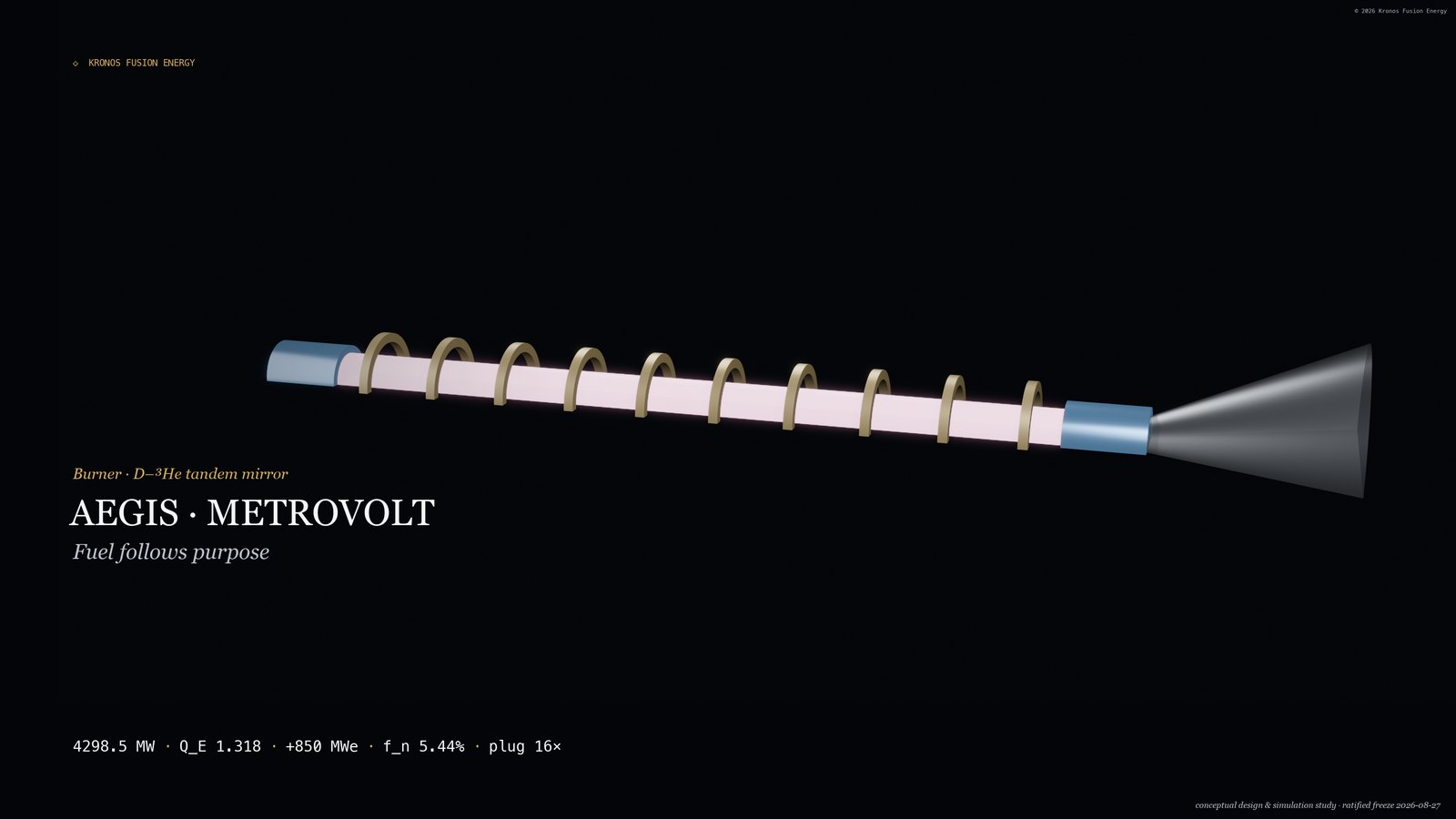
- Direct energy conversion. Because the tandem mirror exhausts charged particles onto collector electrodes, part of its output is generated directly as electricity rather than through a steam turbine.
- Firm power. It runs continuously, providing the kind of firm, dispatchable output that data centers and cities need and that intermittent sources cannot supply on their own.
Its scale (~+2832 MWe) suits siting near the largest continuous loads — hyperscale data-center campuses and metropolitan demand centers.