KRONOS-CTRL: MHD Stability Module
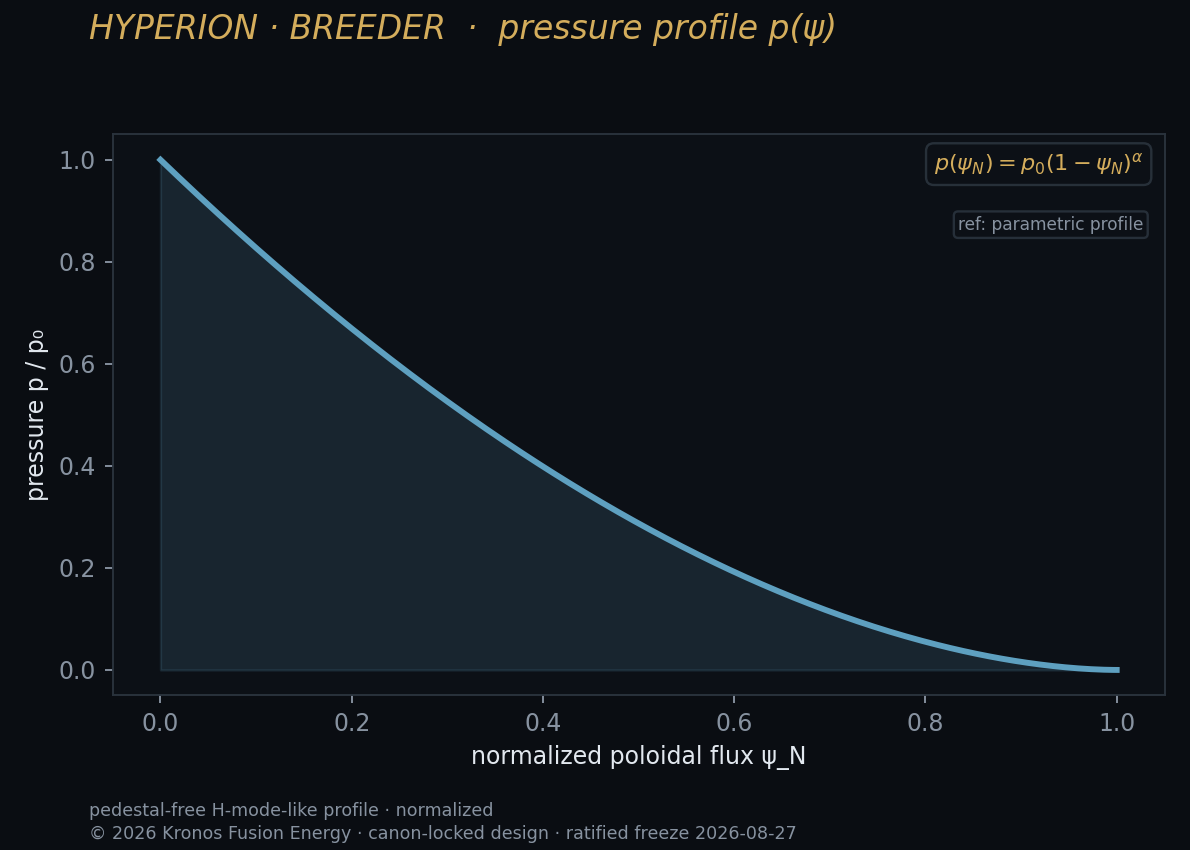
The MHD Stability module holds the plasma shape, equilibrium, and stability margins that anchor the whole twin.
Scope
The MHD Stability module is the plasma heart of KRONOS-CTRL. It maintains the current equilibrium (via the Grad-Shafranov PINN and reconstruction), the plasma shape (boundary, triangularity, X-point), and the stability margins (via the stability PINN). For the breeder this is the negative-triangularity equilibrium and its peeling-ballooning and kink margins; for the burner it is the mirror equilibrium, the plug configuration, and the interchange/mirror-mode margins.
Why it anchors the others
The equilibrium fixes the neutron source profile (Neutronics), the plasma heat-flux footprint (Thermomechanics), and, for the burner, the confinement that sets end-loss power (Power Systems). So the MHD module is solved first each twin step and its output propagates to the others; their feedback (thermal expansion of the vessel, changes in the confining potential) is folded in on the next Picard pass of the coupled solve.
- Holds: psi(R,Z), q-profile, boundary shape, delta, X-point / plug configuration
- Computes: MHD growth-rate margins, peeling-ballooning (breeder), mirror modes (burner)
- Feeds: source profile to Neutronics, heat flux to Thermomechanics, confinement to Power Systems
- Serves: shape-control and plug-density MPC, disruption/precursor detection
The module's continuous stability margin is the single most safety-relevant number L3 produces for plasma control: shape MPC constrains against it, the anomaly ensemble watches its erosion, and the disruption-avoidance logic triggers on it. Reporting that margin accurately, and lowering confidence when the equilibrium reconstruction residual rises, is the module's core responsibility.
Because it drives everything else, the MHD module is the most heavily validated part of the twin, benchmarked against finite-element equilibrium and eigenvalue MHD codes across the operating space before deployment and re-validated on drift.