Tritium Breeding Ratio Parameter Sweeps
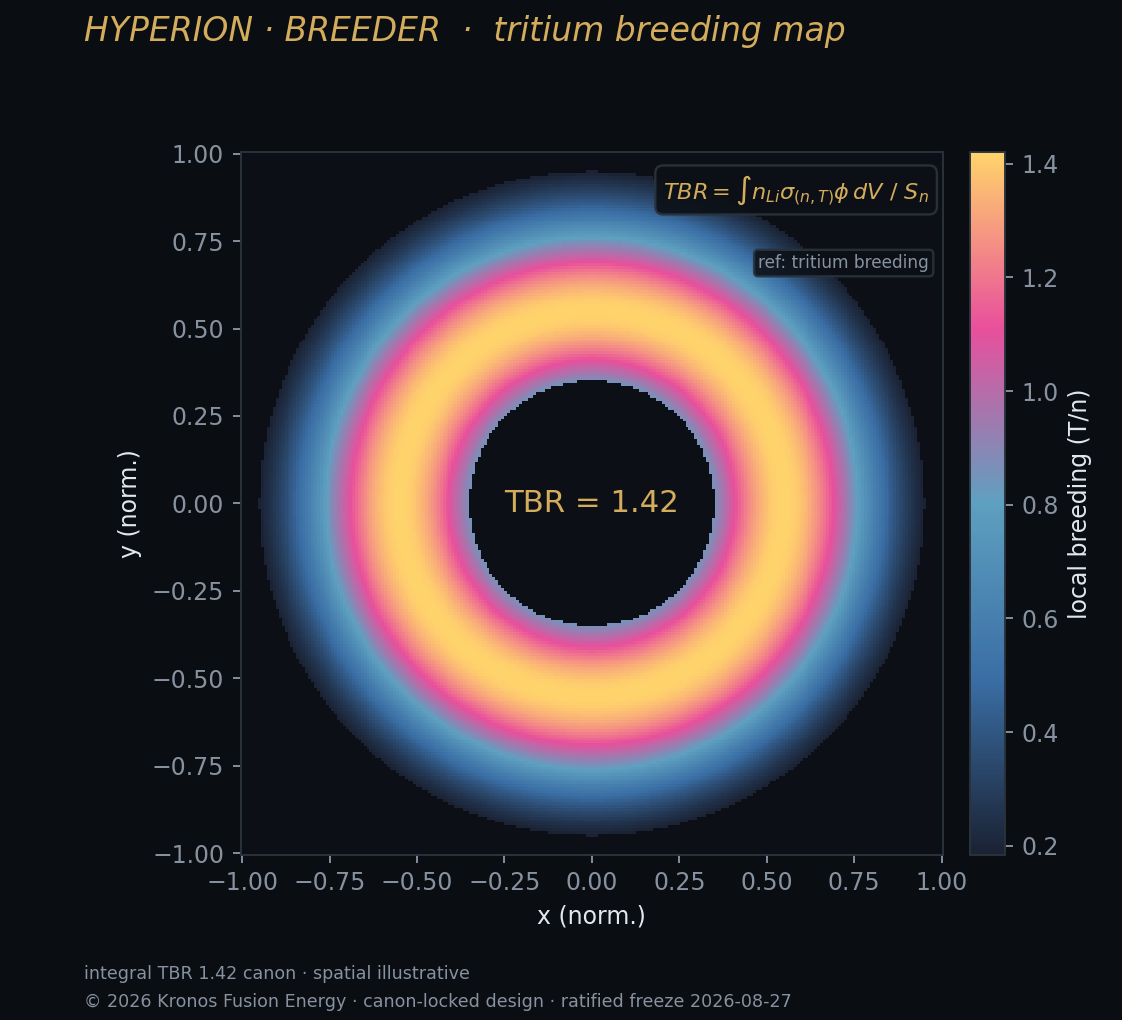
Wide, independent Monte Carlo campaigns that map breeder blanket design against the TBR lever set 1.1, 1.5, and 1.8.
TBR as a swept design lever
Kronos treats the breeder's tritium breeding ratio as a design lever rather than a single fixed target, studying it across 1.1, 1.5, and 1.8. A parameter sweep on L0 launches many independent neutronics runs, each with different blanket composition, lithium-6 enrichment, multiplier fraction, and structural layout, and scores the TBR each configuration achieves.
An embarrassingly parallel campaign
Each configuration is independent, so the sweep is embarrassingly parallel: thousands of Monte Carlo jobs run concurrently with no cross-talk, ideal for elastic cloud HPC. The campaign fans out, each job traces its histories to a variance target, and results are gathered into a response surface over the design space.
- Lithium-6 enrichment fraction
- Neutron multiplier loading
- Blanket thickness and coolant fraction
- Structural and manifold penalties on breeding
Reading the response surface
The output is a map from blanket design to achievable TBR, with statistical error bars from the Monte Carlo. Configurations that reach 1.5 or 1.8 cost geometry and material choices that the sweep makes explicit, so the design team trades breeding margin against practicality with quantified confidence rather than intuition.
Interesting regions of the surface are then re-run on certified nodes under strict reproducibility before any value is trusted for design. Cloud explores the space broadly; bare-metal certifies the specific points that matter. A TBR figure that will drive design must be replayable bit-for-bit.
The sweep result is more than a number. It quantifies how sensitive breeding is to each lever, which tells the fuel-cycle model how much margin exists and tells the twin's isotope-balancing surrogate how breeding responds to configuration. The lever set 1.1, 1.5, 1.8 is a deliberate span from marginal to comfortable, chosen to bracket the honest engineering range.