Time-Integration Schemes
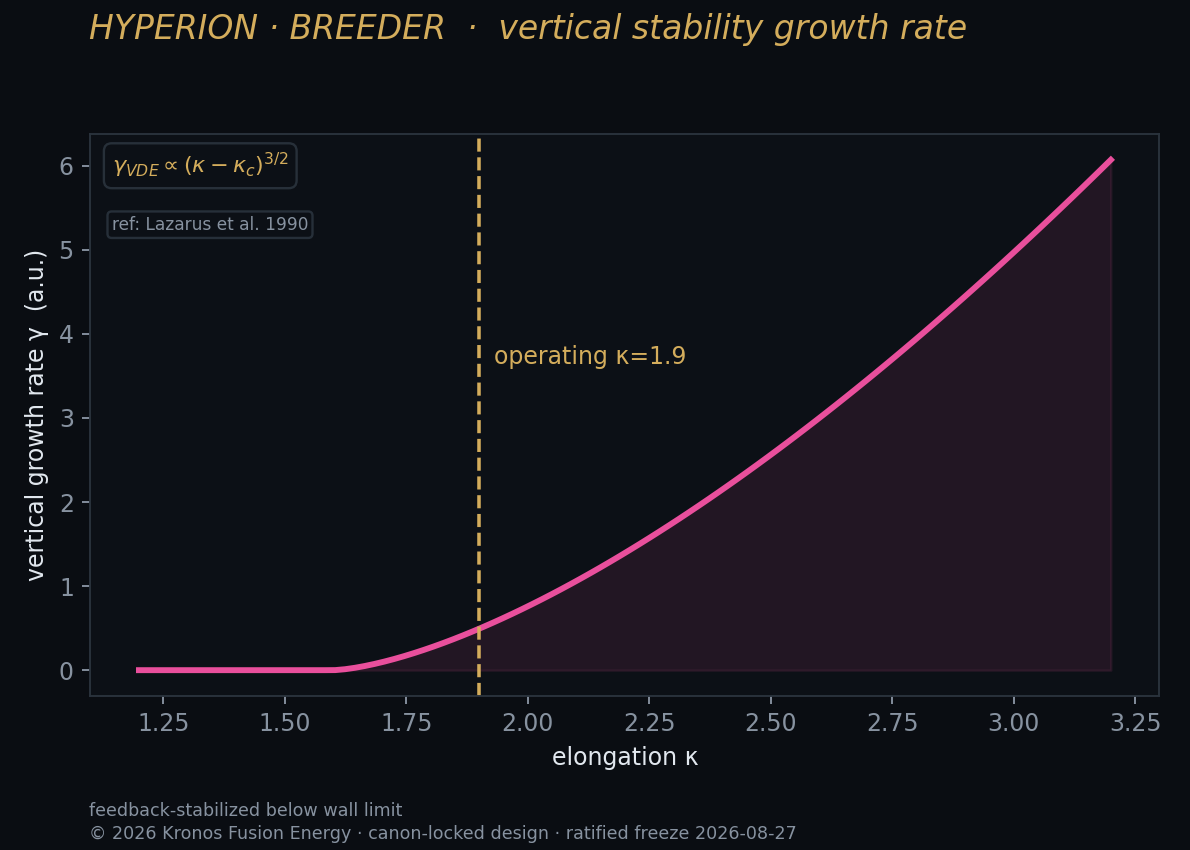
Choosing explicit or implicit stepping for Kronos's time-dependent MHD, transport, and disruption solves, and why stiffness decides.
Marching equations forward in time
Time-dependent workloads, resistive MHD, transport evolution, disruption dynamics, must be marched forward step by step. The scheme that advances them, explicit or implicit, is one of the most consequential numerical choices Kronos makes, because it decides both the cost per step and the size of step allowed. The right choice is dictated by stiffness.
Explicit versus implicit
An explicit scheme computes the next state directly from the current one: cheap per step, but stable only for steps below a limit set by the fastest timescale. An implicit scheme solves a system coupling the new state to itself: costly per step, but stable at much larger steps. When timescales span orders of magnitude, implicit wins despite its per-step cost.
Stiffness in Kronos physics
MHD and transport are stiff: fast MHD modes and slow resistive or transport evolution coexist. An explicit scheme would be forced to the fastest timescale, taking impractically many tiny steps. So Kronos uses implicit integration for these, accepting a linear or nonlinear solve each step, the same sparse systems finite elements produce, in exchange for stable, physically meaningful step sizes.
Accuracy and stability are distinct. A stable scheme will not blow up, but it can still be inaccurate if the step is too large for the dynamics of interest. Kronos chooses step size and scheme order to resolve the physics a study cares about, disruption growth in the breeder, potential dynamics in the burner, not merely to stay stable.
The choice ties directly to compute. Implicit steps mean solving large systems repeatedly, which is communication-bound and reproducibility-sensitive, so these solves live on the certified core. Explicit steps, where physics allows, are cheaper and more parallel. Time integration is thus both a mathematical and an architectural decision for both machines.