The Stack and the Magnet System
How the architecture controls and protects the high-field REBCO magnets and coordinates the cryogenic ice-piston preload cycle.
The highest-stakes interface
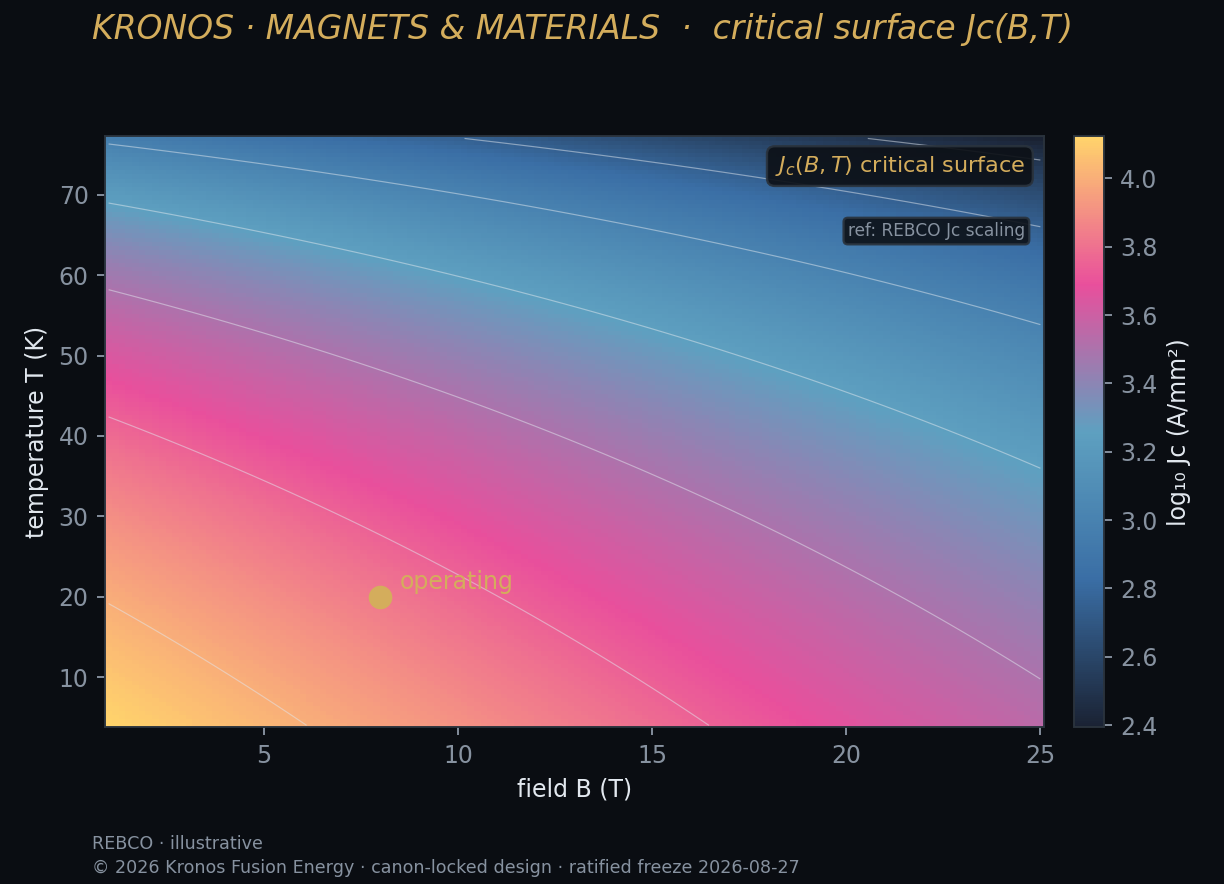
The high-field REBCO magnet system is where the architecture's safety guarantees are tested hardest. The breeder runs 16.84 T peak field (8 T on-axis); the burner runs a 26.49 T plug and 17 T throat. Controlling these magnets and protecting them from quench is the responsibility that shapes L1's entire design.
What the stack does with the magnets
- Control — FPGA-driven coil currents for equilibrium, shaping, and stability.
- Sensing — REBCO strain gauges and thermal and voltage monitoring feeding L2.
- Protection — the autonomous quench dump, triggered by hardware thresholds.
- Preload — coordination of the cryogenic ice-piston cycle that conditions the coils.
The ice-piston preload cycle
The ice-piston preload mechanically pre-stresses the magnet structure so that electromagnetic loads during operation stay within the winding's tolerance. It is a cryogenic process coordinated across the plant interface, and its state is monitored because mechanical margin and quench risk are coupled. The twin's Thermomechanics module tracks it.
Why protection is deterministic
A REBCO quench releases stored magnetic energy fast, and at these fields the coil can be damaged before software could react. That is why quench protection is the archetypal autonomous hardware failsafe: physical thresholds, hardware trigger, zero AI dependency. AI's role is upstream — REBCO strain and thermal trends feed anomaly detection that warns long before thresholds are reached.
Magnet control lives within the sub-10 microsecond boundary, and magnet state feeds the twin's Thermomechanics module.