The Stack and the Fuel Cycle
Real-time isotope balancing: how the architecture tracks and schedules tritium, helium-3, and neutron output as an operational, never economic, problem.
Controlling the fuel loop
The fuel cycle is where the breeder's products are made and where both machines' fuel is managed. The architecture treats it as a real-time balancing problem: measuring inventory, tracking production, and scheduling supply, all as operations, never as economics.
What the stack tracks
- Breeder tritium production — a roughly 4 kg/yr tritium class output.
- Helium-3 co-production — roughly 1.97 kg/yr.
- 14 MeV neutron flux, tied to the tritium breeding ratio lever (1.1 / 1.5 / 1.8).
- Burner D-3He fuel supply against the DEC train's operating windows.
The tritium breeding ratio as a lever
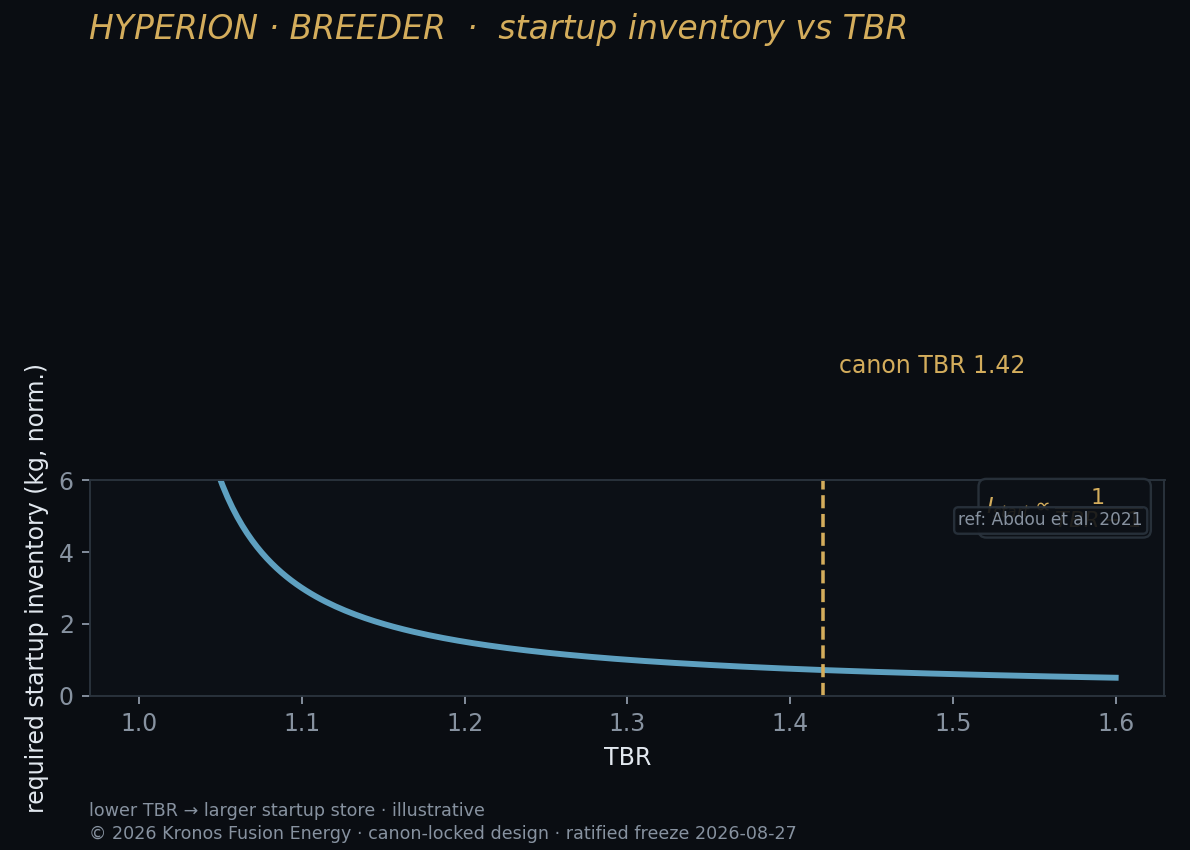
On the breeder, the tritium breeding ratio (TBR) is treated as a design lever studied across 1.1, 1.5, and 1.8, not a fixed result. L0's Monte Carlo neutronics quantifies breeding for each case, and the twin's Neutronics module tracks the operating point. The honest gates keep this explicit: TBR is a study range, not a settled number.
Real-time balancing
During operation, L2 maintains the isotope inventory from neutron-flux and gas diagnostics, the twin projects production forward, and L7's operations functions schedule fuel handling and product logistics. The whole loop is described operationally — inventory, timing, availability — with no price or cost anywhere in the architecture.
The neutron side connects to the twin's Neutronics module; scheduling is a green operations function.