Burner Sensor-to-Actuator Map
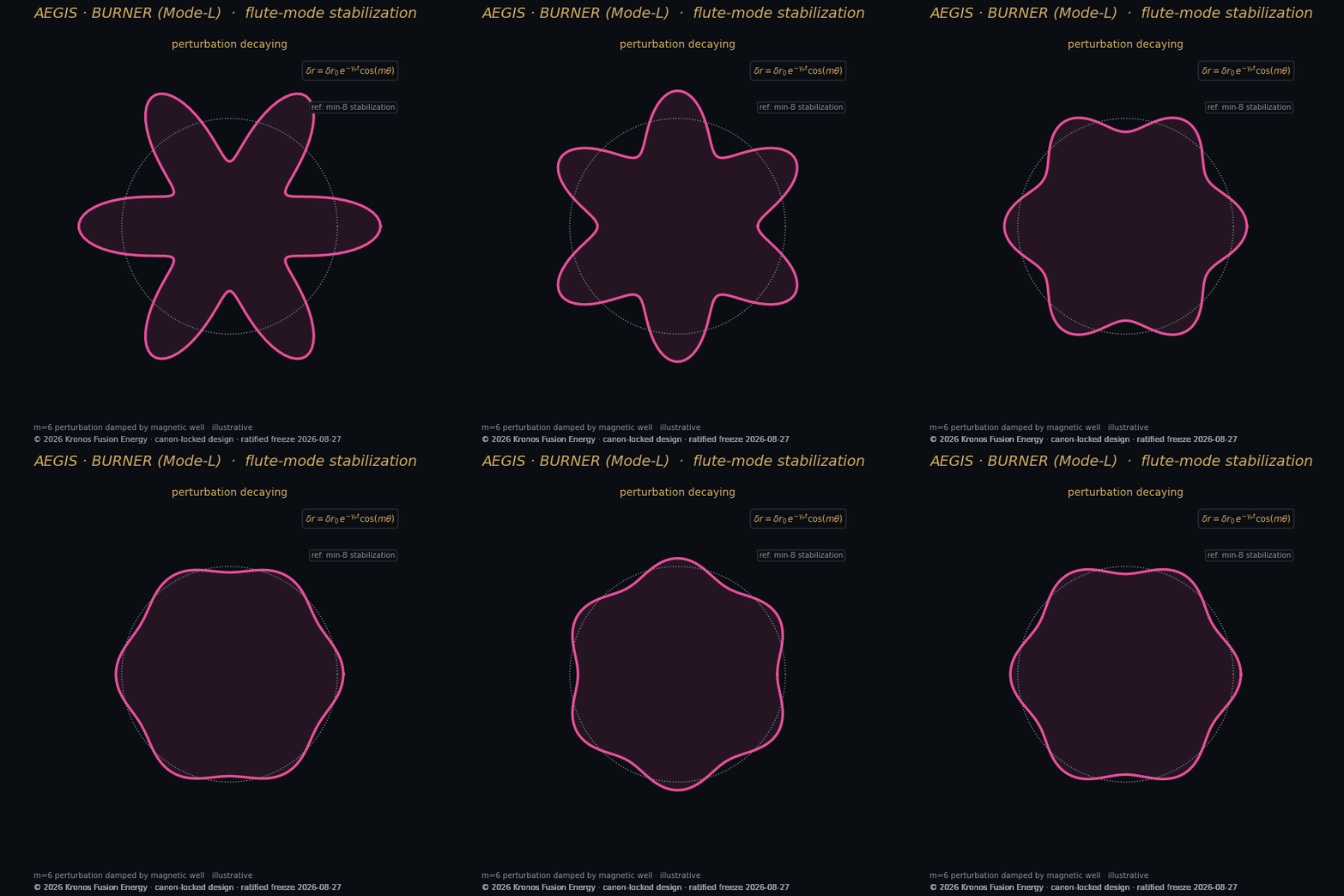
For the burner (Aegis / MetroVolt), the control chains center on the end plugs, the ambipolar potential, and the direct-energy-conversion train.
The burner control chains
The burner (Aegis fixed defense installations / MetroVolt data centers) is a D–3He tandem-mirror generator with a 26.49 T plug field, 17 T throat, neutron fraction 5.44%, and direct energy conversion of the escaping ion flux. Its chains are distinct from a tokamak's: confinement is set by mirror fields and an electrostatic potential, not by a toroidal current.
Principal chains
- Plug field: coil-current sense + strain -> plug-coil controller -> plug supply (see the stress gate below).
- End-plug density: microwave/interferometry -> plug-density MPC -> plug fueling + heating.
- Ambipolar potential: potential/emissive probes -> potential controller -> plug heating / bias electrodes.
- Power extraction: collector currents/voltages -> DEC controller -> collector grid bias + grid-tie inverter.
Honest gates on these interfaces
Two of the four canonical burner gates fall directly on physical interfaces. The plug-coil interface must hold a field whose structure overstresses the coil by ~3–3.9× at the design bore — infeasible as specified. The plug-density / potential interface must sustain an operating regime 166–830× beyond any device ever run, so it is not post-dictable today. These are physics facts stated as design and validation findings, not softened.
| Burner gate | Where it lands | Factor |
|---|---|---|
| plug stress | plug-coil interface | 3-3.9x |
| regime | plug-density interface | 166-830x |
| He-3 supply | plug fueling | 400x |
| availability | whole plant | 0.86-0.995 |
The remaining two gates — helium-3 demand at ~400× domestic supply and availability of 0.86–0.995 versus hyperscale Tier III 0.99982 — shape how the fueling and power interfaces are provisioned and why breeder-bred plus lunar helium-3 matter.