Quantum Simulation of REBCO Superconductors
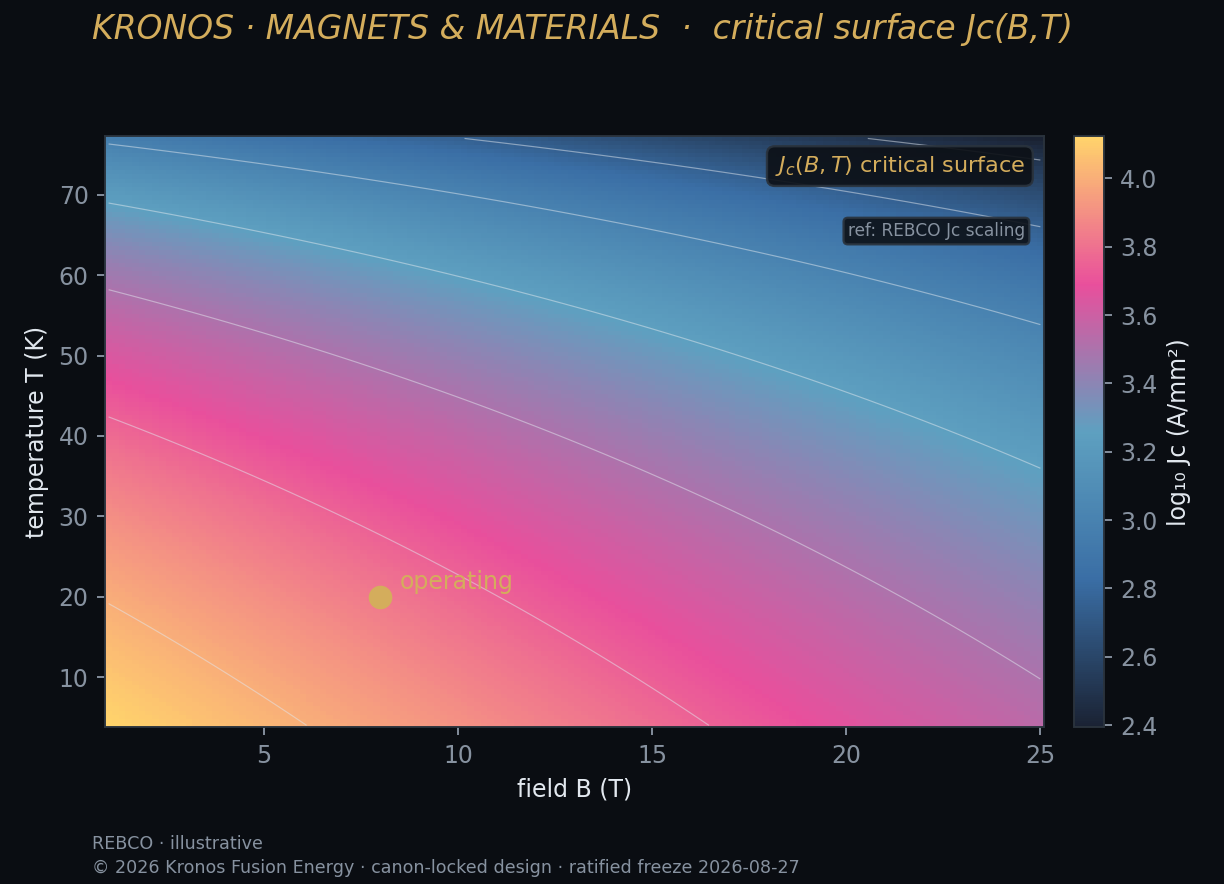
The breeder's 16.84 T magnets rely on REBCO, a correlated-electron superconductor whose microscopics remain a target for quantum simulation.
Why REBCO is a quantum problem
The breeder reaches a peak field of 16.84 T (8 T on axis) and 9.66 MA plasma current using REBCO high-temperature superconducting tape. REBCO is a cuprate: its superconductivity emerges from strongly correlated copper-oxygen planes that resist mean-field description. The canonical minimal model is the two-dimensional Hubbard model, itself unsolved in the interesting regime.
# Fermi-Hubbard model (minimal cuprate physics):
H = -t sum_{<i,j>,s} ( c_{i,s}^dag c_{j,s} + h.c. )
    + U sum_i n_{i,up} n_{i,down}
#   t  hopping amplitude,  U on-site Coulomb repulsion
#   large U / doping regime = classically hard, quantum-relevant
What we would want to know
- Critical current and its degradation under strain, which limits magnet design margins.
- Pinning behavior and how defects set the current the tape can carry.
- Response to the neutron and gamma environment near the plasma over fleet lifetimes.
Quantum vs classical reality
The Hubbard model is a headline quantum-simulation target precisely because classical methods (quantum Monte Carlo, DMRG, tensor networks) hit the fermion sign problem or entanglement growth in two dimensions. A quantum device that could reach large 2D lattices at strong coupling would be genuinely new physics capability.
But the practical link to magnet engineering is indirect: engineering-scale critical-current and quench behavior are governed by mesoscale defect structure, not by solving the Hubbard model. Kronos positions REBCO quantum simulation as fundamental-understanding research, not as a design tool for the FOAK magnets, whose margins are set by measured tape performance and classical electromagnetics. Strain-driven quench sensing on the real magnets is a classical control problem handled elsewhere in the stack.