PINNs for MHD Stability Analysis
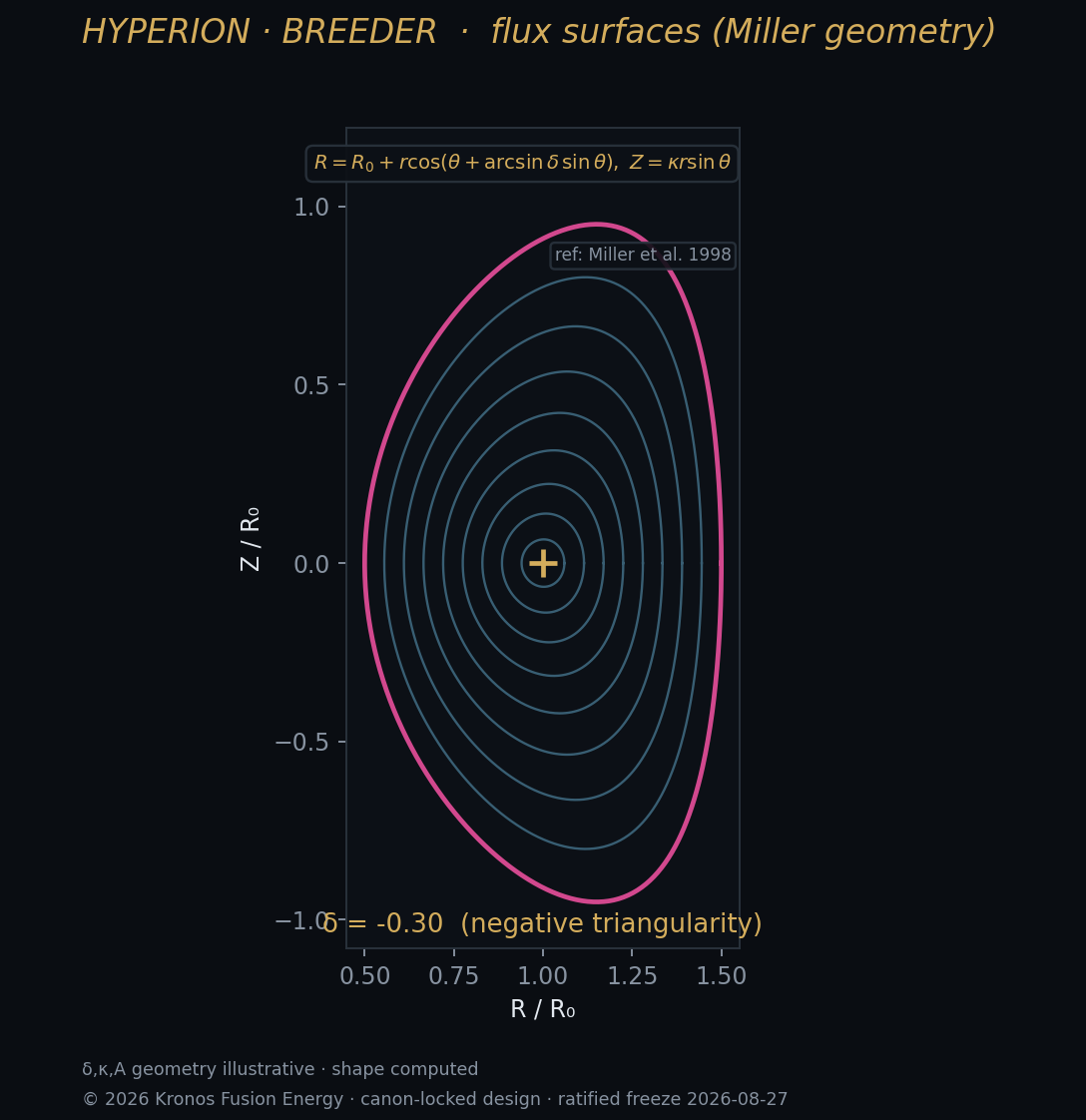
Beyond equilibrium, Kronos uses PINNs to evaluate ideal-MHD stability so the twin knows how close the plasma is to a limit, not just where it sits.
Equilibrium is not enough
A valid Grad-Shafranov equilibrium can still be unstable. To avoid disruptions the breeder twin must know the growth rates of the dangerous ideal-MHD modes, kink, ballooning, and (for the negative-triangularity edge) the peeling-ballooning boundary that governs ELMs. Kronos trains a stability PINN that, given an equilibrium, returns the least-stable eigenvalue and its mode structure.
The eigenvalue formulation
Linearized ideal MHD casts stability as an eigenvalue problem for the plasma displacement xi: the force operator F(xi) balances against the inertia, and the sign of the eigenvalue omega^2 decides stability.
# linearized ideal-MHD normal-mode problem
#   F(xi) = - rho * omega^2 * xi
# F : self-adjoint ideal-MHD force operator (pressure + field-line bending)
# omega^2 > 0  -> stable oscillation
# omega^2 < 0  -> exponential growth, gamma = sqrt(-omega^2)
#
# PINN objective: minimize Rayleigh quotient subject to normalization
#   omega^2 = < xi, F(xi) > / < xi, rho xi >
The PINN represents the displacement field xi_theta and minimizes the Rayleigh quotient under a normalization constraint, so it converges to the least-stable eigenmode. Trained across the operating space, it returns a growth-rate estimate in one forward pass, fast enough for the shadow to project how a mode will evolve over the next 50-100 ms.
For the breeder this is central to holding the ELM-free negative-triangularity regime: the twin continuously reports the margin to the peeling-ballooning boundary so shape-control MPC can back off before the edge crosses it. For the burner, the analogous PINN evaluates the interchange and mirror-mode stability of the end plug, feeding the plug-density controller.