PINNs Solving the Grad-Shafranov Equilibrium
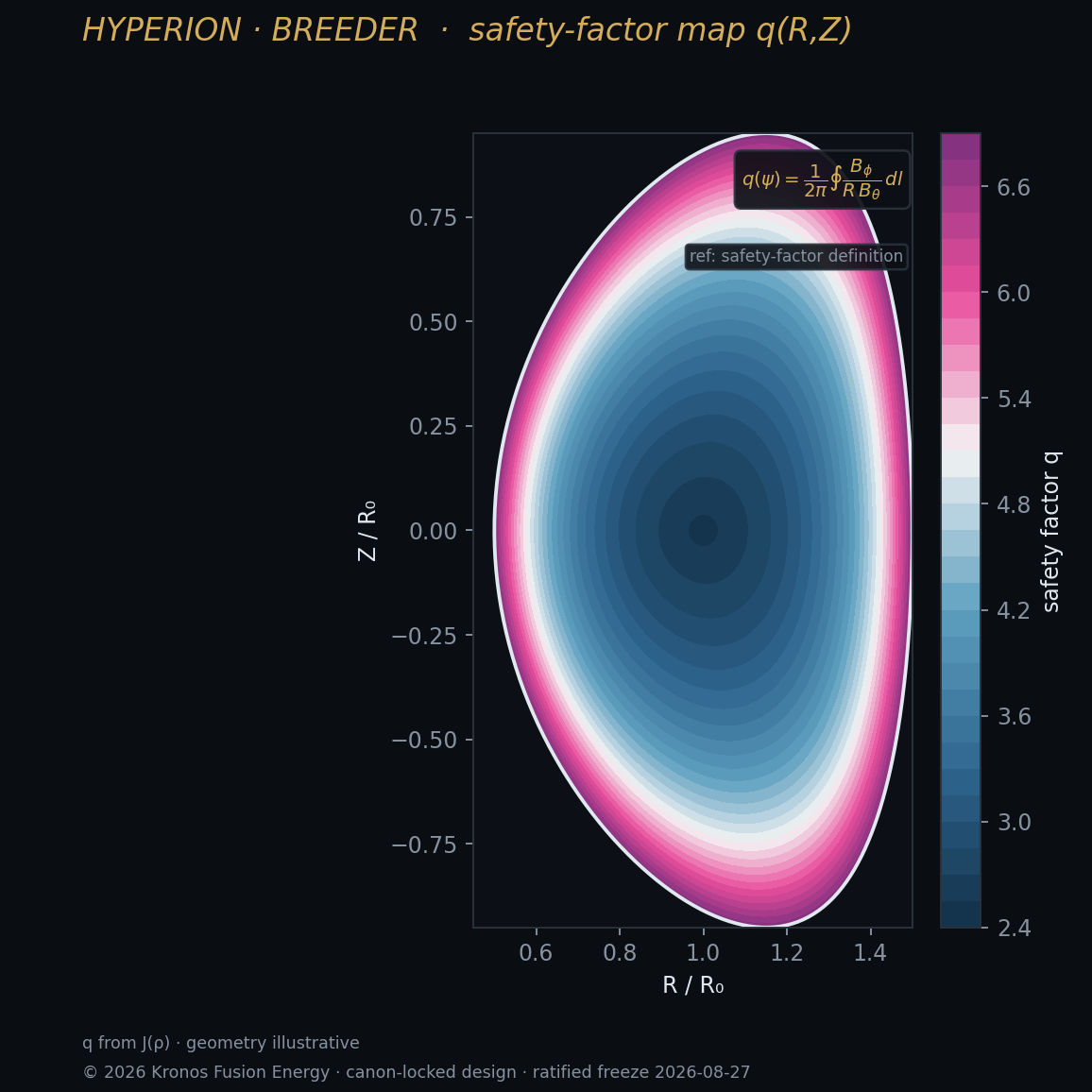
Kronos solves the breeder's magnetohydrodynamic equilibrium with a physics-informed neural network that embeds the Grad-Shafranov operator in its loss.
The equilibrium problem
An axisymmetric tokamak equilibrium is governed by the Grad-Shafranov equation, a nonlinear elliptic PDE for the poloidal flux function psi(R,Z). It balances the plasma pressure gradient against the magnetic force:
# Grad-Shafranov equation (axisymmetric ideal MHD equilibrium)
#   R d/dR( (1/R) dpsi/dR ) + d2psi/dZ2  =  - mu0 R^2 p'(psi) - F(psi) F'(psi)
# equivalently, with the elliptic operator Delta*:
#   Delta_star(psi) = - mu0 R^2 dp/dpsi - F dF/dpsi
# p(psi)  : plasma pressure profile
# F(psi)  : poloidal current function, F = R B_toroidal
Classical solvers march a finite-element or finite-difference mesh to convergence each time the equilibrium changes. That is too slow for a 50-100 ms predictive shadow that must re-solve as the breeder plasma evolves. Kronos instead trains a PINN psi_theta(R,Z; boundary, profiles) whose network output is differentiable, so the Grad-Shafranov operator is evaluated by automatic differentiation and enforced pointwise.
Native solving
The network takes spatial coordinates and the current profile/boundary parameters as input and returns psi. Its loss (detailed on the loss-formulation page) penalizes the Grad-Shafranov residual on interior collocation points and the boundary condition on the plasma edge. Trained across the breeder's operating space, the PINN becomes an equilibrium solver that evaluates in a single forward pass and re-solves as fast as the twin steps.
This matters specifically for the breeder's negative-triangularity delta -0.30 shape at 9.66 MA and 16.84 T peak field: the equilibrium is where the ELM-free advantage of negative triangularity is realized or lost, and the twin must hold that shape accurately to reason about stability. The PINN provides the equilibrium that the MHD Stability module and the shape-control MPC both build on.