Free-Boundary Equilibrium and Coil Currents
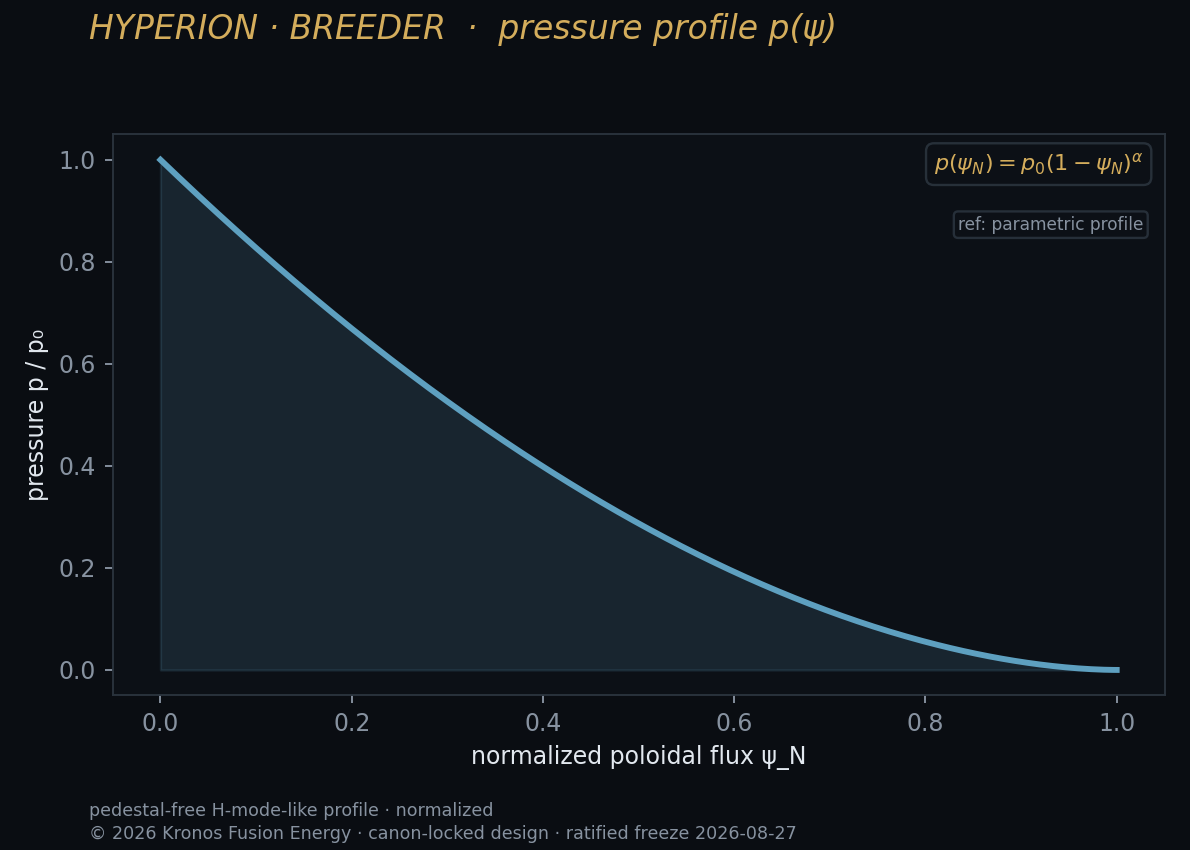
The breeder's plasma boundary is not fixed; Kronos's free-boundary PINN co-solves the plasma equilibrium and the external coil currents that hold its shape.
Fixed vs free boundary
A fixed-boundary solve assumes the plasma edge is known and finds the interior flux. The real control problem is the opposite: the poloidal-field coil currents are the actuators, and the boundary shape is a consequence. A free-boundary PINN takes coil currents (and plasma profiles) as input and returns both the interior equilibrium and the resulting last-closed flux surface, including the X-point and strike points on the divertor.
Coupling to actuation
This is what makes the PINN useful to shape-control MPC. The controller proposes coil-current trajectories; the free-boundary PINN predicts the shape they produce, including whether the negative-triangularity delta -0.30 target and the divertor strike-point placement are met, all inside the shadow horizon. The PINN's differentiability means MPC can also obtain gradients of shape with respect to coil current directly, which sharpens the optimization.
# free-boundary map used by shape-control MPC
#   inputs : I_coils (PF/CS currents), p'(psi), FF'(psi)
#   output : psi(R,Z), boundary(theta), X-point (R_x,Z_x), delta, kappa
shape = pinn_freeboundary(I_coils, p_prime, ff_prime)
# MPC reads shape.delta, shape.strike_points and their d/dI_coils
The vacuum-vessel geometry matters here. The breeder's CrMoNbV vessel and the thermal expansion tracked by the Thermomechanics module change the coil-to-plasma coupling slightly as the machine heats; the free-boundary PINN is conditioned on the current vessel geometry from the twin so its shape predictions stay accurate through a pulse.
Because coil currents are physical actuators with limits, the free-boundary map is always used inside the certified safe operating envelope: MPC may only request shapes reachable with in-limit currents, and the failsafe path for coil faults remains an L1 hardware function independent of the PINN.