Neutronics Monte Carlo for the Breeder
Tracing 14 MeV neutrons through Hyperion's blanket to quantify tritium breeding, heating, and activation across the TBR lever set.
The breeder neutronics problem
The breeder (Hyperion) is a D-T spherical tokamak producing 85.0 MW of fusion power, dominated by 14 MeV neutrons from the D-T reaction. Those neutrons must do two jobs in the blanket: breed tritium via lithium reactions and deposit their energy as recoverable heat. Monte Carlo transport on L0 is how both are quantified before the machine exists.
Tritium breeding as a design lever
The tritium breeding ratio (TBR) is treated as a design lever, studied across 1.1, 1.5, and 1.8. Each value corresponds to different blanket composition, lithium enrichment, and neutron multiplier choices. The Monte Carlo campaign scores the T(n,x) and Li(n,x) reaction rates that determine TBR, letting the design team map breeding against the geometry that produces it.
Coupled outputs
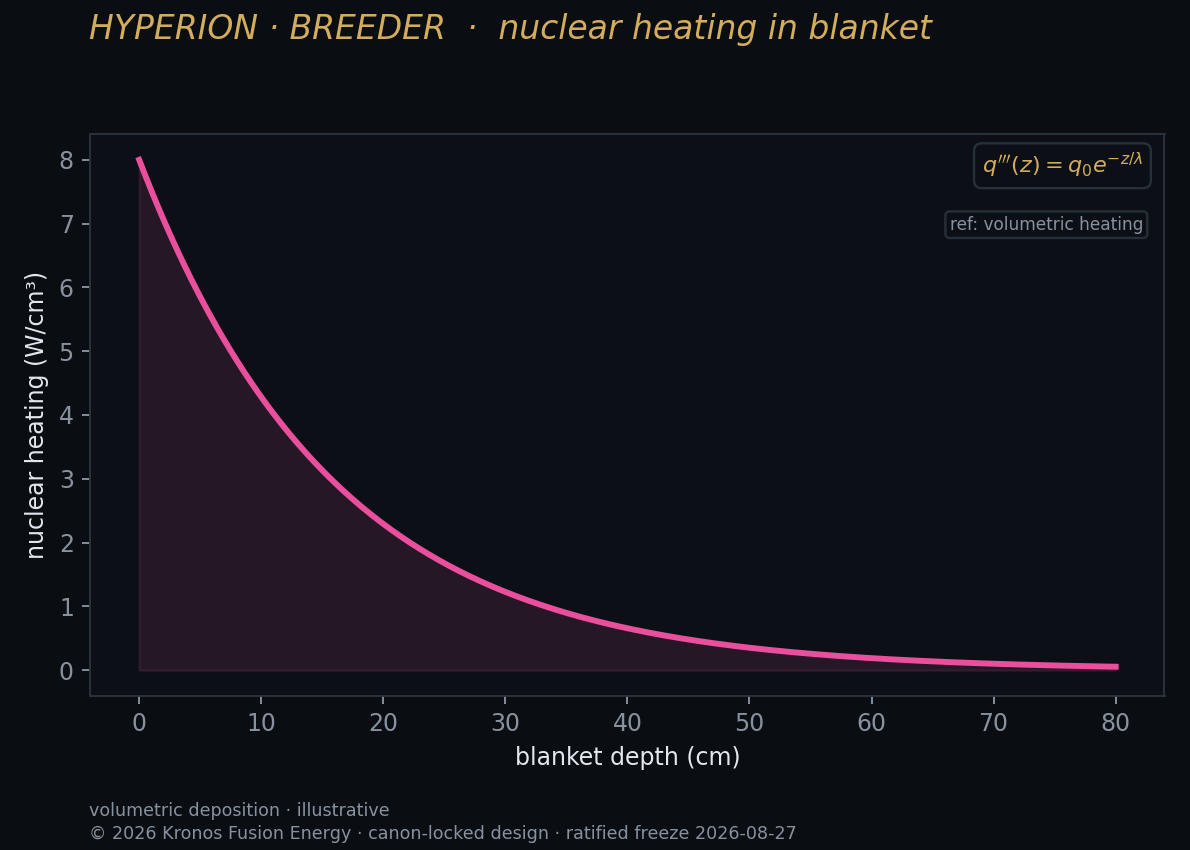
Neutronics does not stop at breeding. The same histories score nuclear heating throughout the blanket and structure, and those heating fields are handed to the activation and damage and thermomechanics workloads. The breeder's roughly 4 kg/yr tritium class output and 1.97 kg/yr helium-3 co-product trace back to these transport results.
- 14 MeV source sampling over the plasma volume
- Li(n,alpha)T and Li(n,n'alpha)T breeding reaction rates
- Neutron multiplication and spectral softening in the blanket
- Nuclear heating maps for thermomechanical coupling
Geometry fidelity matters. The spherical-tokamak layout, with R0 1.2 m and aspect ratio 2.5, places the center column and blanket in a tight, strongly heterogeneous arrangement. Monte Carlo captures this without homogenizing it, which is essential because streaming paths and local breeding hot and cold spots dominate the achievable TBR.
Every breeder neutronics result carries its cross-section library and seed manifest into the archive, so a TBR value can be re-derived and audited. These certified results become the training data for the twin's real-time neutronics response tables used in isotope balancing.