Neutron Flux Diagnostics
Calibrated neutron monitors give the fabric a direct measure of fusion rate — 14 MeV for the breeder, a low 5.44% fraction for the burner.
The direct fusion monitor
Neutron flux is the most direct measure of fusion reaction rate. The breeder's D-T reactions produce 14 MeV neutrons in proportion to fusion power, making calibrated neutron flux the anchor of the instantaneous Q estimate. The burner's D-3He burn is low-neutron — a 5.44% neutron fraction — so its neutron monitors serve a different, complementary role.
Breeder: fusion power and breeding
- Neutron flux anchors the instantaneous Q feature (design point Q_sci 3.076 at 85.0 MW).
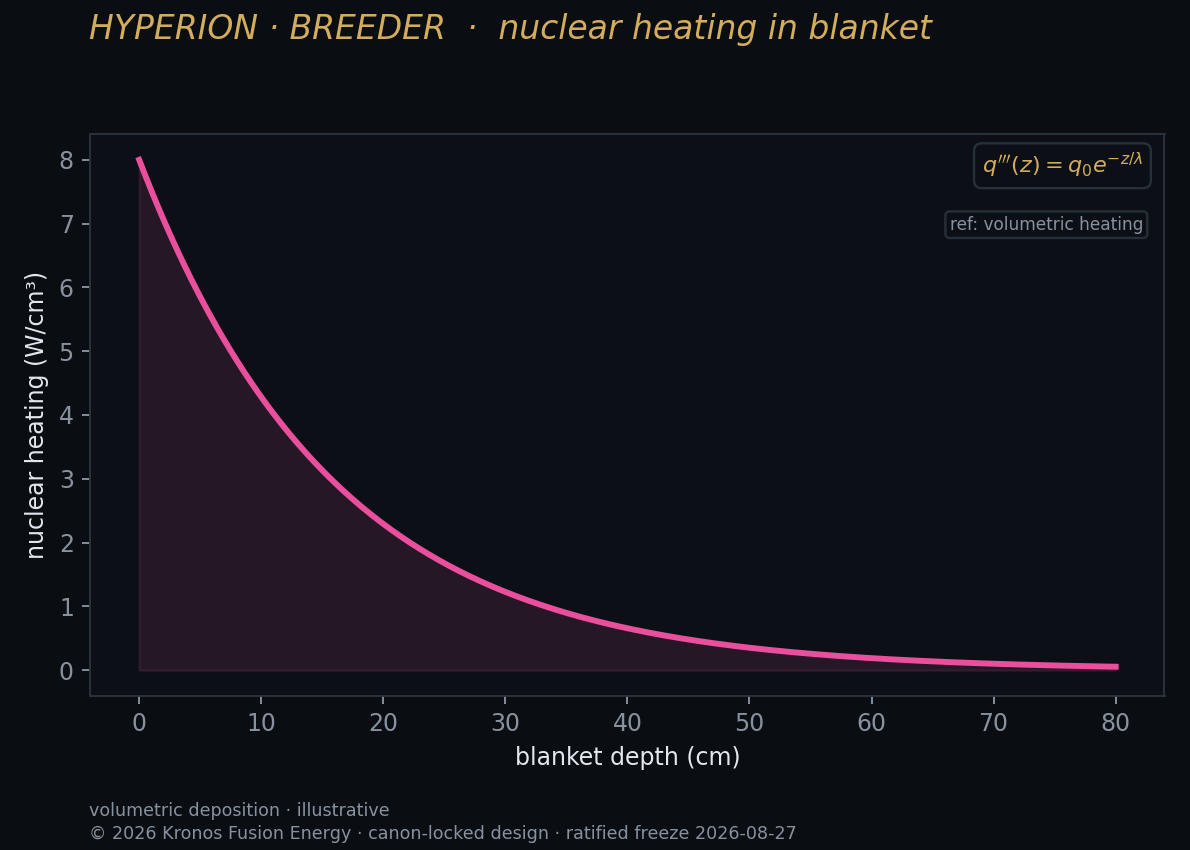
- Spatial neutron mapping informs the tritium breeding blanket, where the breeding ratio is treated as a design lever across 1.1/1.5/1.8.
- The 14 MeV field also drives sensor drift and materials effects the fabric tracks.
- Neutron and profile-based power estimates cross-check each other.
Burner: low-neutron by design
D-3He is low-neutron, not aneutronic; the residual 5.44% neutron fraction is monitored for machine protection, activation management, and as an independent fusion-rate cross-check. Because the fraction is small, the burner leans more on charged-particle and DEC-train diagnostics for its power accounting.
Calibration is everything
A neutron flux number is only as trustworthy as its absolute calibration and its drift model, since it directly sets a headline feature. The fabric maintains that calibration per detector, cross-checks against redundant monitors and profile-derived power, and records the calibration version in lineage. These are design and validation specifications; the breeder's first tritium is expected near 2030.