Neutron Fluence Mapping
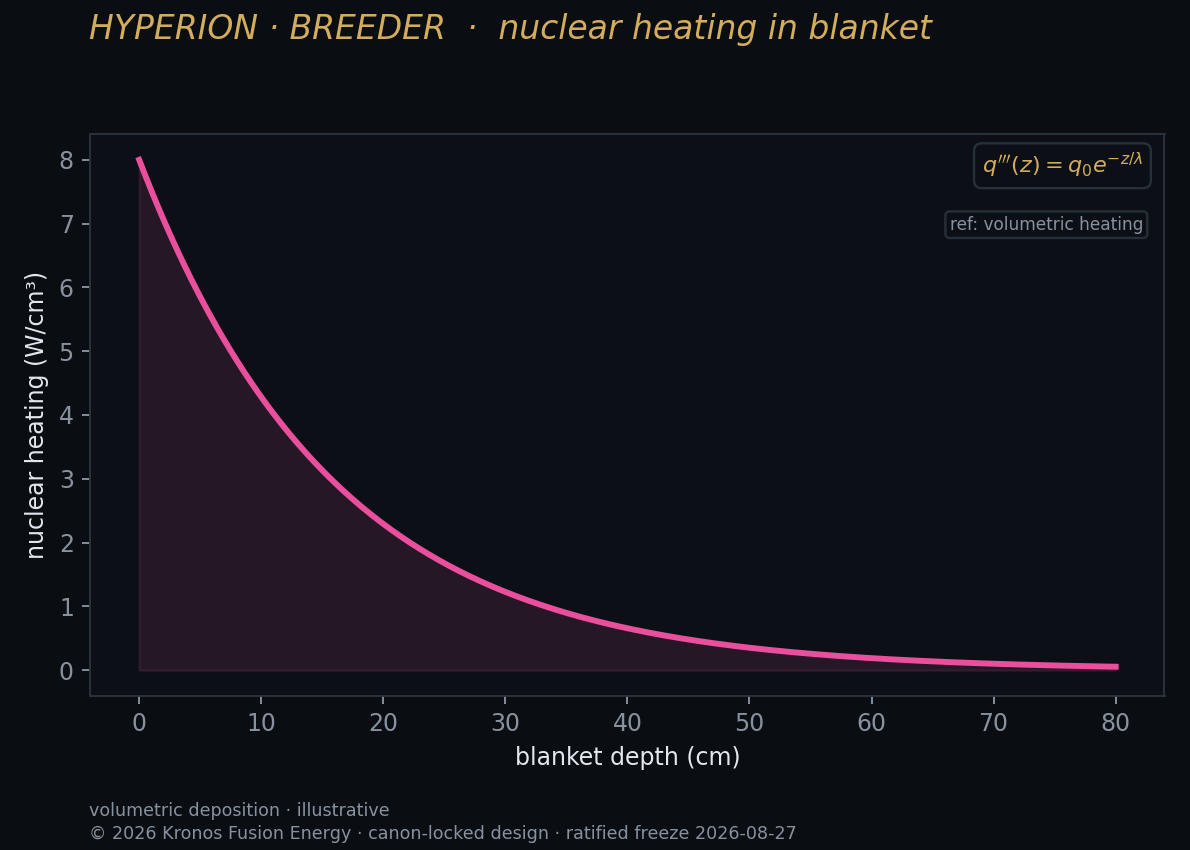
Spatially resolved neutron fluence tracks where 14 MeV neutrons deposit, feeding tritium-breeding accounting and materials-life monitoring in the breeder.
Where the neutrons go
The breeder's value rests on capturing 14 MeV neutrons in a blanket that breeds tritium. Neutron fluence mapping resolves the spatial and time-integrated neutron field, so the fabric can account for breeding, monitor activation, and track cumulative dose to materials and sensors. It turns a scalar flux into a spatial feature.
Feeding the breeding account
The tritium breeding ratio is treated as a design lever across 1.1/1.5/1.8. Closing the fuel cycle depends on knowing how many neutrons reach the breeding blanket and where. Fluence mapping, combined with isotope telemetry, gives the real-time picture the fuel-cycle balancing needs (see isotope telemetry), targeting the roughly 4 kg/yr tritium class the design aims for.
Materials and sensor life
- Cumulative fluence sets the expected drift and end-of-life of neutron-exposed sensors.
- Fluence hotspots inform structural-health monitoring of the CrMoNbV vessel.
- Time-integrated maps are retained in the archive for lifetime accounting.
- Helium and hydrogen generation in structures correlate with local fluence.
Reconstruction
Like density, the fluence field is reconstructed from a finite set of monitors against the machine geometry — a constrained inversion, not raw interpolation. The offline multi-physics Monte Carlo transport models on L0 provide the response functions the reconstruction uses. Results are normalized into machine coordinates and versioned. This is a design and validation capability for the FOAK breeder whose construction begins Q2 2027.