Neutron Diagnostic Interface
Neutron flux, spectra, and cameras measure fusion rate and 14 MeV yield; the interface feeds the fusion-power estimate and the breeding budget.
Measuring the reaction directly
Neutrons are the most direct signature of fusion. The breeder produces 14 MeV neutrons from D–T (design fusion power 85.0 MW), and the burner produces a much smaller neutron flux — only 5.44% of D–3He energy is neutronic. The neutron interface measures total flux, energy spectrum, and spatial emission to estimate fusion rate and, on the breeder, close the breeding budget.
Signal set
- Total yield: fission chambers / activation foils for absolute rate.
- Spectrum: to separate 14 MeV D-T neutrons from scattered/other components.
- Imaging: collimated cameras for the spatial emission profile.
- Cross-link: feeds the twin's neutronics/blanket estimate.
# fusion rate + breeding closure
rate_fus = calibrate(neutron_count, detector_eff)   # absolute
P_fus_est = rate_fus * E_per_reaction               # design: 85.0 MW class
# breeding closure
TBR_eff = bred_T_measured / (rate_fus * fraction_to_blanket)
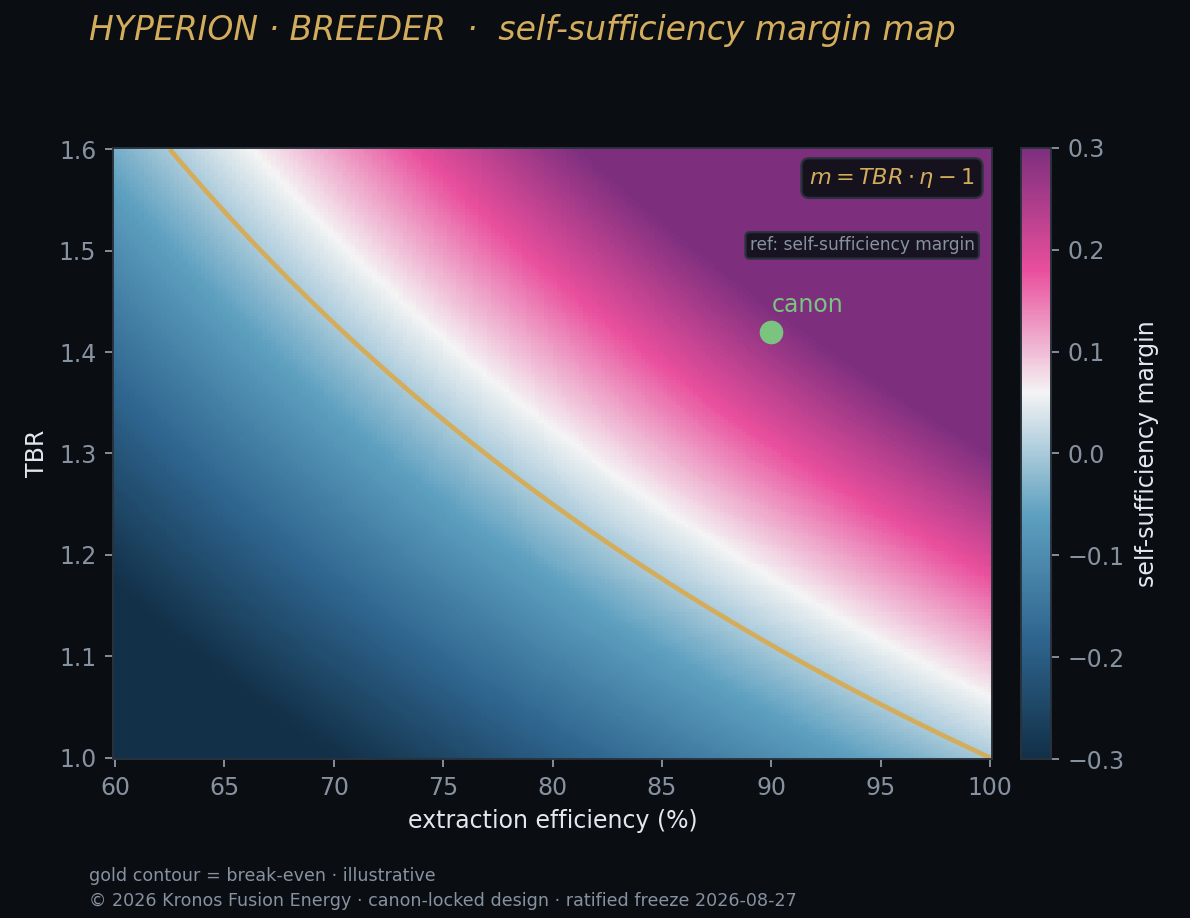
On the breeder, the neutron rate ties directly to the fusion-power estimate and to the tritium breeding ratio (a design lever across 1.1 / 1.5 / 1.8): the measured 14 MeV source is the denominator when closing the breeding budget with purge-gas assay.
Owner and calibration
Owner: L2 for acquisition; L3 for rate/profile inference; L4/L7 for the breeding and accountancy budget. Absolute calibration (detector efficiency, geometry) is the hard part and is traced to reference sources. The 85.0 MW figure is a design and validation value; no measured fusion power is claimed before FOAK first tritium (~2030).