MPC for Burner End-Plug Density
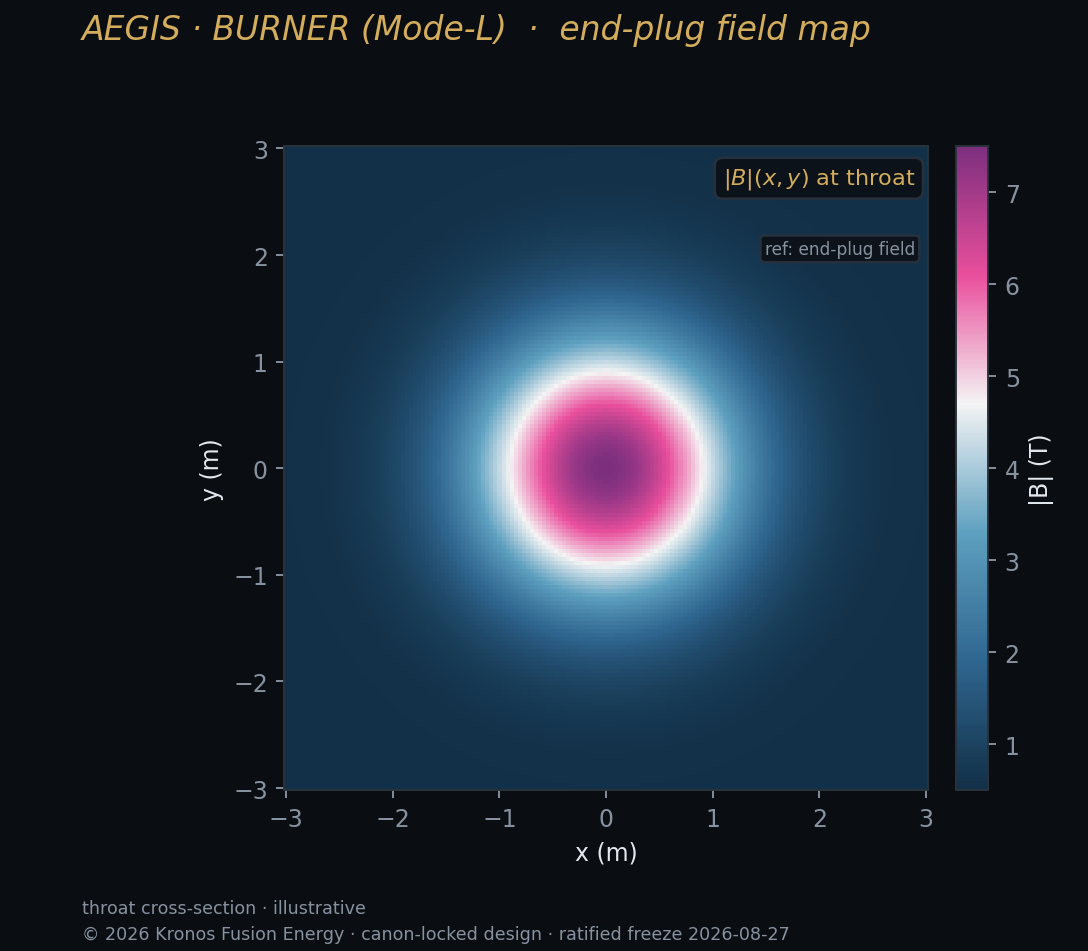
The tandem-mirror burner is confined by its end plugs; Kronos's MPC agent regulates plug density to hold the ambipolar potential that traps the central cell.
The control objective
In the D-3He tandem-mirror burner, central-cell confinement is set by the ambipolar potential established by the dense end plugs at 26.49 T. Too little plug density and the confining potential dip weakens and the central cell leaks; too much and plug power and stability suffer. Plug-density control is the MPC that holds the plug density, and hence the potential profile, at the target for good central-cell confinement.
Model and actuation
The prediction model is the ambipolar-potential PINN: given plug fueling and heating it predicts the plug density and the resulting potential profile phi(z), and hence central-cell confinement, across the horizon. The actuators are end-plug fueling, plug heating (ECH/neutral-beam), and the DEC collector potentials that set the boundary condition on phi.
# plug-density / potential MPC (burner)
minimize over u = (fuel_plug, P_heat, V_dec)[0..N-1]:
    sum_k ( (n_plug_k - n_ref)^2 * q_n
            + (phi_conf_k - phi_ref)^2 * q_phi   # confining potential dip
            + u_k^T R u_k )
s.t.  (n_plug_k, phi_k) = pinn_ambipolar(u_k, state_k)
      n_plug_k, phi_k, u_k within burner safe envelope
      mirror_stability_margin(state_k) >= margin_min
The control couples to direct energy conversion: the DEC collector potentials are both an actuator for the ambipolar boundary and the point where power is extracted, so plug-density control and Power-Systems control are solved with shared state rather than independently. Changing the DEC potential to extract more power shifts the confining potential, and MPC accounts for that coupling explicitly.
Because plug-density collapse can be fast (tens of milliseconds as the potential erodes), Kronos precomputes recovery maneuvers the controller can trigger on an anomaly-ensemble precursor, rather than planning recovery from scratch when confinement is already failing. Below that, the hardware protection layer still guards the magnets and power train.