MPC for Breeder Plasma-Shape Control
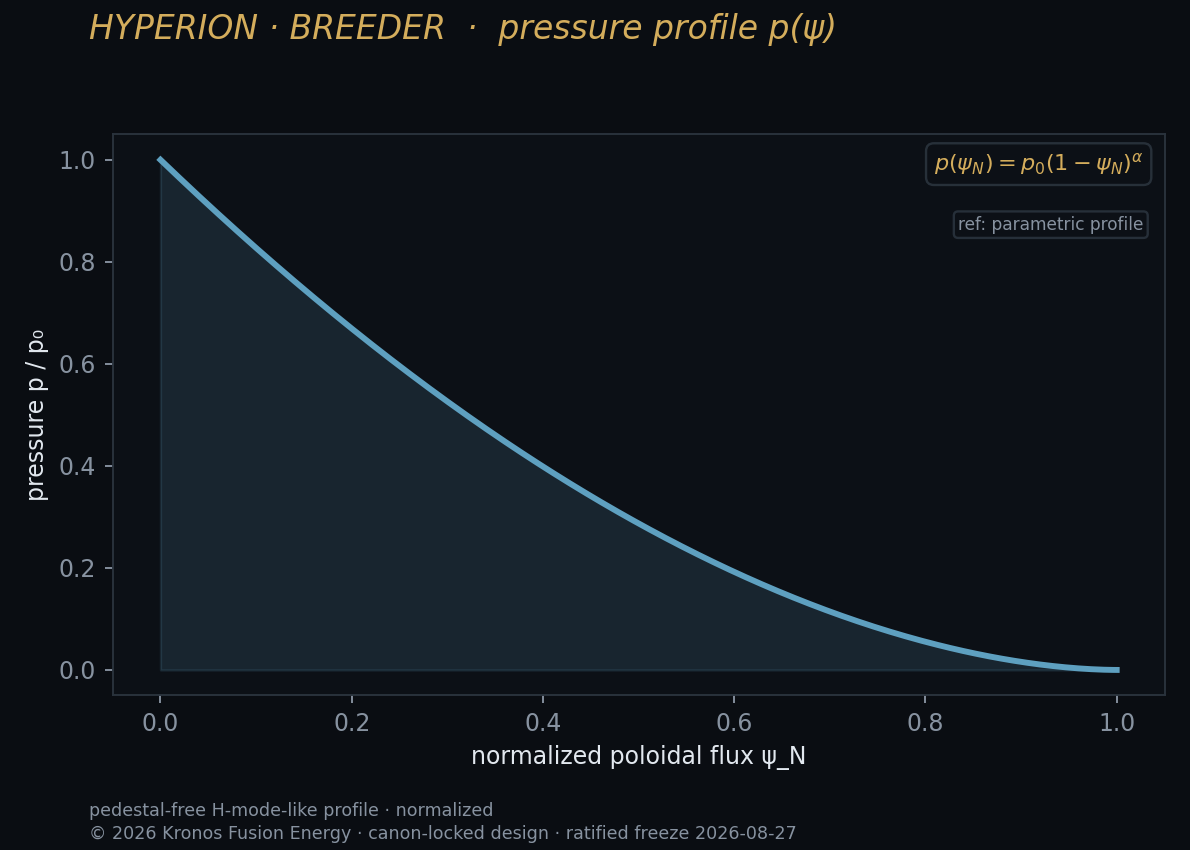
Holding the negative-triangularity ELM-free shape of Hyperion is an MPC problem over poloidal-field coil currents and the free-boundary equilibrium.
The control objective
The breeder's performance and ELM-free character depend on maintaining the negative-triangularity delta -0.30 boundary, the elongation, the X-point and divertor strike points, all at 9.66 MA. Shape control is the MPC that drives the poloidal-field and central-solenoid coil currents to hold that target shape against disturbances (pressure evolution, current-profile changes, thermal drift of the vessel).
Model and actuation
The prediction model is the free-boundary equilibrium PINN: given candidate coil currents it returns the resulting boundary, delta, kappa and strike points, differentiably, so MPC gets both the predicted shape and its sensitivity to each coil. The objective tracks the target shape while suppressing coil moves and respecting current and slew limits.
# shape-control MPC objective (per cycle)
minimize over I_coils[0..N-1]:
    sum_k ( ||shape_k - shape_ref||_W^2       # boundary, delta, X-point
            + I_coils_k^T R I_coils_k          # coil effort
            + dI_k^T S dI_k )                  # slew suppression
s.t.  shape_k = pinn_freeboundary(I_coils_k, profiles_k)
      I_coils_k in coil limits, dI_k in slew limits
      margin_MHD(shape_k) >= margin_min        # stay ELM-free / stable
The MHD-margin constraint ties shape control to the stability PINN: MPC is not allowed to hold a pretty shape that sits on the peeling-ballooning boundary. It trades a small shape error for staying comfortably ELM-free when the two conflict, which is the whole point of choosing negative triangularity.
Vertical stability is handled on a faster inner loop (elongated plasmas are vertically unstable and need sub-millisecond feedback), which lives closer to L1; the shape MPC provides the slower current-distribution targets that inner loop tracks. This separation of timescales keeps the fast stabilization deterministic while MPC handles the multivariable shape optimization above it.