Lithium Supply and the Breeding Blanket
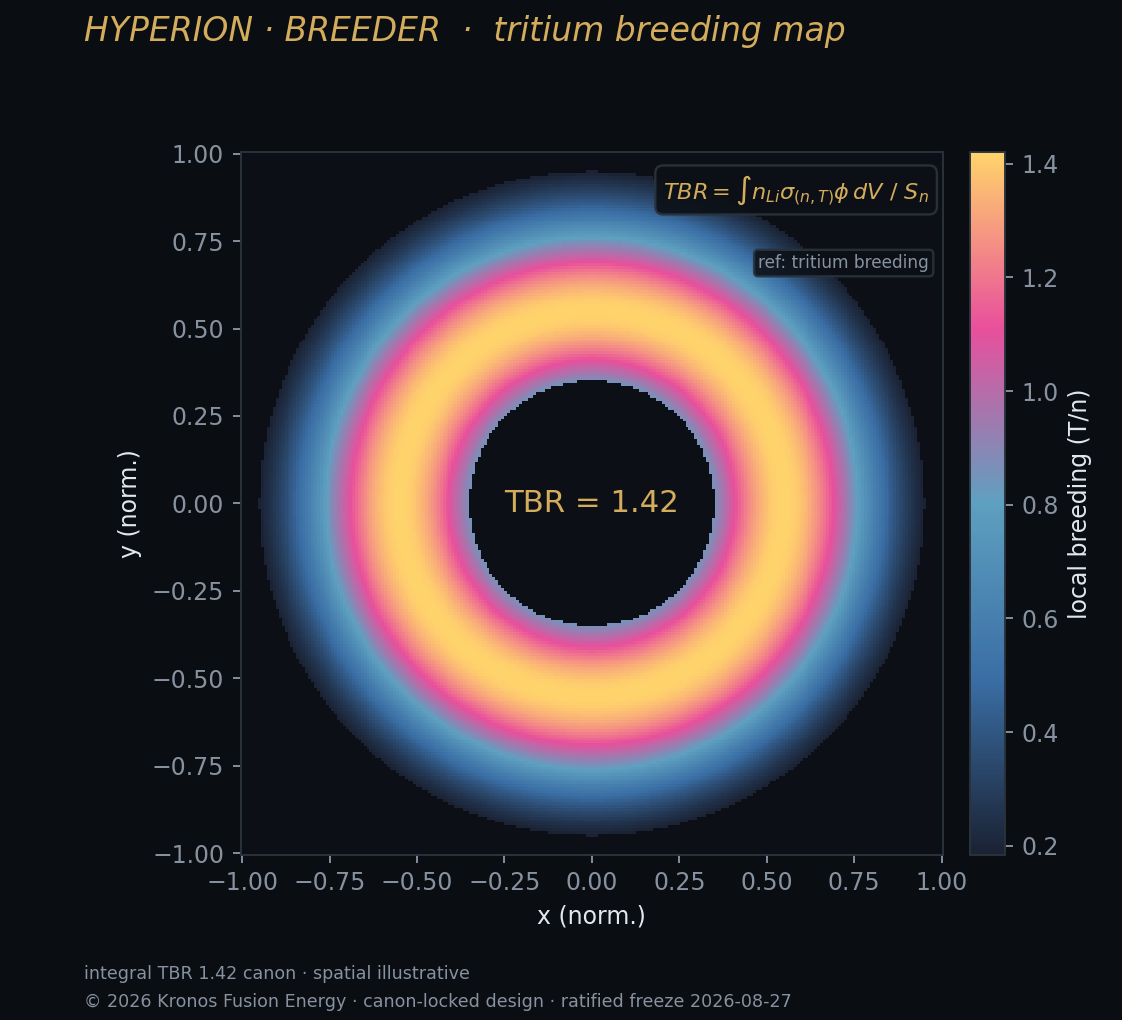
Lithium in the breeder blanket converts 14 MeV neutrons into tritium; L7 links lithium supply, the TBR design lever, and tritium output as one balance.
Lithium closes the tritium cycle
The breeder (Hyperion) makes its own tritium by capturing 14 MeV neutrons in a lithium blanket. Neutron capture on lithium yields tritium and helium; the ratio of tritium bred to tritium burned is the tritium breeding ratio (TBR), treated across the design as a lever at 1.1, 1.5, or 1.8. Lithium supply, blanket design, and TBR are therefore one coupled question, and L7 tracks them together.
Why the lever matters to supply
A higher TBR lever breeds more tritium per unit of neutron flux, increasing exportable tritium toward the ~4 kg/yr class and building margin against inventory loss, but it demands more capable blanket coverage and lithium inventory. A lower lever eases the blanket but leaves less export margin. L7 does not choose the lever; it exposes the consequence of the chosen lever on lithium demand and tritium output so the choice is made with full material visibility.
| TBR lever | Tritium export margin | Lithium/blanket demand |
|---|---|---|
| 1.1 | tight | lower |
| 1.5 | moderate | moderate |
| 1.8 | ample | higher |
Lithium isotopic composition (the lithium-6 fraction) strongly affects breeding, so inbound lithium is tracked by isotopic assay, not just mass. Enriched lithium-6 raises local breeding for a given blanket, changing how much total lithium a target TBR requires. L7 records the assay and feeds it to the neutronics module of the twin so predicted TBR matches the material actually loaded.
The tritium bred is not all exported: the breeder must retain enough to sustain its own D-T burn and cover radioactive decay and process losses. L7 accounts for retention, decay, and loss so that exported tritium is a true surplus, never a figure that ignores the plant's own consumption.
These balances run today on the twin's neutronics at design-stage flux. The lithium-to-tritium accounting interface is live now so that, at FOAK ~2030, real blanket performance is measured against the same model rather than a new one.