L3 for the Breeder: Equilibrium Control
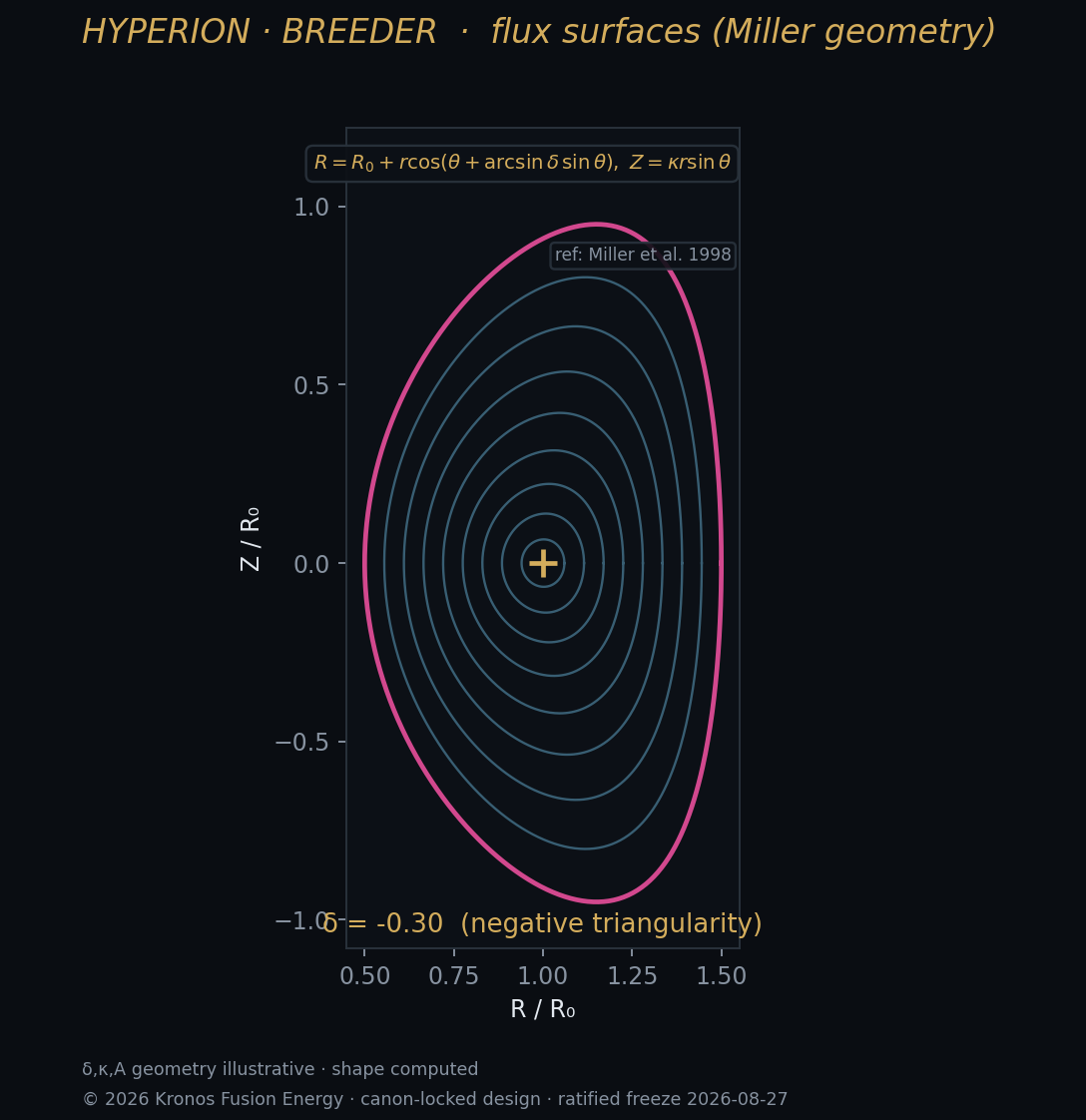
For Hyperion, the central L3 task is holding a valid, stable Grad-Shafranov equilibrium at 9.66 MA in a compact spherical geometry.
The breeder's defining control problem
The breeder is a compact spherical tokamak, R0 1.2 m, aspect ratio 2.5, 9.66 MA plasma current, 16.84 T peak field. Its performance rests on maintaining a valid MHD equilibrium continuously as pressure and current profiles evolve. Everything else in the breeder twin, neutron source, heat loads, stability margins, is downstream of that equilibrium, so L3's first job is to reconstruct and control it accurately.
How L3 does it
The Grad-Shafranov PINN provides fast equilibrium reconstruction from GNN-conditioned diagnostics; the free-boundary PINN maps coil currents to plasma shape; shape-control MPC drives the poloidal-field and solenoid coils to hold the target boundary; the stability PINN reports margins that constrain the MPC. The predictive shadow projects the equilibrium 50-100 ms ahead so control acts before the plasma drifts.
- Compact ST: strong shaping, high current density, tight equilibrium tolerances
- Actuators: PF/CS coils; fast vertical-stability loop below the shape MPC
- Constraints: MHD margin, divertor heat flux, coil and strain limits
- Target: negative-triangularity delta -0.30 boundary held stably
The spherical geometry sharpens the challenge: strong shaping and high current density mean the equilibrium is sensitive and vertical stability demands fast feedback. Kronos splits timescales, a fast vertical-position loop near L1 for stabilization, a slower multivariable shape MPC above it, so each runs at the cadence its physics requires.
Because the machine is a design-stage validation pre-FOAK, equilibrium control is validated in plant-in-the-loop simulation against reference equilibrium solvers, with the path to synchronize against real reconstruction once FOAK first tritium arrives ~2030. No net-gain behavior is claimed from this control before hardware exists.