Breeder KPIs: Availability, Shape Fidelity, and Breeding Context
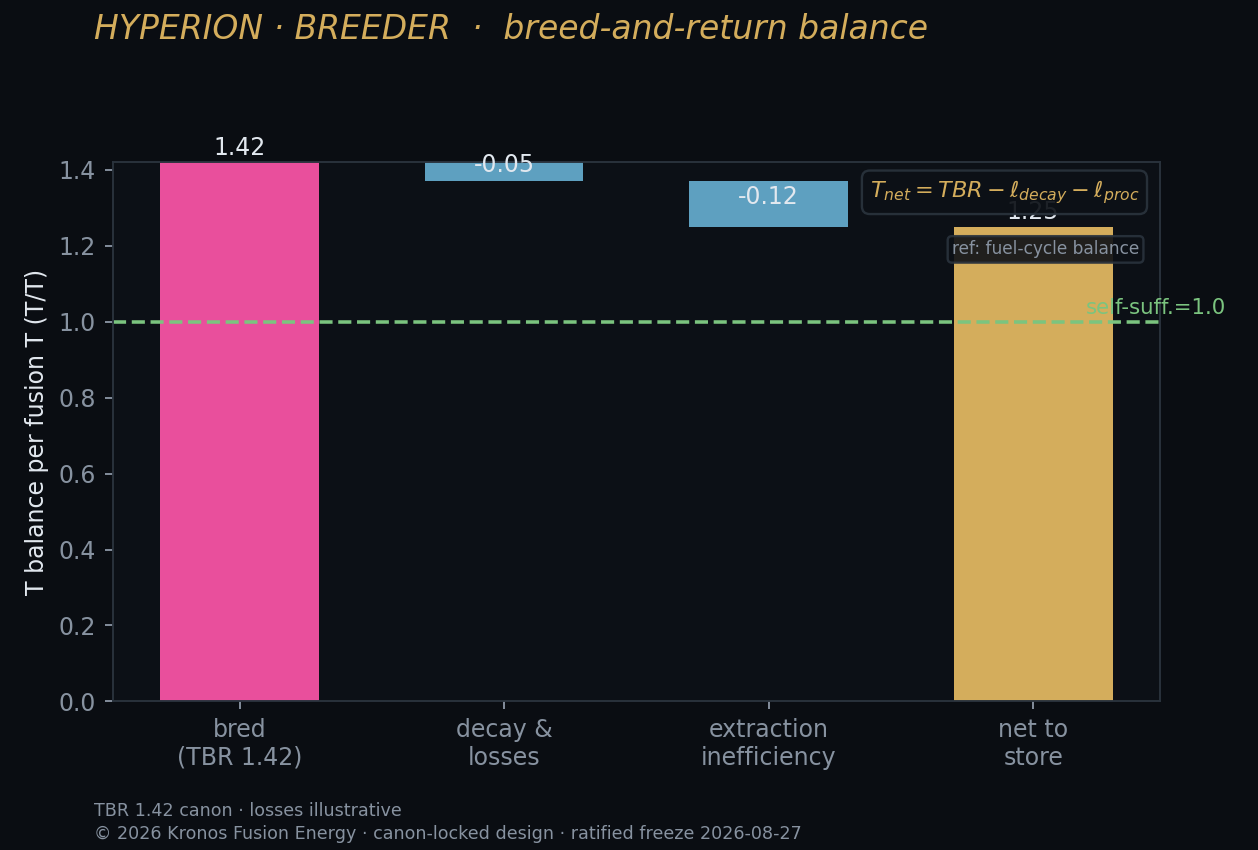
The operational indicators that define a good breeder run — shot quality, shape fidelity, magnet health, and tritium-cycle context — with no economics.
What 'good operation' means for the breeder
The breeder (Hyperion) is judged operationally, never financially. Its KPIs answer whether the machine is running well physically and how much confidence to place in that judgment. Availability here means operational readiness and uptime of the plant and its diagnostics — the fraction of intended operating time the machine is actually able to run — expressed physically, with no cost or financial content of any kind.
Core breeder KPIs
- Shot quality: fraction of shots reaching target parameters without disruption
- Shape fidelity: measured triangularity vs delta -0.30, ELM-free fraction
- Performance: Q_sci vs 3.076, fusion power vs 85.0 MW, current vs 9.66 MA
- Disruption rate and mean precursor lead time achieved
- Diagnostic availability: fraction of the 60+ ports healthy (un-imputed)
- Magnet health: REBCO strain and quench margin at 16.84 T peak field
Tritium breeding as a design lever, shown honestly
The tritium breeding ratio (TBR) is treated as a design lever across 1.1 / 1.5 / 1.8, and the operating surface shows the fuel-cycle balance in that context rather than asserting a single settled number. The KPI presents tritium production and consumption balance with the assumed TBR case labeled, so the operator always knows which design assumption the displayed balance rests on. Helium-3 co-production context is shown similarly.
Framing stays honest: these are design-and-validation studies, so performance KPIs are shown against reference design points with confidence bands, and no hardware net-gain is claimed before first-of-a-kind first tritium (~2030). Diagnostic-availability and disruption-rate KPIs are the most actionable day to day, because they gate the operator's ability to trust every other number. See dashboards and KPIs and the burner counterpart.