The Ideal MHD Energy Principle
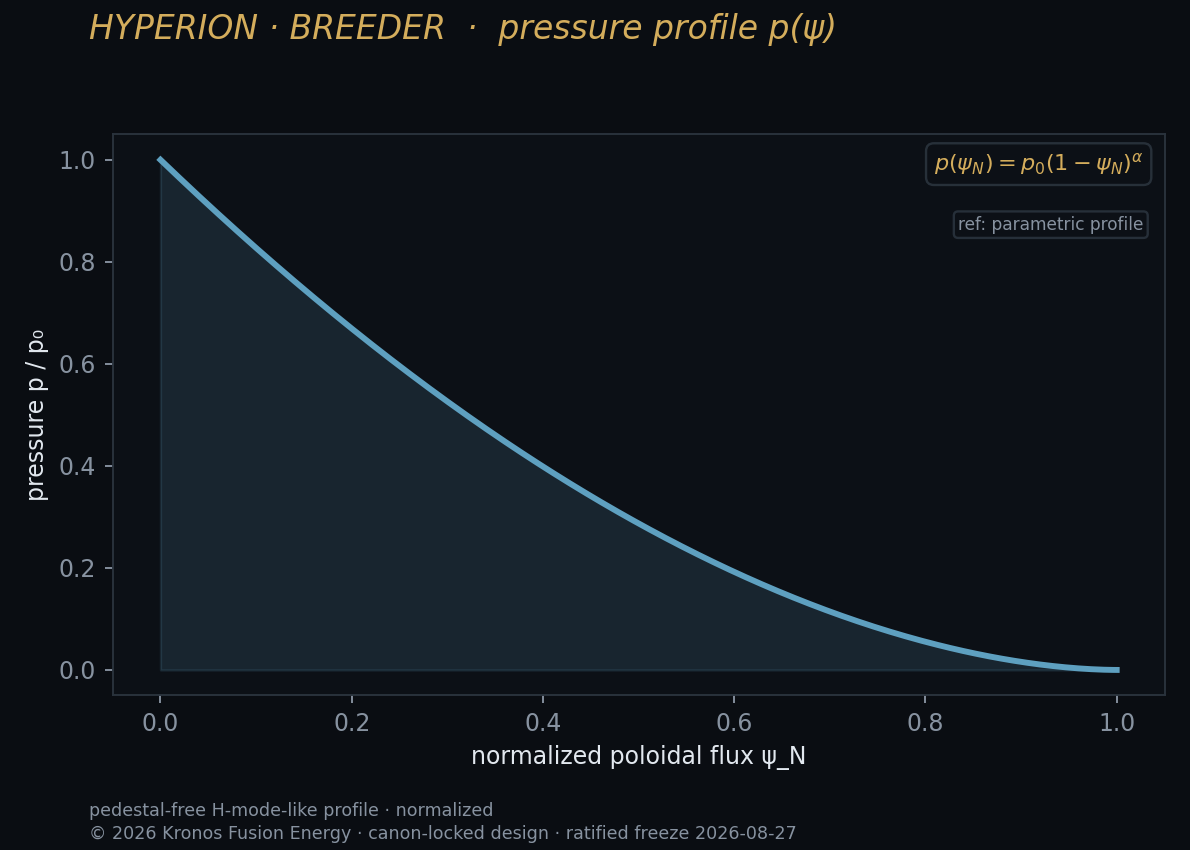
Whether a breeder equilibrium is stable reduces to the sign of a single energy functional; its minimization defines the safe operating envelope the AI must respect.
Stability as an energy question
Linearized ideal MHD asks whether a small displacement xi of the plasma from equilibrium releases or costs energy. The change in potential energy is a quadratic functional delta-W[xi]. If delta-W is positive for every allowed displacement, the equilibrium is stable; if any displacement makes it negative, that mode grows. This variational principle is the mathematical backbone of every breeder stability limit.
Energy principle:  delta-W[xi] = (1/2) Integral  [ stabilizing - driving ] dV

  delta-W = (1/2) Integral {
      |Q_perp|^2 / mu0                         (field-line bending, >0)
    + B^2/mu0 |div_perp xi + 2 xi.kappa|^2      (compression, >0)
    + gamma p |div xi|^2                        (plasma compression, >0)
    - 2 (xi.grad p)(xi.kappa)                   (pressure/curvature drive)
    - j_par (xi* x b).Q                         (current drive, kink)
  } dV

  Q = grad x (xi x B) ,  kappa = field-line curvature
Reading the terms
The first three terms are always stabilizing: bending, compressing, and squeezing field lines and plasma cost energy. The last two are the drives. The pressure-curvature term is negative (destabilizing) where the pressure gradient points the same way as the unfavorable field curvature - the origin of interchange and ballooning modes. The current-drive term feeds kink and tearing modes. Negative triangularity alters the curvature term favorably at the edge.
From functional to eigenproblem
Minimizing delta-W subject to a normalization on xi is a Rayleigh quotient, so the marginal stability question becomes a generalized eigenvalue problem. The smallest eigenvalue's sign is the stability verdict; its eigenvector is the mode structure the anomaly detectors watch for.
Rayleigh quotient (growth rate gamma):

  gamma^2 = -  delta-W[xi] / K[xi]

  K[xi] = (1/2) Integral rho |xi|^2 dV     (kinetic norm, >0)

  gamma^2 > 0  -> unstable (exponential growth)
  gamma^2 < 0  -> stable (oscillation)
  gamma^2 = 0  -> marginal stability boundary
The AI stack does not re-minimize delta-W in the control loop; it learns the marginal-stability boundary in parameter space from offline eigenvalue solves, giving MPC a fast, differentiable constraint surface. Proximity to that surface is a monitored, reported quantity, and the protection failsafe never depends on the learned boundary alone.