AI Architecture › Mathematical Foundations
Mathematical Foundations
Mathematical Foundations
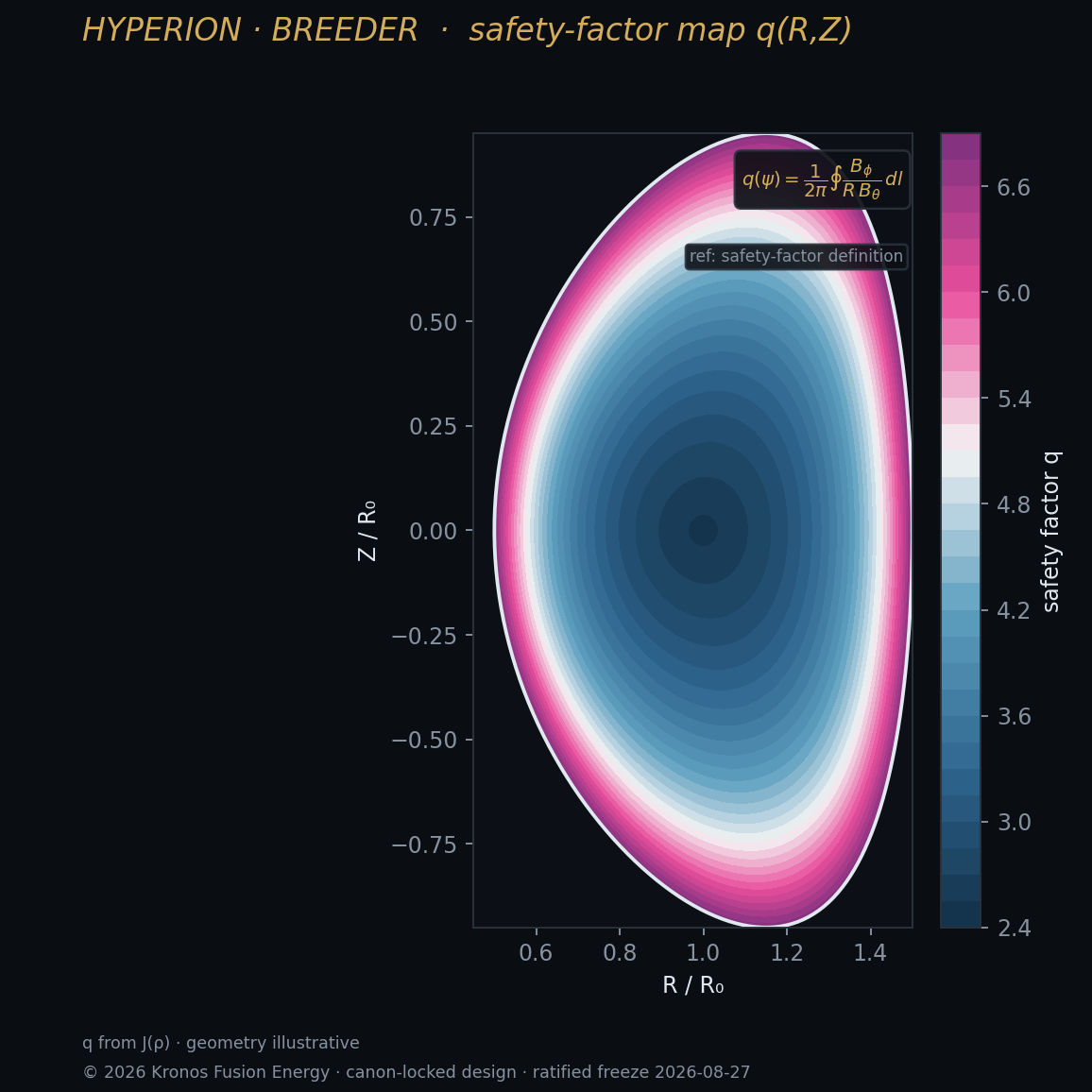
The math behind each layer — PINNs, Grad-Shafranov, MPC, GNNs, state estimation — anchored to Kronos's use.
What this layer does
The math behind each layer — PINNs, Grad-Shafranov, MPC, GNNs, state estimation — anchored to Kronos's use. Every page in this section is part of the same control stack — click any card to go deeper, or return to the Master Blueprint to see how it connects.
Explore this layer
Ambipolar Potential and Pastukhov ConfinementBayesian Inference FoundationsBayesian Optimization for Scenario DesignBootstrap Current and Profile Self-ConsistencyConstrained Optimization, Lagrangians, and DualityEquilibrium Reconstruction as an Inverse ProblemEquivariance and Invariance in Graph NetworksExtended and Unscented Kalman FiltersFlux Coordinates and the Safety FactorFree-Boundary Grad-ShafranovGaussian ProcessesGraph Neural Networks for Coupled SubsystemsGraph Neural Networks: Message-Passing MathematicsGreen's Functions and Poloidal-Field Coil ResponseInformation Theory for Sensor SelectionMCMC and Hamiltonian Monte CarloMPC Constraints and the KKT ConditionsMPC QP Solver MathematicsMathematical Foundations of the S.M.A.R.T. GeneratorMirror Interchange Stability and Minimum-BModel-Predictive Control: The Optimal-Control FormulationMonte Carlo and Variance ReductionNegative-Triangularity Shaping MathematicsNeural Operators: DeepONet and Fourier Neural OperatorsObservability and State EstimationPINN Conditioning and Training DynamicsPINN Formulation for Grad-ShafranovPINN Loss Construction and WeightingPINN for the Burner Ambipolar PotentialPINNs for Inverse ProblemsPhysics-Informed Neural Networks: FundamentalsReceding Horizon, Terminal Cost, and StabilityResistive Wall Mode MathematicsSpectral Graph Theory for DiagnosticsStability-Problem Map Across Both MachinesTandem-Mirror Equilibrium MathematicsThe Ballooning Mode Equation and s-alpha SpaceThe Ensemble Kalman FilterThe Grad-Shafranov EquationThe Ideal MHD Energy PrincipleThe Kalman FilterThe Linear MHD Stability EigenproblemThe Linear-Quadratic Regulator BaselineTrajectory Optimization for Scenario DesignVariational Inference for Fast UncertaintyVertical Stability MathematicsWeak Form and Finite-Element Discretization of Grad-Shafranov