End-Plug Density Control
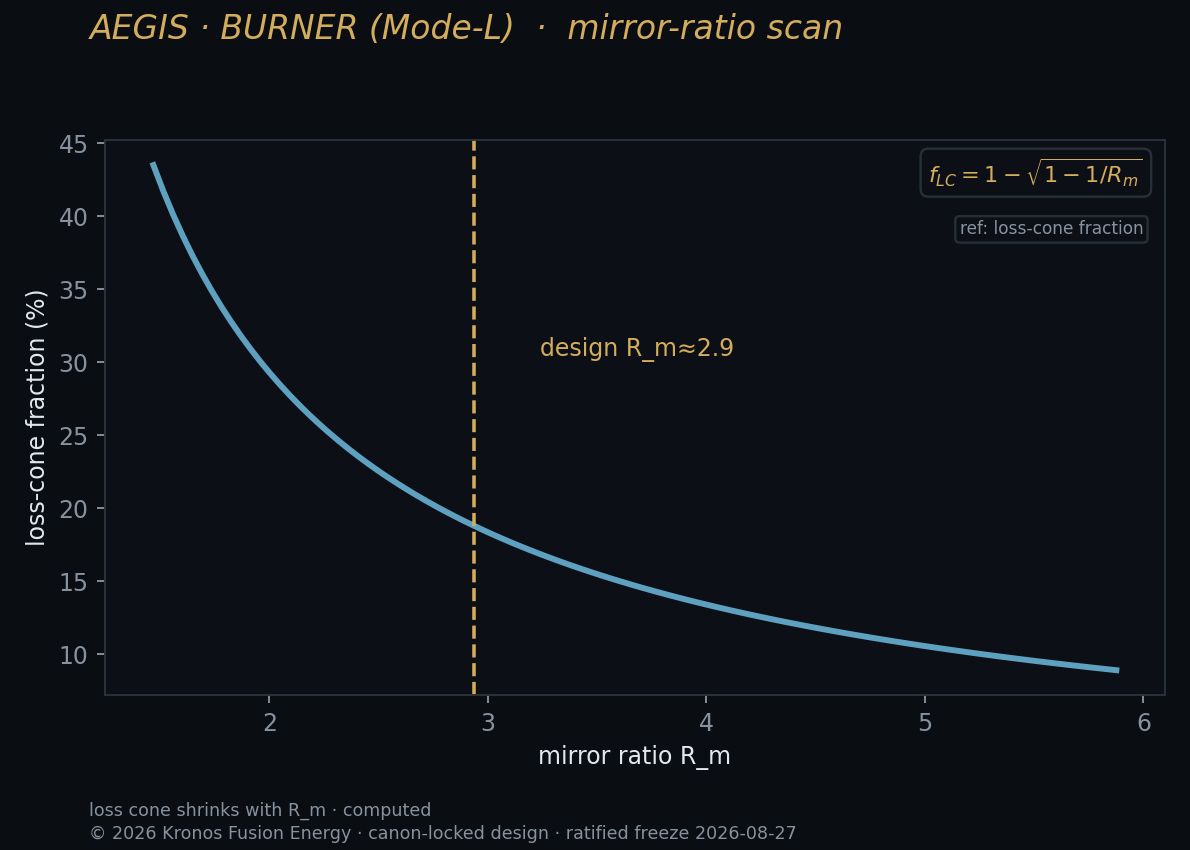
The tandem-mirror burner confines the central cell with dense end plugs; L1 regulates plug density as the machine's primary confinement actuator.
Plugs make the mirror confine
The burner is a D-3He tandem mirror: the central-cell plasma is confined axially by dense, high-potential end plugs rather than by closing field lines. The plug density sets the electrostatic barrier that holds central-cell ions, so end-plug density is the burner's master confinement control variable. L1 regulates it continuously.
The control loop
L1 estimates plug density from the diagnostics constellation in the plug cells and drives the plug's heating and fueling actuators — neutral beams and gas/pellet fueling — to hold density at the setpoint. The loop must reject losses and transients fast enough that the confining potential does not sag, since a drop in plug density directly weakens central-cell confinement.
Coupling to the potential
- Plug density sets the ambipolar potential barrier height.
- Beam power sustains the plug population against losses.
- Fueling maintains the density profile in the plug and central cell.
- The 26.49 T plug field provides the mirror ratio that makes plugging possible.
Density and potential are inseparable here: the loop that holds density is, in effect, holding the ambipolar potential that confines the machine. L1 runs them as coupled objectives on the shared clock, with density as the directly-actuated quantity and potential as the confinement outcome to be regulated.
Why the high field
The 26.49 T plug and 17 T throat produce the mirror ratio needed to build and hold the plug. Maintaining that field is the magnet system's job, protected by the quench failsafe; L1's density loop then works within the confinement geometry the field creates. Together the field, the plug density, and the potential define the burner's operating point.