The Diagnostics Constellation
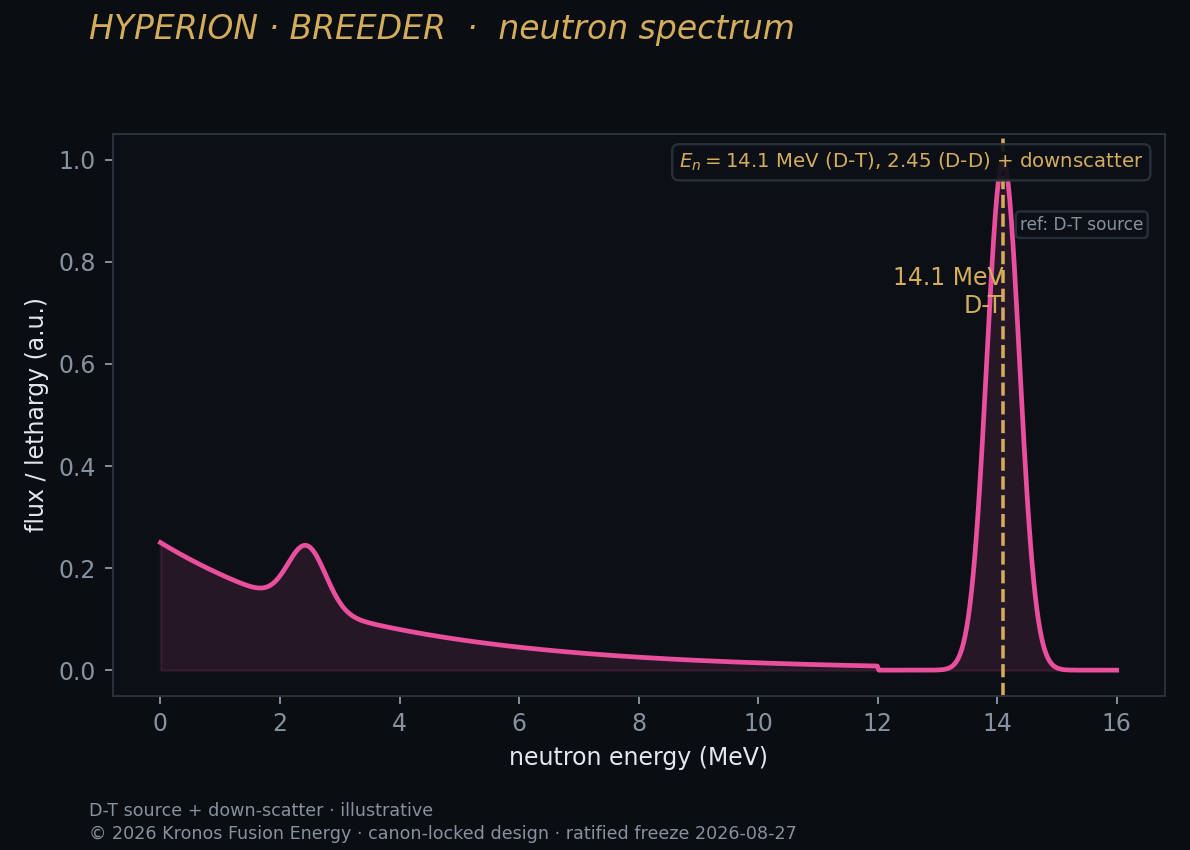
The sensor suite the whole stack sees through: Thomson scattering, interferometry, Mirnov coils, flux loops, REBCO strain, ECE, fast-ion trackers, and neutron flux.
The plant's senses
The diagnostics constellation is the set of instruments through which the architecture observes the plasma and the machine. More than 60 analog channels flow from it into L2, where they are validated and fused. Everything the twin knows and the copilots reason about begins here.
The instruments
- Thomson scattering — electron temperature and density profiles.
- Interferometry — line-integrated density.
- Mirnov coils and flux loops — magnetic fluctuations and equilibrium reconstruction.
- REBCO strain gauges — magnet mechanical state.
- Electron cyclotron emission (ECE) — electron temperature dynamics.
- Fast-ion trackers — energetic-ion behavior.
- Neutron flux — fusion rate and, on the breeder, 14 MeV neutron transport.
Chosen for models, not only humans
Because the plant is AI-native, the constellation is specified for what the twin needs to infer. Redundant and topologically related sensors let GNNs impute a dropped channel from its neighbors; complementary diagnostics let PINNs constrain an equilibrium from several independent measurements. The suite is an inference substrate, not just a set of gauges.
Different physics, same suite
On the breeder the constellation resolves equilibrium, MHD, and disruption precursors around the delta -0.30 shape. On the burner the same classes of instrument resolve plug density, the ambipolar potential, and neutron fraction near 5.44%. The suite is shared; what it is pointed at differs per machine.
The constellation reports through the Data Fabric over cryo-rated feedthroughs; its fusion into state feeds the KRONOS-CTRL twin.