Coupled Multi-Physics Coupling Mathematics
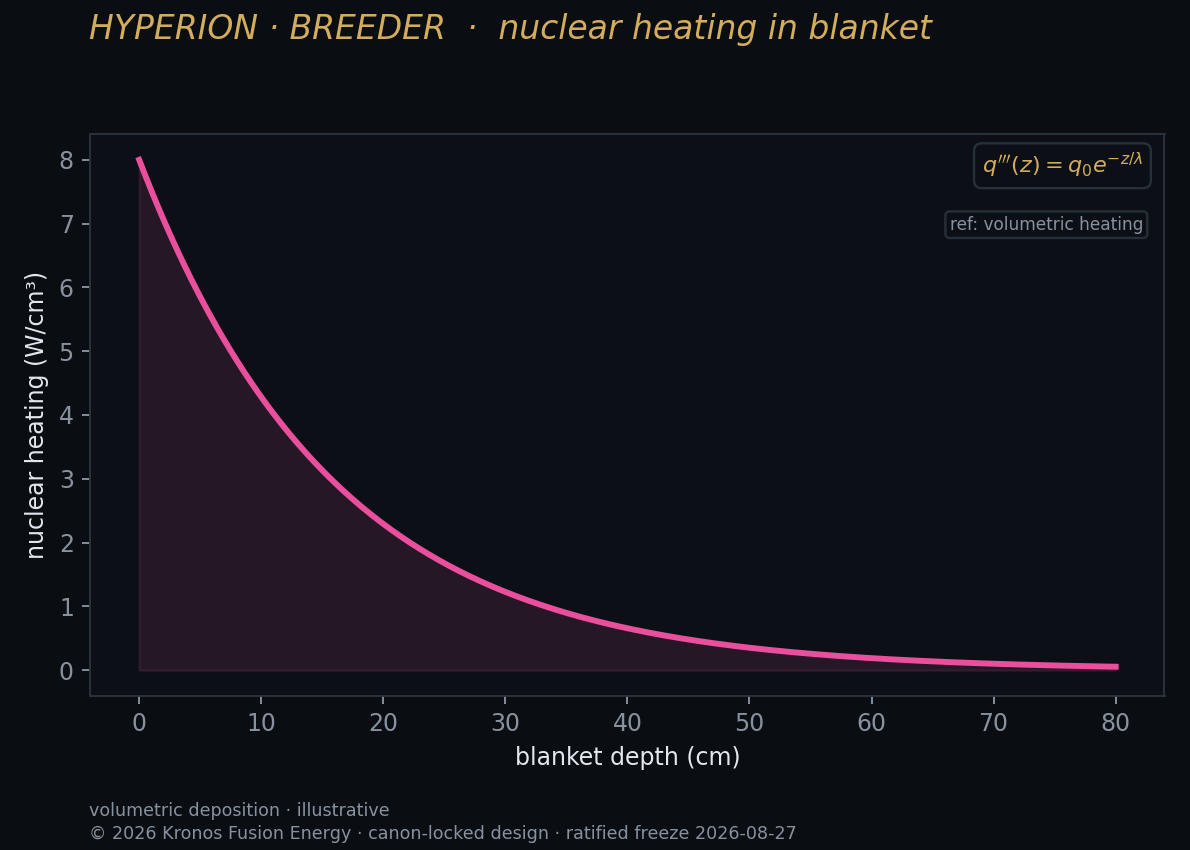
How Kronos links neutronics, thermomechanics, and MHD so the interactions between them are captured, not assumed away.
The physics does not decouple
In a real machine, neutrons heat the blanket, heat deforms structure, structure and fields interact, and the plasma responds. These physics are coupled, and treating them in isolation misses the interactions that matter. Multi-physics coupling is the mathematics of linking separate solvers so their mutual influence is captured, which is central to honest L0 simulation.
The coupling chain
A representative breeder chain runs: Monte Carlo neutronics produces a nuclear-heating field; that field drives a thermomechanical solve of the blanket and CrMoNbV vessel; the resulting temperatures and deformations feed back into geometry and material properties. Each arrow is a data handoff between solvers with different meshes and timescales, which coupling must reconcile.
- Neutronics heating into thermomechanics
- Temperature and deformation into geometry and properties
- Equilibrium and MHD into thermal and mechanical loads
- Field interpolation between mismatched meshes
Loose versus tight coupling
Coupling can be loose, solvers exchange fields between steps, or tight, solvers iterate to a jointly consistent state each step. Loose coupling is cheaper and often sufficient when feedback is weak; tight coupling is needed when the physics interact strongly within a step. Kronos chooses per problem, because unnecessary tight coupling wastes compute and unnecessary loose coupling misses physics.
Coupling across mismatched meshes and timescales is where the numerical difficulty lives. A heating field on the neutronics geometry must be conservatively interpolated onto the thermomechanical mesh, and fast and slow physics must be reconciled without violating conservation. Getting this wrong quietly corrupts results, so conservation and interpolation accuracy are checked as part of validation.
Both machines need coupling, with different chains. The breeder couples breeding-era heating to structural life; the burner couples its low neutron load and end-loss physics to the direct-conversion train and magnet structure. The coupling framework is shared; the specific physics linked together defines each machine's multi-physics problem.