Orange — Thermal, Reactor, and DEC
Orange blocks are the physics itself — plasma, magnets, divertor, and the direct-energy-conversion train — the hardware the whole stack exists to serve.
What orange means
Orange marks the reactor and its thermal and energy-conversion paths: the plasma, the high-field magnets, the vessel and divertor, and — on the burner — the multi-modal direct-energy-conversion (DEC) train. Orange is where the physics happens and where every other layer's decisions ultimately land.
What lives in orange
- The plasma — breeder D-T at Q_sci 3.076 and 85.0 MW; burner D-3He with 5.44% neutron fraction.
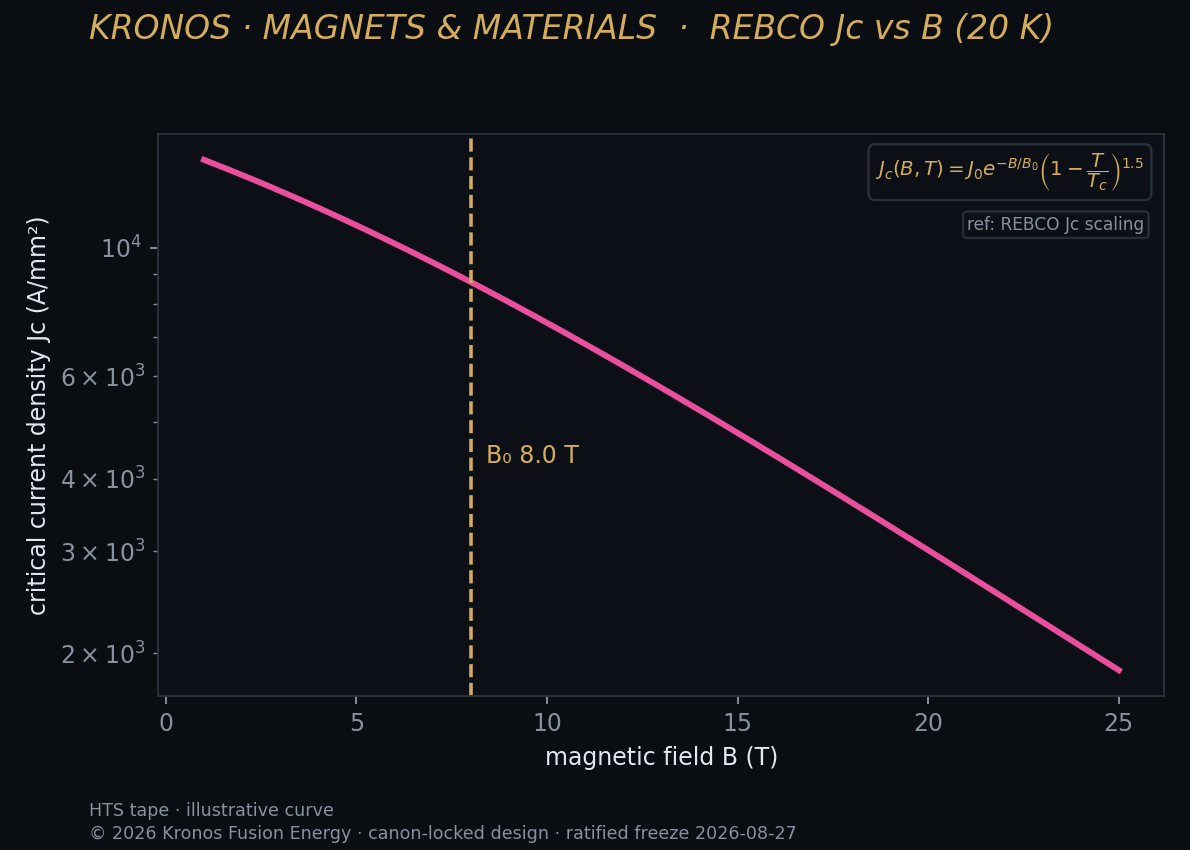
- The REBCO magnet system — breeder 16.84 T peak (8 T on-axis); burner 26.49 T plug, 17 T throat.
- The vessel, divertor, and expander that handle heat and particle exhaust.
- The burner's DEC train — TWDEC, ultra-high-field MHD, and thermionic stages.
Why the physics is one color
Grouping all reactor and thermal paths as orange makes the safety-critical energy flow legible at a glance. Any line entering an orange block is, by definition, on a path that can affect the plasma or the magnets — so the color grammar forces those connections to be scrutinized against the line semantics.
Two machines, two control problems
Orange looks different physically on each machine. The breeder's orange is a spherical torus whose control problem is equilibrium and disruption avoidance around a negative-triangularity, ELM-free shape. The burner's orange is an open magnetic bottle whose control problem is end-plug density, the ambipolar potential, and steering charged-particle flux into the DEC train.
The hardware paths are mapped in physical plant wiring, the magnet system, and the DEC train.