Burner (Aegis / MetroVolt) Control-Room View
The operator surface for the D-3He tandem mirror: end-plug density, the ambipolar potential well, and direct energy conversion of a 5.44%-neutron-fraction output.
What the burner operator watches
The burner (Aegis / MetroVolt) is a D-3He tandem-mirror generator with a 26.49 T plug and 17 T throat, a 5.44% neutron fraction, and direct energy conversion (DEC). Its control-room view is organized along the machine axis rather than around a torus. The dominant problems are sustaining end-plug density, holding the ambipolar potential well that confines the central-cell ions, and keeping DEC grid modulation stable. Aegis and MetroVolt are two housings of the same machine (fixed defense installations and data-center generation, respectively) and share this view.
Axial state along the mirror
The overlay lofts mirror flux tubes between the plug and throat and paints two axial profiles operators live by: end-plug density and the ambipolar potential. The potential-well depth is what confines the central cell, so it is shown against the depth required for confinement, with margin explicit. Plug field (26.49 T) and throat field (17 T) margins are drawn alongside, since the confinement geometry depends on them.
- End-plug density vs setpoint, both ends, with balance indicator
- Ambipolar potential profile and well depth vs confinement requirement
- Plug field 26.49 T and throat field 17 T margins
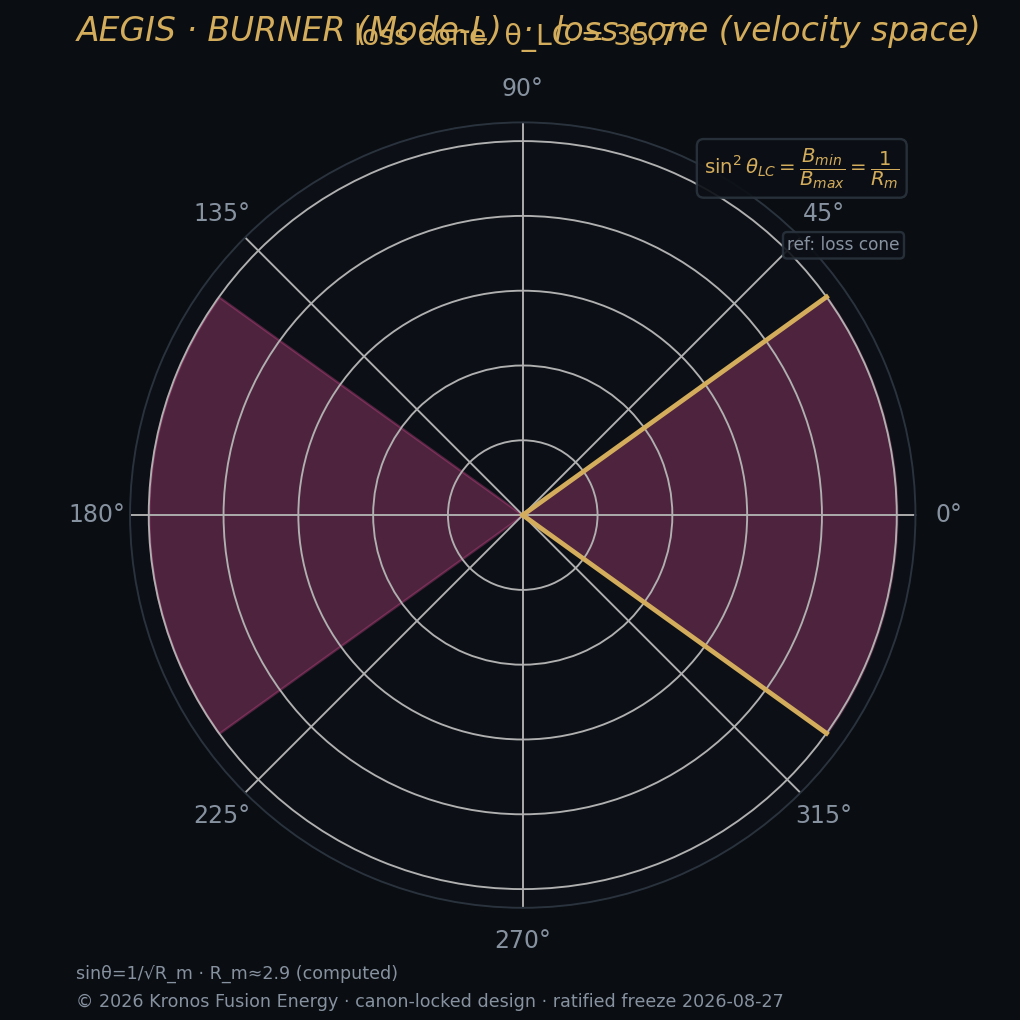
- Mirror ratio and central-cell confinement quality
- Neutron-fraction (5.44%) blanket load and DEC collector state
Direct energy conversion
The DEC segment shows collector grid voltages and the modulation loop that converts escaping charged-particle energy directly. Grid-voltage stability and fault-ride-through status are foregrounded because DEC is the burner's power path. An end-plug density excursion is the burner's analogue of a breeder disruption precursor: it is surfaced early through the alerting stream with lead time, and the predictive shadow projects the density and potential forward so the operator can correct before confinement degrades.
Honest framing applies as everywhere: these are design-and-validation studies, and no hardware net-gain claim is made before the breeder FOAK (~2030). Compare with the breeder view and see burner net-power and DEC KPIs.